334 posters, 125 sessions, 831 authors, 236 institutions
ePostersLive by SciGen Technologies S.A. All rights reserved.
78th Annual PostGraduate Assembly in Anesthesiology (PGA78) 2024
December 6 - 9, 2024 | New York City

3178
Perioperative Anesthetic Considerations for Robot-Assisted VATS and Resection of Mediastinal Teratoma Compressing Superior Vena Cava and Right Atrium
Poster Presenter
Authors
Affiliations
Part of Topic
#3178: Perioperative Anesthetic Considerations for Robot-Assisted VATS and Resection of
Mediastinal Teratoma Compressing Superior Vena Cava and Right Atrium
Edbert D. Lu, BA1, Mohsin Mothana, BS1, Jeremy Tang, MD, PhD2, Sagar S. Mungekar, MD2
1Rutgers Robert Wood Johnson Medical School, Piscataway, NJ, 2Department of Anesthesiology and Perioperative Medicine, Rutgers Health, New Brunswick, NJ
Learning Objectives
A patient presented with cough and dyspnea. Chest x-ray revealed an anterior mediastinal mass, later confirmed as a mature teratoma by biopsy.
Mediastinal mature teratomas are benign, slow-growing tumors that can compress and even erode into vital structures like the heart and lungs, causing symptoms. Surgical removal poses anesthetic challenges due to mass effect. Here we discuss perioperative management strategies that became crucial to ensuring patient safety.
Case Presentation
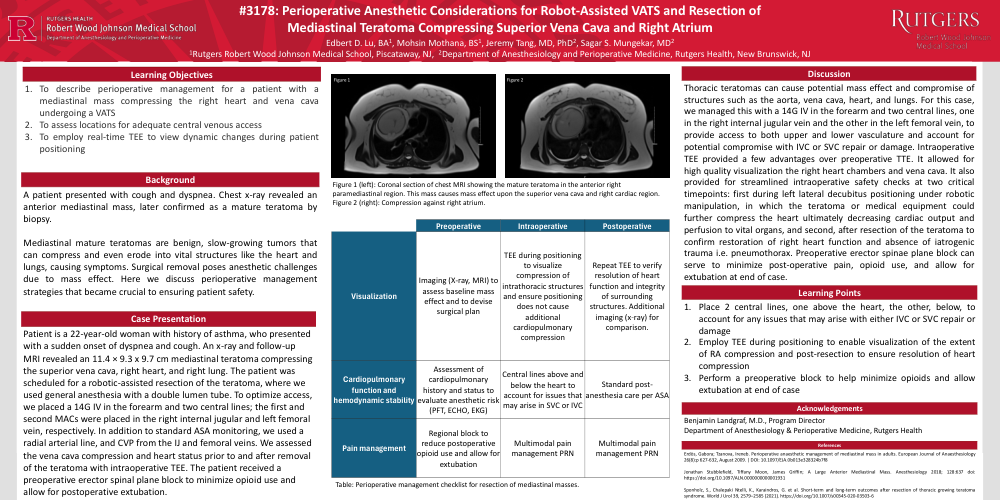
Patient is a 22-year-old woman with history of asthma, who presented with a sudden onset of dyspnea and cough. An x-ray and follow-up MRI revealed an 11.4 × 9.3 x 9.7 cm mediastinal teratoma compressing the superior vena cava, right heart, and right lung. The patient was scheduled for a robotic-assisted resection of the teratoma, where we used general anesthesia with a double lumen tube. To optimize access, we placed a 14G IV in the forearm and two central lines; the first and second MACs were placed in the right internal jugular and left femoral vein, respectively. In addition to standard ASA monitoring, we used a radial arterial line, and CVP from the IJ and femoral veins. We assessed the vena cava compression and heart status prior to and after removal of the teratoma with intraoperative TEE. The patient received a preoperative erector spinal plane block to minimize opioid use and allow for postoperative extubation.
Figure 1 (left): Coronal section of chest MRI showing the mature teratoma in the anterior right paramediastinal region. This mass causes mass effect upon the superior vena cava and right cardiac region.
Figure 2 (right): Compression against right atrium.
Table: Perioperative management checklist for resection of mediastinal masses.
Discussion
Thoracic teratomas can cause potential mass effect and compromise of structures such as the aorta, vena cava, heart, and lungs. For this case, we managed this with a 14G IV in the forearm and two central lines, one in the right internal jugular vein and the other in the left femoral vein, to provide access to both upper and lower vasculature and account for potential compromise with IVC or SVC repair or damage. Intraoperative TEE provided a few advantages over preoperative TTE. It allowed for high quality visualization the right heart chambers and vena cava. It also provided for streamlined intraoperative safety checks at two critical timepoints: first during left lateral decubitus positioning under robotic manipulation, in which the teratoma or medical equipment could further compress the heart ultimately decreasing cardiac output and perfusion to vital organs, and second, after resection of the teratoma to confirm restoration of right heart function and absence of iatrogenic trauma i.e. pneumothorax. Preoperative erector spinae plane block can serve to minimize post-operative pain, opioid use, and allow for extubation at end of case.
Learning Points
Benjamin Landgraf, M.D., Program Director
Department of Anesthesiology & Perioperative Medicine, Rutgers Health
References
Erdös, Gabora; Tzanova, Ireneb. Perioperative anaesthetic management of mediastinal mass in adults. European Journal of Anaesthesiology26(8):p 627-632, August 2009. | DOI: 10.1097/EJA.0b013e328324b7f8
Jonathan Stubblefield, Tiffany Moon, James Griffin; A Large Anterior Mediastinal Mass. Anesthesiology 2018; 128:637 doi: https://doi.org/10.1097/ALN.0000000000001931
Sponholz, S., Chalepaki Ntelli, K., Karaindros, G. et al. Short-term and long-term outcomes after resection of thoracic growing teratoma syndrome. World J Urol 39, 2579–2585 (2021). https://doi.org/10.1007/s00345-020-03503-6