334 posters, 125 sessions, 831 authors, 236 institutions
ePostersLive by SciGen Technologies S.A. All rights reserved.
78th Annual PostGraduate Assembly in Anesthesiology (PGA78) 2024
December 6 - 9, 2024 | New York City

3173
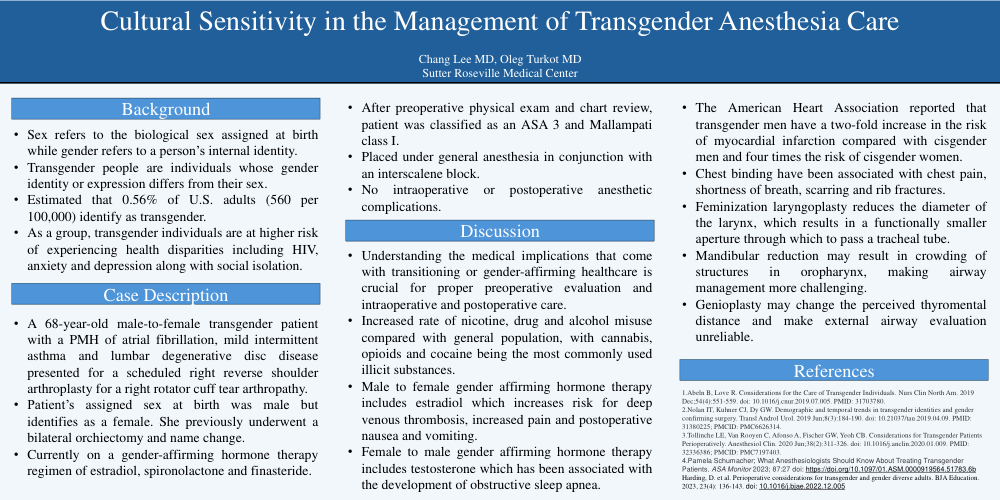
Cultural Sensitivity in the Management of Transgender Anesthesia Care
Poster Presenter
Authors
Affiliations
Part of Topic
-
Sex refers to the biological sex assigned at birth while gender refers to a person’s internal identity.
-
Transgender people are individuals whose gender identity or expression differs from their sex.
-
Estimated that 0.56% of U.S. adults (560 per 100,000) identify as transgender.
-
As a group, transgender individuals are at higher risk of experiencing health disparities including HIV, anxiety and depression along with social isolation.
-
A 68-year-old male-to-female transgender patient with a PMH of atrial fibrillation, mild intermittent asthma and lumbar degenerative disc disease presented for a scheduled right reverse shoulder arthroplasty for a right rotator cuff tear arthropathy.
-
Patient’s assigned sex at birth was male but identifies as a female. She previously underwent a bilateral orchiectomy and name change.
-
Currently on a gender-affirming hormone therapy regimen of estradiol, spironolactone and finasteride.
-
After preoperative physical exam and chart review, patient was classified as an ASA 3 and Mallampati class I.
• Placed under general anesthesia in conjunction with an interscalene block.
• No intraoperative or postoperative anesthetic complications.
Discussion
• Understanding the medical implications that come with transitioning or gender-affirming healthcare is crucial for proper preoperative evaluation and intraoperative and postoperative care.
• Increased rate of nicotine, drug and alcohol misuse compared with general population, with cannabis, opioids and cocaine being the most commonly used illicit substances.
• Male to female gender affirming hormone therapy includes estradiol which increases risk for deep venous thrombosis, increased pain and postoperative nausea and vomiting.
• Female to male gender affirming hormone therapy includes testosterone which has been associated with the development of obstructive sleep apnea.