334 posters, 125 sessions, 831 authors, 236 institutions
ePostersLive by SciGen Technologies S.A. All rights reserved.
78th Annual PostGraduate Assembly in Anesthesiology (PGA78) 2024
December 6 - 9, 2024 | New York City

3172
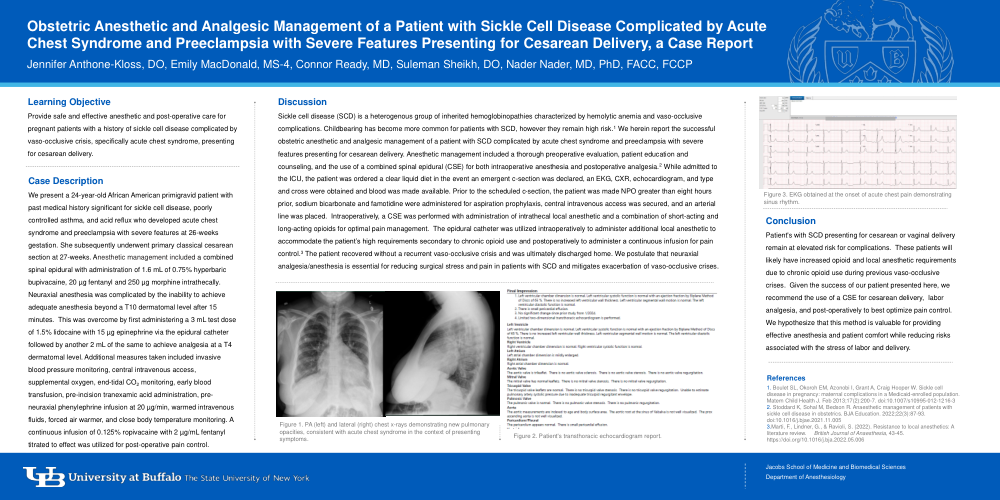
Obstetric Anesthetic and Analgesic Management of a Patient with Sickle Cell Disease Complicated by Acute Chest Syndrome and Preeclampsia with Severe Features Presenting for Cesarean Delivery, a Case Report
Poster Presenter
Part of Topic
Learning Objective
Provide safe and effective anesthetic and post-operative care for pregnant patients with a history of sickle cell disease complicated by vaso-occlusive crisis, specifically acute chest syndrome, presenting for cesarean delivery.
Case Description
We present a 24-year-old African American primigravid patient with past medical history significant for sickle cell disease, poorly controlled asthma, and acid reflux who developed acute chest syndrome and preeclampsia with severe features at 26-weeks gestation. She subsequently underwent primary classical cesarean section at 27-weeks. Anesthetic management included a combined spinal epidural with administration of 1.6 mL of 0.75% hyperbaric bupivacaine, 20 µg fentanyl and 250 µg morphine intrathecally. Neuraxial anesthesia was complicated by the inability to achieve adequate anesthesia beyond a T10 dermatomal level after 15 minutes. This was overcome by first administering a 3 mL test dose of 1.5% lidocaine with 15 µg epinephrine via the epidural catheter followed by another 2 mL of the same to achieve analgesia at a T4 dermatomal level. Additional measures taken included invasive blood pressure monitoring, central intravenous access, supplemental oxygen, end-tidal CO2 monitoring, early blood transfusion, pre-incision tranexamic acid administration, pre-neuraxial phenylephrine infusion at 20 µg/min, warmed intravenous fluids, forced air warmer, and close body temperature monitoring. A continuous infusion of 0.125% ropivacaine with 2 µg/mL fentanyl titrated to effect was utilized for post-operative pain control.
Discussion
Sickle cell disease (SCD) is a heterogenous group of inherited hemoglobinopathies characterized by hemolytic anemia and vaso-occlusive complications. Childbearing has become more common for patients with SCD, however they remain high risk.1 We herein report the successful obstetric anesthetic and analgesic management of a patient with SCD complicated by acute chest syndrome and preeclampsia with severe features presenting for cesarean delivery. Anesthetic management included a thorough preoperative evaluation, patient education and counseling, and the use of a combined spinal epidural (CSE) for both intraoperative anesthesia and postoperative analgesia.2 While admitted to the ICU, the patient was ordered a clear liquid diet in the event an emergent c-section was declared, an EKG, CXR, echocardiogram, and type and cross were obtained and blood was made available. Prior to the scheduled c-section, the patient was made NPO greater than eight hours prior, sodium bicarbonate and famotidine were administered for aspiration prophylaxis, central intravenous access was secured, and an arterial line was placed. Intraoperatively, a CSE was performed with administration of intrathecal local anesthetic and a combination of short-acting and long-acting opioids for optimal pain management. The epidural catheter was utilized intraoperatively to administer additional local anesthetic to accommodate the patient’s high requirements secondary to chronic opioid use and postoperatively to administer a continuous infusion for pain control.3 The patient recovered without a recurrent vaso-occlusive crisis and was ultimately discharged home. We postulate that neuraxial analgesia/anesthesia is essential for reducing surgical stress and pain in patients with SCD and mitigates exacerbation of vaso-occlusive crises.
Conclusion
Patient's with SCD presenting for cesarean or vaginal delivery remain at elevated risk for complications. These patients will likely have increased opioid and local anesthetic requirements due to chronic opioid use during previous vaso-occlusive crises. Given the success of our patient presented here, we recommend the use of a CSE for cesarean delivery, labor analgesia, and post-operatively to best optimize pain control. We hypothesize that this method is valuable for providing effective anesthesia and patient comfort while reducing risks associated with the stress of labor and delivery.
References