334 posters, 125 sessions, 831 authors, 236 institutions
ePostersLive by SciGen Technologies S.A. All rights reserved.
78th Annual PostGraduate Assembly in Anesthesiology (PGA78) 2024
December 6 - 9, 2024 | New York City

3170
Oh Synapse! Intraoperative EEG Changes During a Complex Vascular Bypass
Poster Presenter
Authors
Affiliations
Part of Topic
Oh Synapse! Intraoperative EEG Changes During a Complex Vascular Bypass
Vascular surgical cases pose a variety of anesthetic implications. Commonly, when serial awake neurologic exams are not feasible, EEG monitoring can be utilized to assess adequacy of cerebral perfusionwhen operative procedures involve major cerebral vasculature. Notably, EEG wave changes may guide (1) intraoperative anatomic manipulation, (2) decisions to shunt,and (3) identification ofsurgical complications, such as decreased cerebral perfusion and/orembolic phenomena. Findings in decreased cerebral perfusion can include acute EEG asymmetry, decreased total amplitude or power of EEG waves, and electrocortical slowing or silence. Burst suppression and isoelectricity may also be noted in cerebral ischemia. However, anesthetic agents additionally shift the frequencies and amplitudes of EEG waves. Physiologic changes, such as age, body temperature, and blood pressure, may also impact EEG waves.
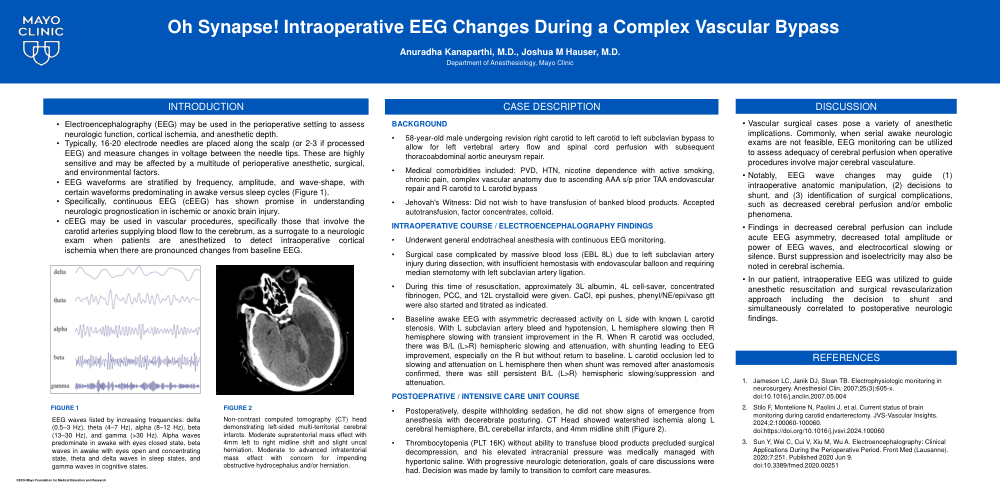
We describe a medically challenging case of a 58-year-old Jehovah’s witness who underwent a revision left carotid to carotid to subclavian artery bypass. His surgical case was complicated by massive blood loss (EBL 8L) due to subclavian artery injury. During this time, episodic hypotension and diminished electroencephalographic (EEG) waveforms were noted. While EEG waveforms slightly improved with hemostasis and revascularization, diminished left-sided EEG waveforms persisted throughout the operative period, conferring a poor neurologic prognosis. Postoperatively, he remained intubated and transferred to the intensive care unit (ICU), where delayed emergence and decerebrate posturing concerning for intracranial hypertension prompted additional imaging, which demonstrated profound left hemispheric multi-territorial ischemic changes, consistent with watershed injury, midline shift, and findings concerning for active brainstem herniation. Given profound thrombocytopenia, he unfortunately was not a candidate for decompressive craniectomy. Upon extensive discussions with his family, comfort care measures were pursued, and hepassed away shortly thereafter.
In our patient, intraoperative EEG was utilized to guide anesthetic resuscitation and surgical revascularization approach and simultaneously correlated to postoperative neurologic findings. His complex perioperative management and utility of EEG monitoring are discussed.