334 posters, 125 sessions, 831 authors, 236 institutions
ePostersLive by SciGen Technologies S.A. All rights reserved.
78th Annual PostGraduate Assembly in Anesthesiology (PGA78) 2024
December 6 - 9, 2024 | New York City

3163
Pre-operative evaluation of a patient with severe glottic stenosis
Poster Presenter
Authors
Affiliations
Part of Topic
Title: Pre-operative evaluation of a patient with severe glottic
stenosis
Authors: Devon Patel, MD 1, Adam Bindelglass, MD 1, Meng Wang MD, PhD 1 (Department of Anesthesiology1, Renaissance School of Medicine, Stony Brook University, NY, 11794)
Background:
• A key component of the ASA difficult airway
practice guidelines is performing a thorough airway
risk assessment including a review of medical
records, patient interview, and physical
examination.
• Based on the above, an anticipated difficult airway
can be further evaluated with pre-operative bedside
endoscopy, virtual laryngoscopy/bronchoscopy, or
three-dimensional printing.
• Acquired glottic stenosis is a serious complication
of neonatal intubation with risk factors including
prematurity, longer duration of intubation, multiple
numbers of endotracheal tubes (ETT), and size of
ETT.
Case Presentation:
A 40-year-old female with history of posterior glottic
stenosis with cricoarytenoid and vocal cord
involvement with paralysis. She presents to the
Anesthesia Pre-Operative Clinic for evaluation prior
to a cystoscopy with lithotripsy for an 8 mm left renal
calculus.
On pre-operative evaluation, she had no anesthetic
issues in the past, good exercise tolerance (swims
regularly). On exam she is a Mallampati I and without
a stethoscope has audible course breath sounds with
normal respiration.
Past Medical History
• History of premature birth (28 weeks) requiring
open cardiac surgery and intubation for first 4
months of life without tracheotomy.
• History of vocal cord laser surgery at age 14.
• History of C-Section at age 28.
Otolaryngology Consult
• Seen by Stony Brook ENT 7 months prior to
anesthesia evaluation.
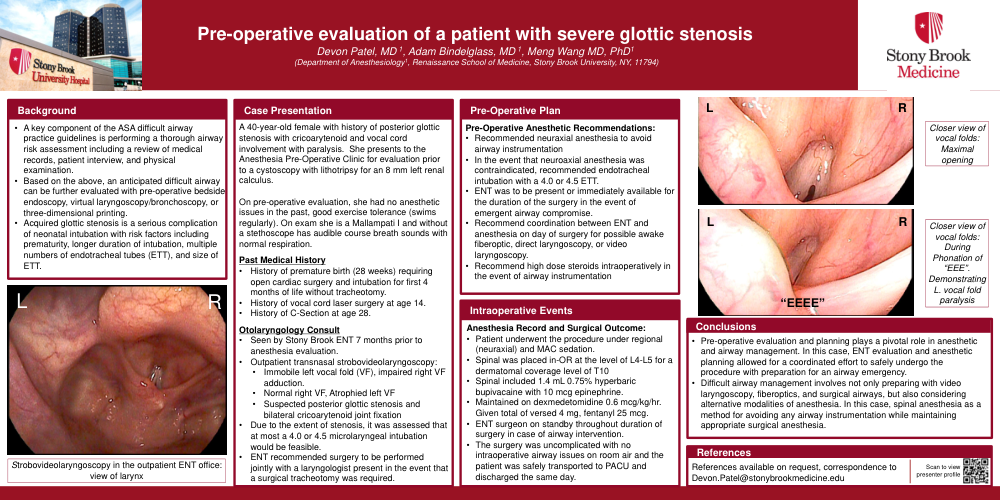
• Outpatient transnasal strobovideolaryngoscopy:
• Immobile left vocal fold (VF), impaired right VF
adduction.
• Normal right VF, Atrophied left VF
• Suspected posterior glottic stenosis and
bilateral cricoarytenoid joint fixation
• Due to the extent of stenosis, it was assessed that
at most a 4.0 or 4.5 microlaryngeal intubation
would be feasible.
• ENT recommended surgery to be performed
jointly with a laryngologist present in the event that
a surgical tracheotomy was required.
Pre-Operative Anesthetic Recommendations:
Pre-Operative Anesthetic Recommendations:
• Recommended neuraxial anesthesia to avoid
airway instrumentation
• In the event that neuroaxial anesthesia was
contraindicated, recommended endotracheal
intubation with a 4.0 or 4.5 ETT.
• ENT was to be present or immediately available for
the duration of the surgery in the event of
emergent airway compromise.
• Recommend coordination between ENT and
anesthesia on day of surgery for possible awake
fiberoptic, direct laryngoscopy, or video
laryngoscopy.
• Recommend high dose steroids intraoperatively in
the event of airway instrumentation
Intraoperative Events:
Anesthesia Record and Surgical Outcome:
• Patient underwent the procedure under regional
(neuraxial) and MAC sedation.
• Spinal was placed in-OR at the level of L4-L5 for a
dermatomal coverage level of T10
• Spinal included 1.4 mL 0.75% hyperbaric
bupivacaine with 10 mcg epinephrine.
• Maintained on dexmedetomidine 0.6 mcg/kg/hr.
Given total of versed 4 mg, fentanyl 25 mcg.
• ENT surgeon on standby throughout duration of
surgery in case of airway intervention.
• The surgery was uncomplicated with no
intraoperative airway issues on room air and the
patient was safely transported to PACU and
discharged the same day.
Discussion:
• Pre-operative evaluation and planning plays a pivotal role in anesthetic
and airway management. In this case, ENT evaluation and anesthetic
planning allowed for a coordinated effort to safely undergo the
procedure with preparation for an airway emergency.
• Difficult airway management involves not only preparing with video
laryngoscopy, fiberoptics, and surgical airways, but also considering
alternative modalities of anesthesia. In this case, spinal anesthesia as a
method for avoiding any airway instrumentation while maintaining
appropriate surgical anesthesia.