334 posters, 125 sessions, 831 authors, 236 institutions
ePostersLive by SciGen Technologies S.A. All rights reserved.
78th Annual PostGraduate Assembly in Anesthesiology (PGA78) 2024
December 6 - 9, 2024 | New York City

3156
Regional Anesthetic Approach to Subcutaneous Implantable Cardioverter Defibrillator Placement
Poster Presenter
Authors
Murad Elias, Bill Hum, Bharathi Scott, Emily Wang, Eman Nada
Affiliations
Part of Topic
Regional Anesthetic Approach to Subcutaneous Implantable Cardioverter Defibrillator Placement
Murad Elias, M.D., Emily Wang, M.D., Bill Hum, M.S., Bharathi Scott, M.D., Eman Nada, MBBCH, Ph.D, FASA
Patients who require implantable cardioverter defibrillator (ICD) placement often have significant comorbidities, increasing their risk of complications from general anesthesia.
ICD placement is commonly done under general anesthesia because it is associated with significant peri- and post-operative pain secondary to tunneling the leads during placement, due to involvement of the highly innervated mid-axillary chest wall.
A regional approach offers several advantages, such as avoiding the adverse effects of general anesthesia and providing an alternative in patients with difficult airways.
Here we present the case of a 74-year-old male with ischemic cardiomyopathy, EF 30%, and a history of tongue cancer s/p laryngectomy, chemotherapy, and head/neck radiation resulting in vocal cord paralysis, recurrent aspiration PNA, and neck tissue wasting who required an ICD for primary prevention.
Given the pt’s history of laryngectomy and difficult airways, he was at high risk for GA complications and the decision was made to use regional approach.
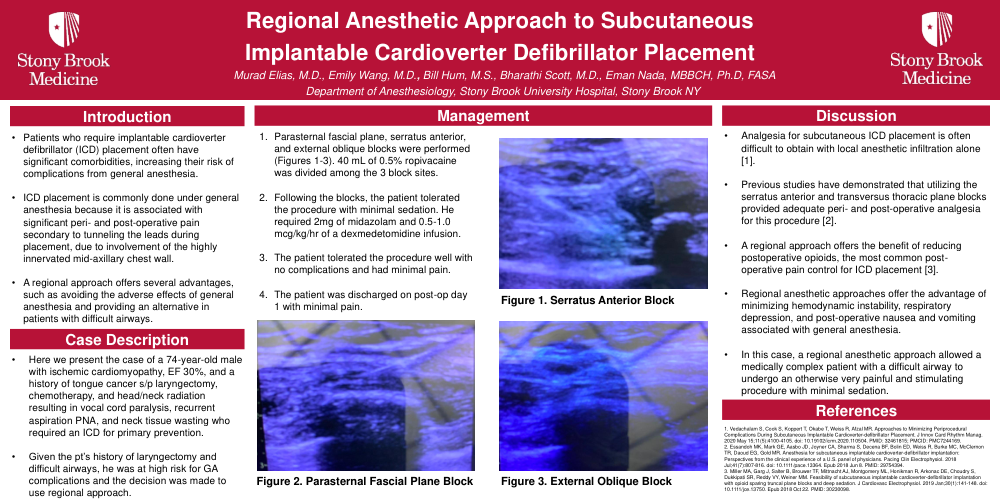
Parasternal fascial plane, serratus anterior, and external oblique blocks were performed (Figures 1-3).40 mL of 0.5% ropivacaine was divided among the 3 block sites.
Following the blocks, the patient tolerated the procedure with minimal sedation. He required 2mg of midazolam and 0.5-1.0 mcg/kg/hr of a dexmedetomidine infusion.
The patient tolerated the procedure well with no complications and had minimal pain.
The patient was discharged on post-op day 1 with minimal pain.
Analgesia for subcutaneous ICD placement is often difficult to obtain with local anesthetic infiltration alone [1].
Previous studies have demonstrated that utilizing the serratus anterior and transversus thoracic plane blocks provided adequate peri- and post-operative analgesia for this procedure [2].
A regional approach offers the benefit of reducing postoperative opioids, the most common post-operative pain control for ICD placement [3].
Regional anesthetic approaches offer the advantage of minimizing hemodynamic instability, respiratory depression, and post-operative nausea and vomiting associated with general anesthesia.
In this case, a regional anesthetic approach allowed a medically complex patient with a difficult airway to undergo an otherwise very painful and stimulating procedure with minimal sedation.
1. Vedachalam S, Cook S, Koppert T, Okabe T, Weiss R, Afzal MR. Approaches to Minimizing Periprocedural Complications During Subcutaneous Implantable Cardioverter-defibrillator Placement. J Innov Card Rhythm Manag. 2020 May 15;11(5):4100-4105. doi: 10.19102/icrm.2020.110504. PMID: 32461815; PMCID: PMC7244169.
2. Essandoh MK, Mark GE, Aasbo JD, Joyner CA, Sharma S, Decena BF, Bolin ED, Weiss R, Burke MC, McClernon TR, Daoud EG, Gold MR. Anesthesia for subcutaneous implantable cardioverter-defibrillator implantation: Perspectives from the clinical experience of a U.S. panel of physicians. Pacing Clin Electrophysiol. 2018 Jul;41(7):807-816. doi: 10.1111/pace.13364. Epub 2018 Jun 8. PMID: 29754394.
3. Miller MA, Garg J, Salter B, Brouwer TF, Mittnacht AJ, Montgomery ML, Honikman R, Arkonac DE, Choudry S, Dukkipati SR, Reddy VY, Weiner MM. Feasibility of subcutaneous implantable cardioverter-defibrillator implantation with opioid sparing truncal plane blocks and deep sedation. J Cardiovasc Electrophysiol. 2019 Jan;30(1):141-148. doi: 10.1111/jce.13750. Epub 2018 Oct 22. PMID: 30230098.