334 posters, 125 sessions, 831 authors, 236 institutions
ePostersLive by SciGen Technologies S.A. All rights reserved.
78th Annual PostGraduate Assembly in Anesthesiology (PGA78) 2024
December 6 - 9, 2024 | New York City

3151
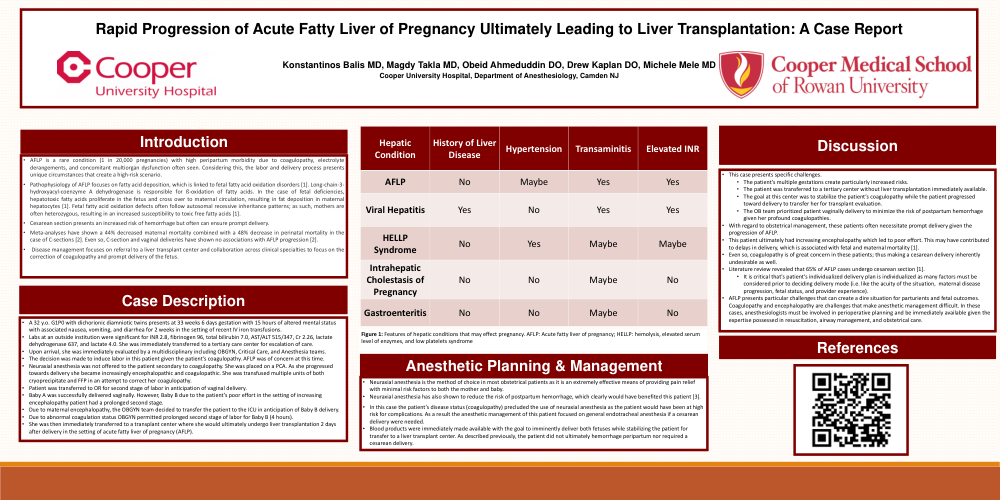
Rapid Progression of Acute Fatty Liver of Pregnancy Ultimately Leading to Liver Transplantation: A Case Report
Poster Presenter
Authors
Konstantinos Balis, Magdy Takla, Obeid Ahmeduddin, Drew Kaplan, Michele Mele
Affiliations
Part of Topic
Title: Rapid Progression of Acute Fatty Liver of Pregnancy Ultimately Leading to Liver Transplantation: A Case Report
Authors: Konstantinos Balis MD, Obeid Ahmeduddin DO, Drew Kaplan DO, Michele Mele MD, Magdy Takla MD
Learning Objective: Identify the key anesthetic considerations and management strategies for patients with acute fatty liver during pregnancy, ensuring optimal maternal and fetal outcomes during peripartum care.
Introduction:
AFLP is a rare condition with high peripartum morbidity due to coagulopathy, electrolyte derangements, and concomitant multiorgan dysfunction often seen. Considering this, the labor and delivery process presents unique circumstances that create a high-risk scenario.
The pathophysiology of AFLP focuses on fatty acid deposition, which is linked to fetal fatty acid oxidation disorders [1]. Long-chain-3-hydroxyacyl-coenzyme A dehydrogenase is responsible for ß-oxidation of fatty acids. In the case of fetal deficiencies, hepatotoxic fatty acids proliferate in the fetus and cross over to maternal circulation, resulting in fat deposition in maternal hepatocytes [1]. Fetal fatty acid oxidation defects often follow autosomal recessive inheritance patterns; as such, mothers are often heterozygous, resulting in an increased susceptibility to toxic free fatty acids [1].
With regards to the obstetrical management of patients, cesarean section presents an increased risk of hemorrhage but often can ensure prompt delivery. Meta-analyses have shown a 44% decreased maternal mortality combined with a 48% decrease in perinatal mortality in the case of C-sections [2]. Even so, C-section and vaginal deliveries have shown no associations with AFLP progression [2]. Disease management focuses on referral to a liver transplant center and collaboration across clinical specialties to focus on the correction of coagulopathy and prompt delivery of the fetus.
Case Description:
A 32-year-old G1P0 female, carrying dichorionic diamniotic twins, presented as a transfer from an outside hospital at 33 weeks 6 days gestation for altered mental status with associated nausea, vomiting, and diarrhea for 2 weeks in the setting of recent IV iron transfusions. She began having increased confusion 15 hours before the transfer. At this point she was brought to her local emergency department for further work-up. Labs at that time were significant for INR 2.8, fibrinogen 96, total bilirubin 7.0, AST/ALT 515/347, Cr 2.26, lactate dehydrogenase 637, and lactate 4.0. She was immediately transferred to a tertiary care center for escalation of care.
Upon arrival, the OBGYN, Critical Care, and Anesthesia teams immediately saw her. At this time she was noted to be altered. The decision was made to induce labor in this patient with operative cesarean delivery as a backup plan given the patient’s coagulopathy. Similarly, neuraxial anesthesia was not offered to the patient. She was placed on a PCA. As she progressed towards delivery she became increasingly encephalopathic and coagulopathic. She was transfused multiple units of both cryoprecipitate and FFP in an attempt to correct her coagulopathy.
Upon being fully dilated, the patient was transferred to OR for anticipated vaginal delivery. Baby A was successfully delivered shortly after that. Unfortunately, Baby B was unable to be delivered due to the patient’s poor effort in the setting of increasing encephalopathy. At this point, the OBGYN team decided to transfer the patient from the OR to the ICU. This was coordinated with the ICU team to expedite transfer to a liver transplant center. An OR was reserved for cesarean section or if the patient were to have postpartum hemorrhage. Cesarean delivery of Baby B at this time was not performed as the OB team was concerned that the maternal outcome would be poor (i.e. hemorrhage). Fortunately, the patient was able to deliver Baby B 4 hours after Baby A in the ICU. She was then immediately transferred to a transplant center where she would ultimately undergo liver transplantation 2 days after delivery in the setting of suspected acute fatty liver of pregnancy (AFLP).
Anesthetic Planning & Management:
Anesthesiologists play a vital role in the management of AFLP patients. Of course, neuraxial anesthesia is the method of choice in most obstetrical patients as it is an extremely effective means of providing pain relief with minimal risk factors to both the mother and baby. Neuraxial anesthesia has also shown to reduce the risk of postpartum hemorrhage, which clearly would have benefited this patient [3]. Unfortunately, in this case the patient’s disease status (coagulopathy) precluded the use of neuraxial anesthesia as the patient would have been at high risk for complications like an epidural hematoma. As a result the anesthetic management of this patient focused on general endotracheal anesthesia if a cesarean delivery were needed.
The anesthesia team in this case immediately evaluated the patient and prepared for an operative delivery. Blood products were immediately made available with the goal to imminently deliver both fetuses while stabilizing the patient for transfer to a liver transplant center. As described previously, the patient did not ultimately hemorrhage peripartum nor required a cesarean delivery thus limiting the anesthesia teams role in this case.
Discussion:
This case has quite a few factors that present specific challenges. The patient’s multiple gestations create particularly increased risks. Furthermore, the patient was transferred to a tertiary center without liver transplantation immediately available. This may have delayed definitive treatment, which luckily did not ultimately lead to morbidity. The goal at this center was to stabilize the patient’s coagulopathy while the patient progressed toward delivery to transfer her for transplant evaluation. The OB team prioritized patient vaginally delivery to minimize the risk of postpartum hemorrhage given her profound coagulopathies.
In discussing obstetrical management, these patients often necessitate prompt delivery given the progression of AFLP. This patient ultimately had increasing encephalopathy which led to poor effort. This may have contributed to delays in delivery, which is associated with fetal and maternal mortality [1]. Even so, coagulopathy is of great concern in these patients; thus making a cesarean delivery inherently undesirable as well. Literature review revealed that 65% of AFLP cases undergo cesarean section [1]. It is imperative that each patient undergo an individualized delivery plan as many factors like the acuity of the situation, maternal disease progression, fetal status, and provider experience must be assessed prior to performing a cesarean section on these extremely high risk patients.
AFLP presents particular challenges that can create a dire situation for pregnant mothers and fetal outcomes. Coagulopathy and encephalopathy are challenges that make anesthetic management difficult. In these cases, anesthesiologists must be involved in perioperative planning and be immediately available given the expertise possessed in resuscitation, airway management, and obstetrical care.
References:
|
1. Naoum EE, Leffert LR, Chitilian HV, Gray KJ, Bateman BT. Acute Fatty Liver of Pregnancy: Pathophysiology, Anesthetic Implications, and Obstetrical Management. Anesthesiology. 2019 Mar;130(3):446-461. doi: 10.1097/ALN.0000000000002597. PMID: 30707120; PMCID: PMC7037575. 2. Wang HY, Jiang Q, Shi H, Xu YQ, Shi AC, Sun YL, Li J, Ning Q, Shen GX. Effect of caesarean section on maternal and fetal outcomes in acute fatty liver of pregnancy: a systematic review and meta-analysis. Sci Rep. 2016 Jul 8;6:28826. doi: 10.1038/srep28826. PMID: 27387594; PMCID: PMC4937371. 3. Guglielminotti J, Landau R, Daw J, Friedman AM, Chihuri S, Li G. Use of Labor Neuraxial Analgesia for Vaginal Delivery and Severe Maternal Morbidity. JAMA Netw Open. 2022;5(2):e220137. doi:10.1001/jamanetworkopen.2022.0137 |