334 posters, 125 sessions, 831 authors, 236 institutions
ePostersLive by SciGen Technologies S.A. All rights reserved.
78th Annual PostGraduate Assembly in Anesthesiology (PGA78) 2024
December 6 - 9, 2024 | New York City

3150
Persistent Left SVC Syndrome in a Patient with Turner's Syndrome Undergoing Aortic Valve Repair
Poster Presenter
Authors
Affiliations
Part of Topic
Persistent Left SVC Syndrome in a Patient with Turner's Syndrome Undergoing Aortic Valve Repair
Introduction:
•Turner Syndrome (TS) is a chromosomal disorder in females characterized by the partial or complete loss of the second X-chromosome.
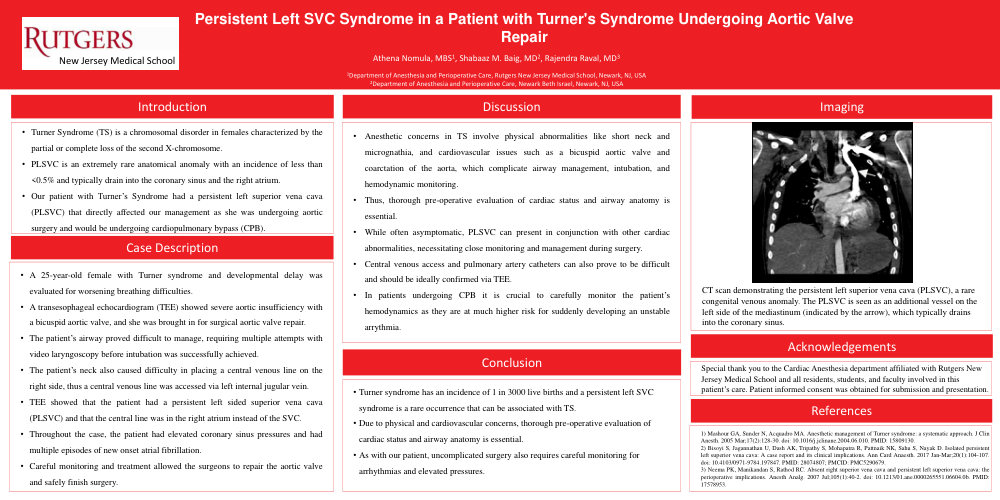
•PLSVC is an extremely rare anatomical anomaly with an incidence of less than <0.5% and typically drain into the coronary sinus and the right atrium.
•Our patient with Turner’s Syndrome had a persistent left superior vena cava (PLSVC) that directly affected our management as she was undergoing aortic surgery and would be undergoing cardiopulmonary bypass (CPB).
Case Description:
•A 25-year-old female with Turner syndrome and developmental delay was evaluated for worsening breathing difficulties.
•A transesophageal echocardiogram (TEE) showed severe aortic insufficiency with a bicuspid aortic valve, and she was brought in for surgical aortic valve repair.
•The patient’s airway proved difficult to manage, requiring multiple attempts with video laryngoscopy before intubation was successfully achieved.
•The patient’s neck also caused difficulty in placing a central venous line on the right side, thus a central venous line was accessed via left internal jugular vein.
•TEE showed that the patient had a persistent left sided superior vena cava (PLSVC) and that the central line was in the right atrium instead of the SVC.
•Throughout the case, the patient had elevated coronary sinus pressures and had multiple episodes of new onset atrial fibrillation.
•Careful monitoring and treatment allowed the surgeons to repair the aortic valve and safely finish surgery.
Discussion:
•Anesthetic concerns in TS involve physical abnormalities like short neck and micrognathia, and cardiovascular issues such as a bicuspid aortic valve and coarctation of the aorta, which complicate airway management, intubation, and hemodynamic monitoring.
•Thus, thorough pre-operative evaluation of cardiac status and airway anatomy is essential.
•While often asymptomatic, PLSVC can present in conjunction with other cardiac abnormalities, necessitating close monitoring and management during surgery.
•Central venous access and pulmonary artery catheters can also prove to be difficult and should be ideally confirmed via TEE.
•In patients undergoing CPB it is crucial to carefully monitor the patient’s hemodynamics as they are at much higher risk for suddenly developing an unstable arrythmia.
Conclusion:
•Turner syndrome has an incidence of 1 in 3000 live births and a persistent left SVC syndrome is a rare occurrence that can be associated with TS.
•Due to physical and cardiovascular concerns, thorough pre-operative evaluation of cardiac status and airway anatomy is essential.
•As with our patient, uncomplicated surgery also requires careful monitoring for arrhythmias and elevated pressures.