334 posters, 125 sessions, 831 authors, 236 institutions
ePostersLive by SciGen Technologies S.A. All rights reserved.
78th Annual PostGraduate Assembly in Anesthesiology (PGA78) 2024
December 6 - 9, 2024 | New York City

3147
When Surgery Must Wait: The Crucial Role of Preoperative Optimization in Patients with Advanced Right Ventricular Failure and Pulmonary Hypertension
Poster Presenter
Part of Topic
Title
When Surgery Must Wait: The Crucial Role of Preoperative Optimization in Patients with Advanced Right Ventricular Failure and Pulmonary Hypertension
Introduction
Pulmonary arterial hypertension (PAH) with right
ventricular failure (RVF) poses major perioperative
challenges due to the compromised right ventricle's
difficulty with rapid hemodynamic changes. In
advanced cases, volume shifts, vasodilation, positive
pressure ventilation, and altered sympathetic tone can
lead to critical declines in cardiac output and coronary
perfusion. Effective management necessitates an
interdisciplinary approach focused on thorough
preoperative optimization to stabilize hemodynamics
and reduce risks.
Case Report
We present a 67-year-old female with history significant
for idiopathic PAH with fulminant RVF, chronic
respiratory failure on homeoxygen, chronic kidney
disease stage III, and HFpEF who was evaluated for
skin graft placement for non-healing, bilateral lower
extremity skin lesions following a low velocity
traumatic injury.
A pre-operative right heart catheterization was
performed and significant for worsening PAH
(73/26mmHg), RVF, and cardiogenic shock (CI = 1.4)
despite active management with remodulin, tadalafil,
and ambrisentan. Other pertinent medications included
furosemide, metolazone and milrinone for heart failure.
These findings were consistent with an ECHO
performed 10-months prior, which also demonstrated
normal LV function, severely reduced RVEF, severe RV
enlargement w/ septal deviation (D-sign), and severe
tricuspid regurgitation with IVC flow reversal (peak TR
gradient = 64mmHg).
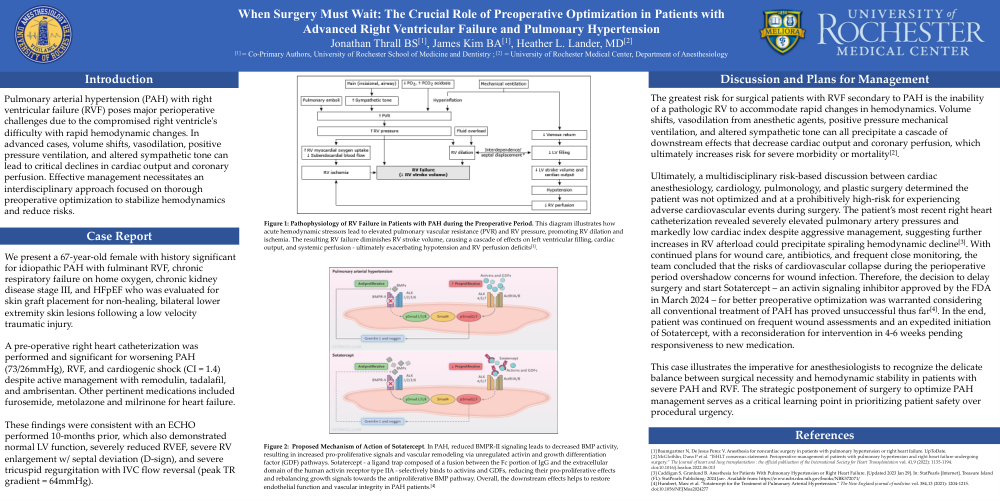
Figure 1
Pathophysiology of RV Failure in Patients with PAH during the Preoperative Period. This diagram illustrates how
acute hemodynamic stressors lead to elevated pulmonary vascular resistance (PVR) and RV pressure, promoting RV dilation and
ischemia. The resulting RV failure diminishes RV stroke volume, causing a cascade of effects on left ventricular filling, cardiac
output, and systemic perfusion - ultimately exacerbating hypotension and RV perfusion deficits[1]
Figure 2
Proposed Mechanism of Action of Sotatercept. In PAH, reduced BMPR-II signaling leads to decreased BMP activity,
resulting in increased pro-proliferative signals and vascular remodeling via unregulated activin and growth differentiation
factor (GDF) pathways. Sotatercept - a ligand trap composed of a fusion between the Fc portion of IgG and the extracellular
domain of the human activin receptor type IIA - selectively binds to activins and GDFs, reducing their pro-proliferative effects
and rebalancing growth signals towards the antiproliferative BMP pathway . Overall, the downstream effects helps to restore
endothelial function and vascular integrity in PAH patients.[4]
Discussion and Plans for Management
The greatest risk for surgical patients with RVF secondary to PAH is the inability
of a pathologic RV to accommodate rapid changes in hemodynamics. Volume
shifts, vasodilation from anesthetic agents, positive pressure mechanical
ventilation, and altered sympathetic tone can all precipitate a cascade of
downstream effects that decrease cardiac output and coronary perfusion, which
ultimately increases risk for severe morbidity or mortality[2]
.
Ultimately, a multidisciplinary risk-based discussion between cardiac
anesthesiology, cardiology, pulmonology, and plastic surgery determined the
patient was not optimized and at a prohibitively high-risk for experiencing
adverse cardiovascular events during surgery. The patient’s most recent right heart
catheterization revealed severely elevated pulmonary artery pressures and
markedly low cardiac index despite aggressive management, suggesting further
increases in RV afterload could precipitate spiraling hemodynamic decline[3]. With
continued plans for wound care, antibiotics, and frequent close monitoring, the
team concluded that the risks of cardiovascular collapse during the perioperative
period overshadow concerns for wound infection. Therefore, the decision to delay
surgery and start Sotatercept – an activin signaling inhibitor approved by the FDA
in March 2024 – for better preoperative optimization was warranted considering
all conventional treatment of PAH has proved unsuccessful thus far[4]. In the end,
patient was continued on frequent wound assessments and an expedited initiation
of Sotatercept, with a reconsideration for intervention in 4-6 weeks pending
responsiveness to new medication.
This case illustrates the imperative for anesthesiologists to recognize the delicate
balance between surgical necessity and hemodynamic stability in patients with
severe PAH and RVF. The strategic postponement of surgery to optimize PAH
management serves as a critical learning point in prioritizing patient safety over
procedural urgency.
References
[1] Baumgartner N, De Jesus Perez V. Anesthesia for noncardiac surgery in patients with pulmonary hypertension or right heart failure. UpToDate.
[2] McGlothlin, Dana P et al. “ISHLT consensus statement: Perioperative management of patients with pulmonary hypertension and right heart failure undergoing
surgery.” The Journal of heart and lung transplantation : the official publication of the International Society for Heart Transplantation vol. 41,9 (2022): 1135-1194.
doi:10.1016/j.healun.2022.06.013
[3] Caddigan S, Granlund B. Anesthesia for Patients With Pulmonary Hypertension or Right Heart Failure. [Updated 2023 Jan 29]. In: StatPearls [Internet]. Treasure Island
(FL): StatPearls Publishing; 2024 Jan-
. Available from: https://www.ncbi.nlm.nih.gov/books/NBK572071/
[4] Humbert, Marc et al. “Sotatercept for the Treatment of Pulmonary Arterial Hypertension.” The New England journal of medicine vol. 384,13 (2021): 1204-1215.
doi:10.1056/NEJMoa2024277