334 posters, 125 sessions, 831 authors, 236 institutions
ePostersLive by SciGen Technologies S.A. All rights reserved.
78th Annual PostGraduate Assembly in Anesthesiology (PGA78) 2024
December 6 - 9, 2024 | New York City

3146
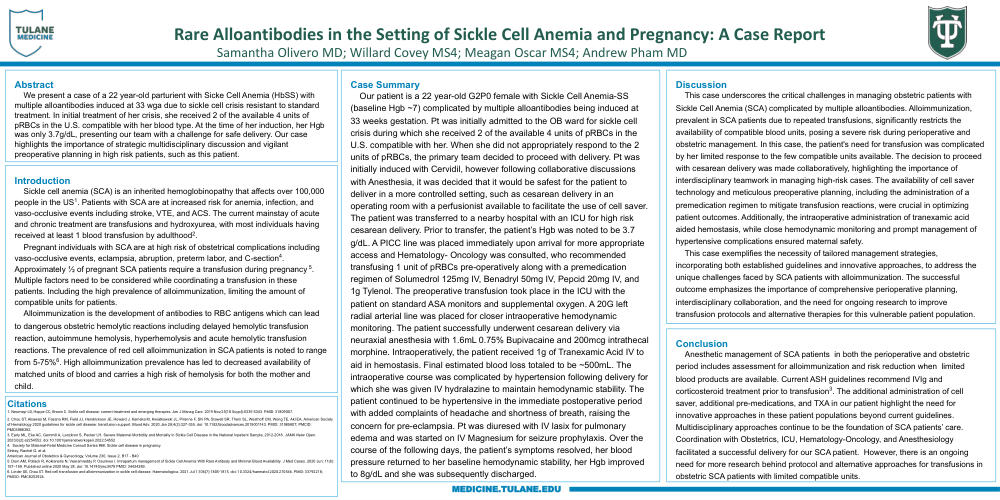
Rare Alloantibodies in the Setting of Sickle Cell Anemia and Pregnancy: A Case Report
Poster Presenter
Authors
Affiliations
Part of Topic
Rare Alloantibodies in the Setting of Sickle Cell Anemia and Pregnancy: A Case Report
Samantha Olivero MD; Willard Covey MS4; Meagan Oscar MS4; Andrew Pham MD
Abstract
We present a case of a 22 year-old parturient with Sicke Cell Anemia (HbSS) with multiple alloantibodies induced at 33 wga due to sickle cell crisis resistant to standard treatment. In initial treatment of her crisis, she received 2 of the available 4 units of pRBCs in the U.S. compatible with her blood type. At the time of her induction, her Hgb was only 3.7g/dL, presenting our team with a challenge for safe delivery. Our case highlights the importance of strategic multidisciplinary discussion and vigilant preoperative planning in high risk patients, such as this patient.
Introduction
Sickle cell anemia (SCA) is an inherited hemoglobinopathy that affects over 100,000 people in the US1. Patients with SCA are at increased risk for anemia, infection, and vaso-occlusive events including stroke, VTE, and ACS. The current mainstay of acute and chronic treatment are transfusions and hydroxyurea, with most individuals having received at least 1 blood transfusion by adulthood2.
Pregnant individuals with SCA are at high risk of obstetrical complications including vaso-occlusive events, eclampsia, abruption, preterm labor, and C-section4. Approximately ½ of pregnant SCA patients require a transfusion during pregnancy 5. Multiple factors need to be considered while coordinating a transfusion in these patients. Including the high prevalence of alloimmunization, limiting the amount of compatible units for patients.
Alloimmunization is the development of antibodies to RBC antigens which can lead to dangerous obstetric hemolytic reactions including delayed hemolytic transfusion reaction, autoimmune hemolysis, hyperhemolysis and acute hemolytic transfusion reactions. The prevalence of red cell alloimmunization in SCA patients is noted to range from 5-75%6. High alloimmunization prevalence has led to decreased availability of matched units of blood and carries a high risk of hemolysis for both the mother and child.
Case Summary
Our patient is a 22 year-old G2P0 female with Sickle Cell Anemia-SS (baseline Hgb ~7) complicated by multiple alloantibodies being induced at 33 weeks gestation. Pt was initially admitted to the OB ward for sickle cell crisis during which she received 2 of the available 4 units of pRBCs in the U.S. compatible with her. When she did not appropriately respond to the 2 units of pRBCs, the primary team decided to proceed with delivery. Pt was initially induced with Cervidil, however following collaborative discussions with Anesthesia, it was decided that it would be safest for the patient to deliver in a more controlled setting, such as cesarean delivery in an operating room with a perfusionist available to facilitate the use of cell saver. The patient was transferred to a nearby hospital with an ICU for high risk cesarean delivery. Prior to transfer, the patient’s Hgb was noted to be 3.7 g/dL. A PICC line was placed immediately upon arrival for more appropriate access and Hematology- Oncology was consulted, who recommended transfusing 1 unit of pRBCs pre-operatively along with a premedication regimen of Solumedrol 125mg IV, Benadryl 50mg IV, Pepcid 20mg IV, and 1g Tylenol. The preoperative transfusion took place in the ICU with the patient on standard ASA monitors and supplemental oxygen. A 20G left radial arterial line was placed for closer intraoperative hemodynamic monitoring. The patient successfully underwent cesarean delivery via neuraxial anesthesia with 1.6mL 0.75% Bupivacaine and 200mcg intrathecal morphine. Intraoperatively, the patient received 1g of Tranexamic Acid IV to aid in hemostasis. Final estimated blood loss totaled to be ~500mL. The intraoperative course was complicated by hypertension following delivery for which she was given IV hydralazine to maintain hemodynamic stability. The patient continued to be hypertensive in the immediate postoperative period with added complaints of headache and shortness of breath, raising the concern for pre-eclampsia. Pt was diuresed with IV lasix for pulmonary edema and was started on IV Magnesium for seizure prophylaxis. Over the course of the following days, the patient’s symptoms resolved, her blood pressure returned to her baseline hemodynamic stability, her Hgb improved to 8g/dL and she was subsequently discharged.
Discussion
This case underscores the critical challenges in managing obstetric patients with Sickle Cell Anemia (SCA) complicated by multiple alloantibodies. Alloimmunization, prevalent in SCA patients due to repeated transfusions, significantly restricts the availability of compatible blood units, posing a severe risk during perioperative and obstetric management. In this case, the patient's need for transfusion was complicated by her limited response to the few compatible units available. The decision to proceed with cesarean delivery was made collaboratively, highlighting the importance of interdisciplinary teamwork in managing high-risk cases. The availability of cell saver technology and meticulous preoperative planning, including the administration of a premedication regimen to mitigate transfusion reactions, were crucial in optimizing patient outcomes. Additionally, the intraoperative administration of tranexamic acid aided hemostasis, while close hemodynamic monitoring and prompt management of hypertensive complications ensured maternal safety.
This case exemplifies the necessity of tailored management strategies, incorporating both established guidelines and innovative approaches, to address the unique challenges faced by SCA patients with alloimmunization. The successful outcome emphasizes the importance of comprehensive perioperative planning, interdisciplinary collaboration, and the need for ongoing research to improve transfusion protocols and alternative therapies for this vulnerable patient population.
Conclusion
Anesthetic management of SCA patients in both the perioperative and obstetric period includes assessment for alloimmunization and risk reduction when limited blood products are available. Current ASH guidelines recommend IVIg and corticosteroid treatment prior to transfusion3. The additional administration of cell saver, additional pre-medications, and TXA in our patient highlight the need for innovative approaches in these patient populations beyond current guidelines. Multidisciplinary approaches continue to be the foundation of SCA patients’ care. Coordination with Obstetrics, ICU, Hematology-Oncology, and Anesthesiology facilitated a successful delivery for our SCA patient. However, there is an ongoing need for more research behind protocol and alternative approaches for transfusions in obstetric SCA patients with limited compatible units.
Citations
1. Neumayr LD, Hoppe CC, Brown C. Sickle cell disease: current treatment and emerging therapies. Am J Manag Care. 2019 Nov;25(18 Suppl):S335-S343. PMID: 31809007.
2. Chou ST, Alsawas M, Fasano RM, Field JJ, Hendrickson JE, Howard J, Kameka M, Kwiatkowski JL, Pirenne F, Shi PA, Stowell SR, Thein SL, Westhoff CM, Wong TE, Akl EA. American Society of Hematology 2020 guidelines for sickle cell disease: transfusion support. Blood Adv. 2020 Jan 28;4(2):327-355. doi: 10.1182/bloodadvances.2019001143. PMID: 31985807; PMCID: PMC6988392.
3. Early ML, Eke AC, Gemmill A, Lanzkron S, Pecker LH. Severe Maternal Morbidity and Mortality in Sickle Cell Disease in the National Inpatient Sample, 2012-2018. JAMA Netw Open. 2023;6(2):e2254552. doi:10.1001/jamanetworkopen.2022.54552
4. Society for Maternal-Fetal Medicine Consult Series #68: Sickle cell disease in pregnancy
Sinkey, Rachel G. et al.
American Journal of Obstetrics & Gynecology, Volume 230, Issue 2, B17 - B40
5. Dom AM, Pollack R, Koklanaris N, Veeramreddy P, Osunkwo I. Intrapartum management of Sickle Cell Anemia With Rare Antibody and Minimal Blood Availability. J Med Cases. 2020 Jun; 11(6): 157–159. Published online 2020 May 28. doi: 10.14740/jmc3479 PMID: 34434389.
6. Linder GE, Chou ST. Red cell transfusion and alloimmunization in sickle cell disease. Haematologica. 2021 Jul 1;106(7):1805-1815. doi: 10.3324/haematol.2020.270546. PMID: 33792218; PMCID: PMC8252926.