334 posters, 125 sessions, 831 authors, 236 institutions
ePostersLive by SciGen Technologies S.A. All rights reserved.
78th Annual PostGraduate Assembly in Anesthesiology (PGA78) 2024
December 6 - 9, 2024 | New York City

3142
Securing a Rapidly Deteriorating Airway – A Case Report on Ludwig’s Angina
Poster Presenter
Authors
Affiliations
Part of Topic
OBJECTIVES
Allow attendees to appreciate the flexibility needed to secure an evolving airway.
Demonstrate the utility of gaining and maintaining various airway techniques.
Discuss key steps to help optimize awake intubation conditions.
BACKGROUND
In the era of video laryngoscopy, does awake fiberoptic intubation remain a necessary skill?
While widespread video laryngoscopy (VL) availability has decreased difficult airways due to poor laryngeal views, other causes of difficult airways may not be amenable to VL use.
Awake fiberoptic intubation (AFOI) remains tool of choice with:
➢
Limited mouth opening
➢
Airway masses
➢
Neck pathology
➢
Questionable or prior difficult ventilation & intubation
Several studies have found a consistent use of AFOI despite VL availability.
➢
Consistent 1.06% awake intubation rates during 12-year period VL was available in large Canadian academic hospital3
➢
Consistent 1-1.7% awake intubation rates in US & UK centers4
Challenges with gaining and maintaining skills.
Senior anesthetic trainees completed a self-assessment regarding airway competencies .5
➢
93% felt they could perform independent video laryngoscopy
➢
68% felt they could perform independent asleep FOI
➢
33% felt they could perform independent awake FOI
CASE DESCRIPTION
A 71-year-old male underwent emergent incision and drainage for Ludwig’s angina complicated by trismus and airway impedance necessitating awake fiberoptic intubation.
INITIAL PRESENTATION
•
Presented to an outside facility where initial imaging demonstrated right mandibular swelling following endodontic abscess drainage of tooth 31.
•
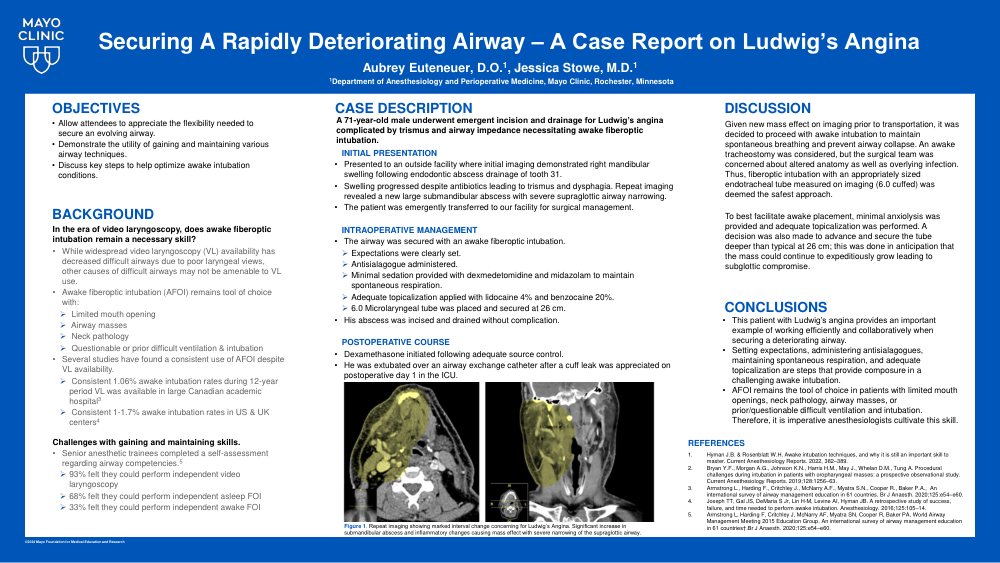
Swelling progressed despite antibiotics leading to trismus and dysphagia. Repeat imaging revealed a new large submandibular abscess with severe supraglottic airway narrowing.
•
The patient was emergently transferred to our facility for surgical management.
INTRAOPERATIVE MANAGEMENT
•
The airway was secured with an awake fiberoptic intubation.
➢
Expectations were clearly set.
➢
Antisialagogue administered.
➢
Minimal sedation provided with dexmedetomidine and midazolam to maintain spontaneous respiration.
➢
Adequate topicalization applied with lidocaine 4% and benzocaine 20%.
➢
6.0 Microlaryngeal tube was placed and secured at 26 cm.
•
His abscess was incised and drained without complication.
POSTOPERATIVE COURSE
•
Dexamethasone initiated following adequate source control.
•
He was extubated over an airway exchange catheter after a cuff leak was appreciated on postoperative day 1 in the ICU.
DISCUSSION
Given new mass effect on imaging prior to transportation, it was decided to proceed with awake intubation to maintain spontaneous breathing and prevent airway collapse. An awake tracheostomy was considered, but the surgical team was concerned about altered anatomy as well as overlying infection. Thus, fiberoptic intubation with an appropriately sized endotracheal tube measured on imaging (6.0 cuffed) was deemed the safest approach.
To best facilitate awake placement, minimal anxiolysis was provided and adequate topicalization was performed. A decision was also made to advance and secure the tube deeper than typical at 26 cm; this was done in anticipation that the mass could continue to expeditiously grow leading to subglottic compromise.
CONCLUSION
•
This patient with Ludwig’s angina provides an important example of working efficiently and collaboratively when securing a deteriorating airway.
•
Setting expectations, administering antisialagogues, maintaining spontaneous respiration, and adequate topicalization are steps that provide composure in a challenging awake intubation.
•
AFOI remains the tool of choice in patients with limited mouth openings, neck pathology, airway masses, or prior/questionable difficult ventilation and intubation. Therefore, it is imperative anesthesiologists cultivate this skill.