334 posters, 125 sessions, 831 authors, 236 institutions
ePostersLive by SciGen Technologies S.A. All rights reserved.
78th Annual PostGraduate Assembly in Anesthesiology (PGA78) 2024
December 6 - 9, 2024 | New York City

3136
Assessing Collateral Circulation: A Case of Hand Ischemia following Arterial Line Placement
Poster Presenter
Authors
Affiliations
Part of Topic
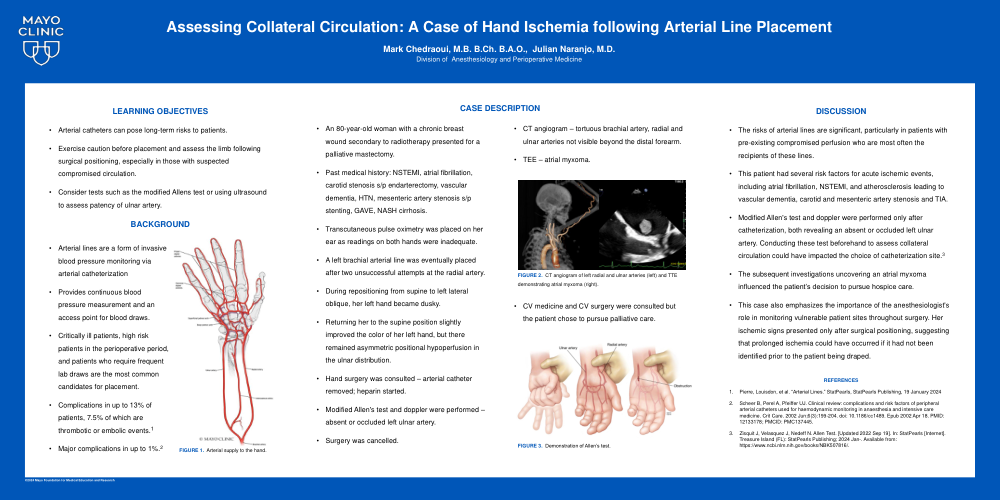
An 80-year-old woman with a chronic breast wound secondary to radiotherapy presented for a palliative mastectomy. • Past medical history: NSTEMI, atrial fibrillation, carotid stenosis s/p endarterectomy, vascular dementia, HTN, mesenteric artery stenosis s/p stenting, GAVE, NASH cirrhosis. • Transcutaneous pulse oximetry was placed on her ear as readings on both hands were inadequate. • A left brachial arterial line was eventually placed after two unsuccessful attempts at the radial artery. • During repositioning from supine to left lateral oblique, her left hand became dusky. • Returning her to the supine position slightly improved the color of her left hand, but there remained asymmetric positional hypoperfusion in the ulnar distribution. • Hand surgery was consulted – arterial catheter removed; heparin started. • Modified Allen's test and doppler were performed – absent or occluded left ulnar artery. • Surgery was cancelled. • CT angiogram – tortuous brachial artery, radial and ulnar arteries not visible beyond the distal forearm. • TEE – atrial myxoma. • CV medicine and CV surgery were consulted but the patient chose to pursue palliative care. Assessing Collateral Circulation: A Case of Hand Ischemia following Arterial Line Placement Mark Chedraoui, M.B. B.Ch. B.A.O., Julian Naranjo, M.D. Division of Anesthesiology and Perioperative Medicine LEARNING OBJECTIVES • Arterial catheters can pose long-term risks to patients. • Exercise caution before placement and assess the limb following surgical positioning, especially in those with suspected compromised circulation. • Consider tests such as the modified Allens test or using ultrasound to assess patency of ulnar artery. BACKGROUND DISCUSSION • The risks of arterial lines are significant, particularly in patients with pre-existing compromised perfusion who are most often the recipients of these lines. • This patient had several risk factors for acute ischemic events, including atrial fibrillation, NSTEMI, and atherosclerosis leading to vascular dementia, carotid and mesenteric artery stenosis and TIA. • Modified Allen's test and doppler were performed only after catheterization, both revealing an absent or occluded left ulnar artery. Conducting these test beforehand to assess collateral circulation could have impacted the choice of catheterization site. 3 • The subsequent investigations uncovering an atrial myxoma influenced the patient’s decision to pursue hospice care. • This case also emphasizes the importance of the anesthesiologist's role in monitoring vulnerable patient sites throughout surgery. Her ischemic signs presented only after surgical positioning, suggesting that prolonged ischemia could have occurred if it had not been identified prior to the patient being draped. REFERENCES 1. Pierre, Louisdon, et al. “Arterial Lines.” StatPearls, StatPearls Publishing, 19 January 2024 2. Scheer B, Perel A, Pfeiffer UJ. Clinical review: complications and risk factors of peripheral arterial catheters used for haemodynamic monitoring in anaesthesia and intensive care medicine. Crit Care. 2002 Jun;6(3):199-204. doi: 10.1186/cc1489. Epub 2002 Apr 18. PMID: 12133178; PMCID: PMC137445. 3. Zisquit J, Velasquez J, Nedeff N. Allen Test. [Updated 2022 Sep 19]. In: StatPearls [Internet]. Treasure Island (FL): StatPearls Publishing; 2024 Jan-. Available from: https://www.ncbi.nlm.nih.gov/books/NBK507816/. • Arterial lines are a form of invasive blood pressure monitoring via arterial catheterization • Provides continuous blood pressure measurement and an access point for blood draws. • Critically ill patients, high risk patients in the perioperative period, and patients who require frequent lab draws are the most common candidates for placement. • Complications in up to 13% of patients, 7.5% of which are thrombotic or embolic events.1 • Major complications in up to 1%.2 CASE DESCRIPTION FIGURE 1. Arterial supply to the hand. FIGURE 2. CT angiogram of left radial and ulnar arteries (left) and TTE demonstrating atrial myxoma (right). FIGURE 3. Demonstration of Allen’s test