334 posters, 125 sessions, 831 authors, 236 institutions
ePostersLive by SciGen Technologies S.A. All rights reserved.
78th Annual PostGraduate Assembly in Anesthesiology (PGA78) 2024
December 6 - 9, 2024 | New York City

3134
Worsening neurological Symptoms of adult tethered cord syndrome after Neuraxial anesthetic
Poster Presenter
Authors
Affiliations
Part of Topic
Presenter: Hamza Abou Alchamat, M.D.
Moderator: Ammar Siddiqui, M.D.
Learning Objective: Spinal anesthesia for adult Tethered Cord syndrome should be avoided. MRI should be done in a timely manner when acute onset of symptoms in lower extremities happens after Spinal Anesthesia
Case description: 33 years old lady, with history of chronic lower extremities pain since childhood.
She got an epidural during pregnancy 15 years ago, developed low back pain at that time.
It significantly worsened after a spinal anesthetic 10 years ago prior to tubal ligation.
Multiple attempts for epidural placement. First 2 attempts she had paresthesia in the right followed by left lower extremity. She then developed paresthesia in both legs. Since that time her low back pain and leg pain have significantly worsened.
She describes the pain as dull with intermittent sharp spikes, also reports constipation and urinary incontinence. She had gait instability with falls over the last 3 years. She reports subjective leg weakness and intermittent fecal incontinence over the last 12 months. No relief with physical therapy.
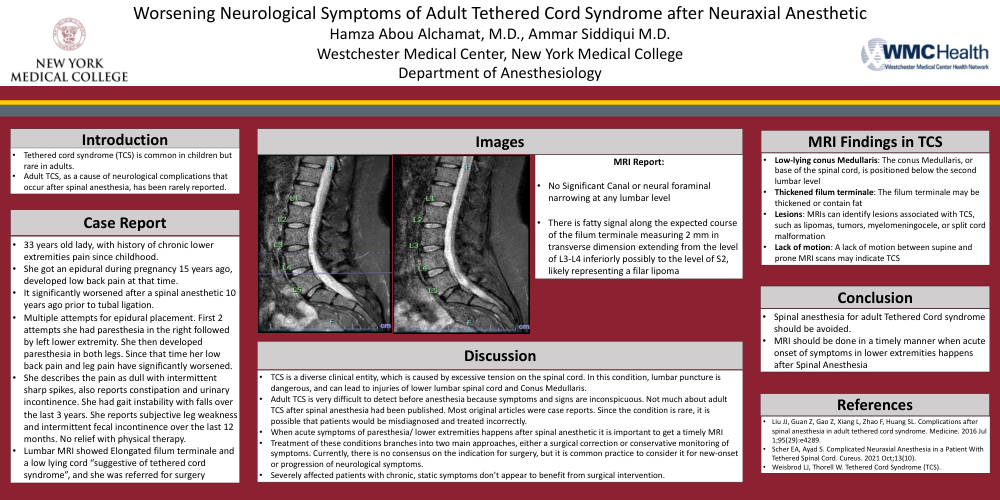
Lumbar MRI showed Elongated filum terminale and a low lying cord “suggestive of tethered cord syndrome”, and she was referred for surgery
Discussion:
Tethered cord syndrome (TCS) is common in children but rare in adults. Adult TCS, as a cause of neurological complication that occurs after spinal anesthesia, has been reported rarely.
TCS is a diverse clinical entity, which is caused by excessive tension on the spinal cord. In this condition, lumbar puncture is dangerous, and can lead to injuries of lower lumbar spinal cord and Conus Medullaris.
Adult TCS is very difficult to detect before anesthesia because symptoms and signs are inconspicuous. Not much about adult TCS after spinal anesthesia had been published. Most original articles were case reports. Since the condition is rare, it is possible that patients would be misdiagnosed and treated incorrectly.
When acute symptoms of paresthesia/ lower extremities happens after spinal anesthetic it is important to get a timely MRI
Treatment of these conditions branches into two main approaches, either a surgical correction or conservative monitoring of symptoms. Currently, there is not a consensus on the indication for surgery, but it is common practice to consider it for new-onset or progression of neurological symptoms.
Severely affected patients with chronic, static symptoms don’t appear to benefit from surgical intervention.
MRI Findings in TCS:
References: (max of 3):
- Liu JJ, Guan Z, Gao Z, Xiang L, Zhao F, Huang SL. Complications after spinal anesthesia in adult tethered cord syndrome. Medicine. 2016 Jul 1;95(29):e4289.
- Scher EA, Ayad S. Complicated Neuraxial Anesthesia in a Patient With Tethered Spinal Cord. Cureus. 2021 Oct;13(10).
- Weisbrod LJ, Thorell W. Tethered Cord Syndrome (TCS).