334 posters, 125 sessions, 831 authors, 236 institutions
ePostersLive by SciGen Technologies S.A. All rights reserved.
78th Annual PostGraduate Assembly in Anesthesiology (PGA78) 2024
December 6 - 9, 2024 | New York City

3133
Intraoperative Management of an Acute Aortic Occlusion with Multiorgan Failure in an Adolescent Patient
Poster Presenter
Authors
Affiliations
Part of Topic
Introduction
·Aortic thrombosis: carry high morbidity and mortality
·Primary aortic thrombi: most are idiopathic
·Secondary aortic thrombi: associated with underlying aortic aneurysms, dissections, and implanted graft materials
·Risk factors: smoking, diabetes, hypertension, dyslipidemia, atrial fibrillation, and malignancy
·Disease presentation abdominal pain with or without hematochezia, ischemic limb pain, claudication, paresthesia, skin discoloration or necrosis, dysarthria, paraplegia, but often can be asymptomatic
·Patient: 15-year-old male presented with acute chest, back and abdominal pain with diminished sensory & motor function of his in lower extremities
·Past medical and surgical history: none
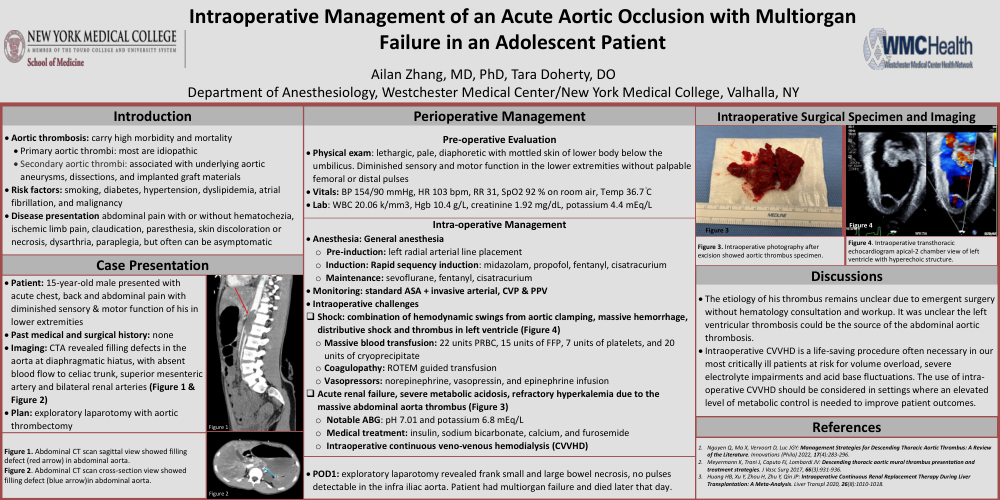
·Imaging: CTA revealed filling defects in the aorta at diaphragmatic hiatus, with absent blood flow to celiac trunk, superior mesenteric artery and bilateral renal arteries (Figure 1 & Figure 2)
·Plan: exploratory laparotomy with aortic thrombectomy
Pre-operative Evaluation
·Physical exam: lethargic, pale, diaphoretic with mottled skin of lower body below the umbilicus. Diminished sensory and motor function in the lower extremities without palpable femoral or distal pulses
·Vitals: BP 154/90 mmHg, HR 103 bpm, RR 31, SpO2 92 % on room air, Temp 36.7 ֯C
·Lab: WBC 20.06 k/mm3, Hgb 10.4 g/L, creatinine 1.92 mg/dL, potassium 4.4 mEq/L
Intra-operative Management
·Anesthesia: General anesthesia
oPre-induction: left radial arterial line placement
o Induction: Rapid sequency induction: midazolam, propofol, fentanyl, cisatracurium
o Maintenance: sevoflurane, fentanyl, cisatracurium
·Monitoring: standard ASA + invasive arterial, CVP & PPV
·Intraoperative challenges
qShock: combination of hemodynamic swings from aortic clamping, massive hemorrhage, distributive shock and thrombus in left ventricle (Figure 4)
oMassive blood transfusion: 22 units PRBC, 15 units of FFP, 7 units of platelets, and 20 units of cryoprecipitate
oCoagulopathy: ROTEM guided transfusion
oVasopressors: norepinephrine, vasopressin, and epinephrine infusion
qAcute renal failure, severe metabolic acidosis, refractory hyperkalemia due to the massive abdominal aorta thrombus (Figure 3)
oNotable ABG: pH 7.01 and potassium 6.8 mEq/L
oMedical treatment: insulin, sodium bicarbonate, calcium, and furosemide
oIntraoperative continuous veno-venous hemodialysis (CVVHD)
·POD1: exploratory laparotomy revealed frank small and large bowel necrosis, no pulses detectable in the infra iliac aorta. Patient had multiorgan failure and died later that day.
Discussions
·The etiology of his thrombus remains unclear due to emergent surgery without hematology consultation and workup. It was unclear the left ventricular thrombosis could be the source of the abdominal aortic thrombosis.
·Intraoperative CVVHD is a life-saving procedure often necessary in our most critically ill patients at risk for volume overload, severe electrolyte impairments and acid base fluctuations. The use of intra-operative CVVHD should be considered in settings where an elevated level of metabolic control is needed to improve patient outcomes.