708 posters, 8 topics, 16 sessions, 1,190 authors, 600 institutions
ePostersLive by SciGen Technologies S.A. All rights reserved.
ISQua's 39th International Conference 2023
August 27 - 30, 2023 | Seoul, Republic of Korea

P615
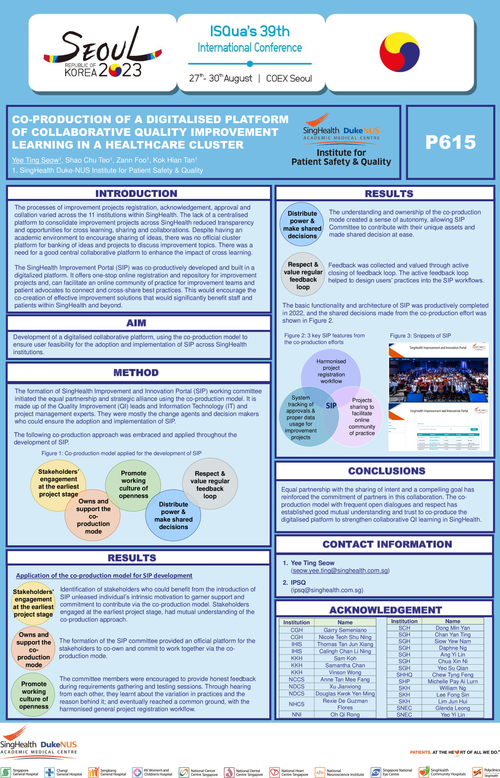
CO-PRODUCTION OF A DIGITALISED PLATFORM OF COLLABORATIVE QUALITY IMPROVEMENT LEARNING IN A HEALTHCARE CLUSTER
Poster Presenter
Authors
Affiliations
Part of Topic
Coproduction with staff and service users
CO-PRODUCTION OF A DIGITALISED PLATFORM OF COLLABORATIVE QUALITY IMPROVEMENT LEARNING IN A HEALTHCARE CLUSTER
Yee Ting Seow1 , Shao Chu Teo1 , Zann Foo1 , Kok Hian Tan1 1. SingHealth Duke-NUS Institute for Patient Safety & Quality
INTRODUCTION
The processes of improvement projects registration, acknowledgement, approval and collation varied across the 11 institutions within SingHealth. The lack of a centralised platform to consolidate improvement projects across SingHealth reduced transparency and opportunities for cross learning, sharing and collaborations. Despite having an academic environment to encourage sharing of ideas, there was no official cluster platform for banking of ideas and projects to discuss improvement topics. There was a need for a good central collaborative platform to enhance the impact of cross learning. The SingHealth Improvement Portal (SIP) was co-productively developed and built in a digitalized platform. It offers one-stop online registration and repository for improvement projects and, can facilitate an online community of practice for improvement teams and patient advocates to connect and cross-share best practices. This would encourage the co-creation of effective improvement solutions that would significantly benefit staff and patients within SingHealth and beyond.
AIM
Development of a digitalised collaborative platform, using the co-production model to ensure user feasibility for the adoption and implementation of SIP across SingHealth institutions.
METHOD
The formation of SingHealth Improvement and Innovation Portal (SIP) working committee initiated the equal partnership and strategic alliance using the co-production model. It is made up of the Quality Improvement (QI) leads and Information Technology (IT) and project management experts. They were mostly the change agents and decision makers who could ensure the adoption and implementation of SIP.
RESULTS
Identification of stakeholders who could benefit from the introduction of SIP unleased individual’s intrinsic motivation to garner support and commitment to contribute via the co-production model. Stakeholders engaged at the earliest project stage, had mutual understanding of the co-production approach.
The formation of the SIP committee provided an official platform for the stakeholders to co-own and commit to work together via the co-production mode.
The committee members were encouraged to provide honest feedback during requirements gathering and testing sessions. Through hearing from each other, they learnt about the variation in practices and the reason behind it; and eventually reached a common ground, with the harmonised general project registration workflow.
The understanding and ownership of the co-production mode created a sense of autonomy, allowing SIP Committee to contribute with their unique assets and made shared decision at ease.
Feedback was collected and valued through active closing of feedback loop. The active feedback loop helped to design users’ practices into the SIP workflows.
CONCLUSIONS
Equal partnership with the sharing of intent and a compelling goal has reinforced the commitment of partners in this collaboration. The co-production model with frequent open dialogues and respect has established good mutual understanding and trust to co-produce the digitalised platform to strengthen collaborative QI learning in SingHealth.