708 posters, 8 topics, 16 sessions, 1,190 authors, 600 institutions
ePostersLive by SciGen Technologies S.A. All rights reserved.
ISQua's 39th International Conference 2023
August 27 - 30, 2023 | Seoul, Republic of Korea

ISQUA2023-ABS-2096
PATIENT EXPERIENCE EVALUATION IN TIMES OF COPRODUCTION - HOSPITAL GARCIA DE ORTA, PORTUGAL
Poster Presenter
Part of Topic
Coproduction with staff and service users
ISQUA2023-ABS-2096
Patient Experience Evaluation
in times of Coproduction
Carlos Hiran Goes De Souza*ꞌ, Ana Terezinha Rodrigues2, Manuel Quintãos3, Maria Paula Ribeiro3, Fernanda Neto3,
Ana Margarida Santos3, Ana Cristina Vidal3,Maria Manuela Alexandre3
*ꞌCEO Accreditation Pathways Institute
2Quality Direction, 3Quality Management, Hospital Garcia de Orta, E.P.E., Lisbon, Portugal
Introduction
The classic concept of assessing patient satisfaction is changing within the services of Hospital Garcia de Orta in Portugal. The transition is towards a more comprehensive assessment of the patient's needs, expectations and feelings during the care received. The information and data obtained from this process are essential input from the patient to co-produce better care and allow the hospital to prioritise actions to improve its offer and services.The 'patient experience' is conceptually seen as a multidimensional, complex approach with multiple simultaneous and interdependent cause-effect relationships (Senge, 1999). The Beryl Institute (2020) defines 'patient experience' as the sum of all interactions, shaped by the organisation's culture, that influence the patient's perception across the continuum of care. A National Institute for Health and Care Excellence (NICE) guideline on the patient experience of NHS services (NICE, 2021) places the patient at the system's centre. This guideline looks at patients as a whole, not just their treatment needs, but also other needs such as respect (e.g. respect, kindness, dignity, understanding), patient concerns (e.g. sexual activity, end-of-life care, anxiety, fears and worries), nutrition, pain management and personal needs, patient independence, consent and capacity, among others. The NHS Institute for Innovation and Improvement (2013) also states that organisations that care about patient experience should demonstrate how they care about patients at every point in the patient journey. Staff should show that they are learning in this area, including education and training, skills, expertise, formal and informal mentoring, and mobilising and inspiring stakeholders to improve efforts to improve the patient journey.In one of the most recent articles, Wolf, Niederhauser, Marshburn & LaVela (2021) state that experience as an idea spans the continuum of care; it remains grounded in the expectations and perceptions of those who interact with healthcare organisations; it builds on the principles of patient-centred care, partnership, and patient and family engagement; they further state that "experience is much more than satisfaction. Satisfaction is a momentary indicator, but experience captures everything someone encounters, the perceptions they take away and the stories they tell, whose meaning and impact will be reflected later.
Goal achieved
Applying the patient experience assessment process led to a better understanding of the patient's needs and expectations. It increased the number of actions to improve the patient journey during their stay and use of the hospital. Based on the patient's contribution to the co-production of better care, the process of moving from the classical concept of satisfaction assessment to a holistic assessment of the patient's experience is underway in the different services of Hospital Garcia de Orta.
Methodology
An exploratory study carried out on 42 patients, using a qualitative-quantitative method based on a questionnaire of 80 questions distributed over eight sessions, corresponding to 8 dimensions of holistic assessment namely:
1. Booking the examination
2. Accessibility to the hospital
3. Accessibility to the service
4. Using the facilities of the Service
5. From the beginning to the end of the exam
6. Dealing with service staff
7. Sense of perception: What you have noticed - and what you haven't noticed?
8. Sense of needs and expectation: What would make you feel more at ease in the service?
In each session, a question was asked to assess overall satisfaction with the service received.
The global perception of the patients in dimensions 1 to 6 is reflected in the questions in session 7 "What have you noticed - and what haven't you noticed?
For each question, a 5-point rating scale was used to quantitatively measure agreement, satisfaction and perception in each dimension analysed.
The sample used in the study consists of 42 patients who used the services of Complementary Diagnostic and Therapeutic Services between 1 and 30 June 2023.
The patients were over 18 years old, 60% female and 40% male.
The inclusion criterion: Adult patients who had made an appointment for at least one examination and who underwent it.
The exclusion criterion: Inpatient, emergency and outpatient patients without prior appointment. Quantitative data analysis was carried out using Excel software, version 2016, using the descriptive statistical measure with the "mode" of central tendency, since not all dimensions had the same number of questions to be assessed.
Results
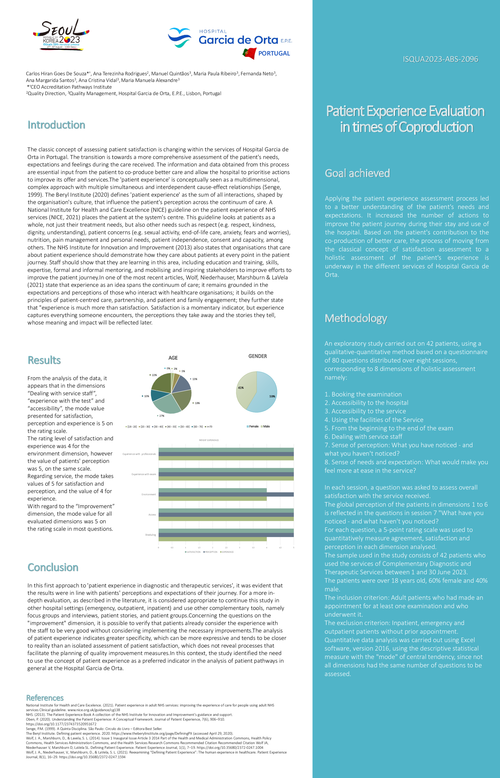
From the analysis of the data, it appears that in the dimensions “Dealing with service staff”, “experience with the test” and “accessibility”, the mode value presented for satisfaction, perception and experience is 5 on the rating scale.
The rating level of satisfaction and experience was 4 for the environment dimension, however the value of patients' perception was 5, on the same scale.
Regarding service, the mode takes values of 5 for satisfaction and perception, and the value of 4 for experience.
With regard to the “Improvement” dimension, the mode value for all evaluated dimensions was 5 on the rating scale in most questions
Conclusion
In this first approach to 'patient experience in diagnostic and therapeutic services', it was evident that the results were in line with patients' perceptions and expectations of their journey. For a more in-depth evaluation, as described in the literature, it is considered appropriate to continue this study in other hospital settings (emergency, outpatient, inpatient) and use other complementary tools, namely focus groups and interviews, patient stories, and patient groups.Concerning the questions on the "improvement" dimension, it is possible to verify that patients already consider the experience with the staff to be very good without considering implementing the necessary improvements.The analysis of patient experience indicates greater specificity, which can be more expressive and tends to be closer to reality than an isolated assessment of patient satisfaction, which does not reveal processes that facilitate the planning of quality improvement measures.In this context, the study identified the need to use the concept of patient experience as a preferred indicator in the analysis of patient pathways in general at the Hospital Garcia de Orta.
References
National Institute for Health and Care Excelence. (2021). Patient experience in adult NHS services: improving the experience of care for people using adult NHS services Clinical guideline. www.nice.org.uk/guidance/cg138
NHS. (2013). The Patient Experience Book A collection of the NHS Institute for Innovation and Improvement’s guidance and support.
Oben, P. (2020). Understanding the Patient Experience: A Conceptual Framework. Journal of Patient Experience, 7(6), 906–910. https://doi.org/10.1177/2374373520951672
Senge, P.M. (1999). A Quinta Disciplina. São Paulo: Circulo do Livro – Editora Best Seller.
The Beryl Institute. Defining patient experience. 2020. https://www.theberylinstitute.org/page/DefiningPX (accessed April 29, 2020).
Wolf, J. A., Marshburn, D., & Lavela, S. L. (2014). Issue 1 Inaugural Issue Article 3 2014 Part of the Health and Medical Administration Commons, Health Policy Commons, Health Services Administration Commons, and the Health Services Research Commons Recommended Citation Recommended Citation Wolf JA, Niederhauser V, Marshburn D, LaVela SL. Defining Patient Experience. Patient Experience Journal, 1(1), 7–19. https://doi.org/10.35680/2372-0247.1004
Wolf, J. A., Niederhauser, V., Marshburn, D., & LaVela, S. L. (2021). Reexamining “Defining Patient Experience”: The human experience in healthcare. Patient Experience Journal, 8(1), 16–29. https://doi.org/10.35680/2372-0247.1594