708 posters, 8 topics, 16 sessions, 1,190 authors, 600 institutions
ePostersLive by SciGen Technologies S.A. All rights reserved.
ISQua's 39th International Conference 2023
August 27 - 30, 2023 | Seoul, Republic of Korea

ISQUA2023-ABS-1617
PATIENT-CLINICIAN CO-CONSTRUCTION IN COMPULSORY COMMUNITY TREATMENT : GUIDELINES AND TOOLS
Poster Presenter
Authors
Affiliations
Part of Topic
Coproduction with staff and service users
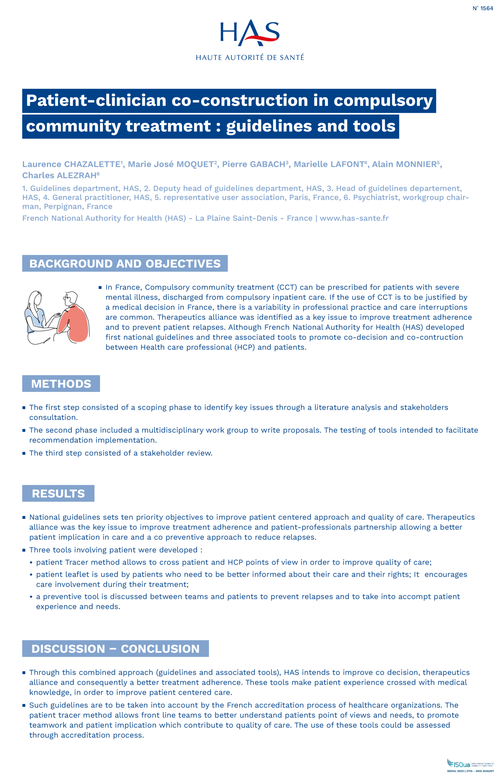
Patient-clinician co construction in compulsory community treatment : guidelines and tools
Background and objectives :
In France, Compulsory community treatment (CCT) can be prescribed for patients with severe mental illness, discharged from compulsory inpatient care. If the use of CCT is to be justified by a medical decision in France, there is a variability in professional practice and care interruptions are common. Therapeutics alliance was identified as a key issue to improve treatment adherence and to prevent patient relapses. Although French National Authority for Health (HAS) developed first national guidelines and three associated tools to promote co decision and cocontruction between Health care professional (HCP) and patients.
Method :
The first step consisted of a scoping phase to identify key issues through a literature analysis and stakeholders consultation.
The second phase included a multidisciplinary work group to write proposals. The testing of tools intended to facilitate recommendation implementation.
The third step consisted of a stakeholder review.
Results :
National guidelines sets ten priority objectives to improve patient centered approach and quality of care. Therapeutics alliance was the key issue to improve treatment adherence and patient-professionals partnership allowing a better patient implication in care and a co preventive approach to reduce relapses.
Three tools involving patient were developed :
-Patient Tracer method allows to cross patient and HCP points of view in order to improve quality of care.
-Patient leaflet is used by patients who need to be better informed about their care and their rights; It encourages care involvement during their treatment.
-A preventive tool is discussed between teams and patients to prevent relapses and to take into accompt patient experience and needs.
Discussion / conclusion :
Through this combined approach (guidelines and associated tools), HAS intends to improve co decision, therapeutics alliance and consequently a better treatment adherence. These tools make patient experience crossed with medical knowledge, in order to improve patient centered care.
Such guidelines are to be taken into account by the French accreditation process of healthcare organizations. The patient tracer method allows front line teams to better understand patients point of views and needs, to promote teamwork and patient implication which contribute to quality of care. The use of these tools could be assessed through accreditation process.