708 posters, 8 topics, 16 sessions, 1,190 authors, 600 institutions
ePostersLive by SciGen Technologies S.A. All rights reserved.
ISQua's 39th International Conference 2023
August 27 - 30, 2023 | Seoul, Republic of Korea

ISQUA2023-ABS-2133
HOW VALUE-DRIVEN CARE (VDC) IN SINGAPORE SUSTAINS COST OF CARE WITHOUT COMPROMISING ITS QUALITY?
Poster Presenter
Authors
Part of Topic
Coproduction with staff and service users
How Value-Driven Care (VDC) in Singapore sustains cost of care without compromising its quality?
WONG SW 1, KOK MF 1, BAI BR 1, NITI M 1,CHEN MX 1, LEE HP 1, MOK WY 1 and WU X1
1 Ministry of Health (MOH) Singapore, Singapore
Introduction
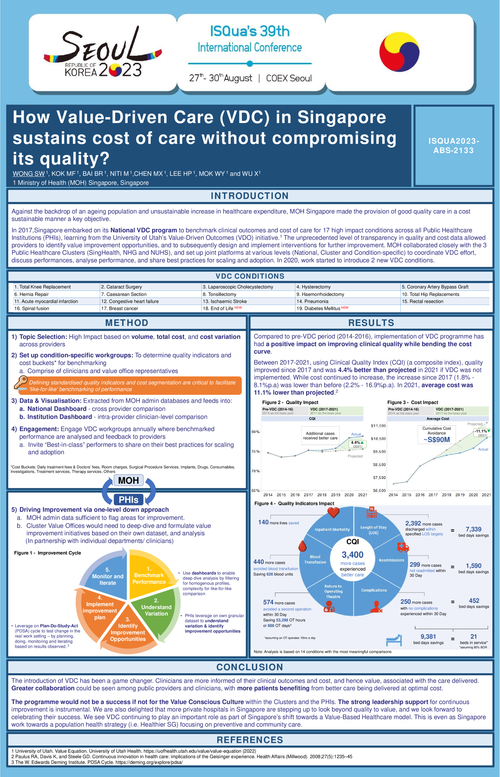
Against the backdrop of an ageing population and unsustainable increase in healthcare expenditure, MOH Singapore made the provision of good quality care in a cost sustainable manner a key objective.
In 2017,Singapore embarked on its National VDC program to benchmark clinical outcomes and cost of care for 17 high impact conditions across all Public Healthcare Institutions (PHIs), learning from the University of Utah’s Value-Driven Outcomes (VDO) initiative.1 The unprecedented level of transparency in quality and cost data allowed providers to identify value improvement opportunities, and to subsequently design and implement interventions for further improvement. MOH collaborated closely with the 3 Public Healthcare Clusters (SingHealth, NHG and NUHS), and set up joint platforms at various levels (National, Cluster and Condition-specific) to coordinate VDC effort, discuss performances, analyse performance, and share best practices for scaling and adoption. In 2020, work started to introduce 2 new VDC conditions.
Methods
*Cost Buckets: Daily treatment fees & Doctors’ fees, Room charges, Surgical Procedure Services, Implants, Drugs, Consumables, Investigations, Treatment services, Therapy services, Others
Compared to pre-VDC period (2014-2016), implementation of VDC programme has had a positive impact on improving clinical quality while bending the cost curve.
Between 2017-2021, using Clinical Quality Index (CQI) (a composite index), quality improved since 2017 and was 4.4% better than projected in 2021 if VDC was not implemented. While cost continued to increase, the increase since 2017 (1.8% - 8.1%p.a) was lower than before (2.2% - 16.9%p.a). In 2021, average cost was 11.1% lower than projected.2
Conclusion
The introduction of VDC has been a game changer. Clinicians are more informed of their clinical outcomes and cost, and hence value, associated with the care delivered. Greater collaboration could be seen among public providers and clinicians, with more patients benefiting from better care being delivered at optimal cost.
The programme would not be a success if not for the Value Conscious Culture within the Clusters and the PHIs. The strong leadership support for continuous improvement is instrumental. We are also delighted that more private hospitals in Singapore are stepping up to look beyond quality to value, and we look forward to celebrating their success. We see VDC continuing to play an important role as part of Singapore’s shift towards a Value-Based Healthcare model. This is even as Singapore work towards a population health strategy (i.e. Healthier SG) focusing on preventive and community care.