708 posters, 8 topics, 16 sessions, 1,190 authors, 600 institutions
ePostersLive by SciGen Technologies S.A. All rights reserved.
ISQua's 39th International Conference 2023
August 27 - 30, 2023 | Seoul, Republic of Korea

ISQUA2023-ABS-1955
IMPACT OF THE COVID-19 PANDEMIC ON HEALTH CARE DELIVERY AND THE NEED TO CO-DESIGN WITH THE CLINICAL CARE TEAM
Poster Presenter
Authors
Affiliations
Part of Topic
Coproduction with staff and service users
IMPACT OF THE COVID-19 PANDEMIC ON HEALTH CARE DELIVERY AND THE NEED TO CO-DESIGN WITH THE CLINICAL CARE TEAM
Nancy Koh, PhD; Robin Wagner RN, MHSA; Robin C. Newton, MD; Kevin B. Weiss, MD
Accreditation Council for Graduate Medical Education, Chicago, United States
INTRODUCTION
The Accreditation Council for Graduate Medical Education (ACGME) accredits all postgraduate medical education programs for physicians in the US. The ACGME’s Clinical Learning Environment Review (CLER) Program conducts periodic site visits to the hospitals and other clinical sites that serve as clinical learning environments (CLEs) for more than 150,000 resident physicians. Between October 2020-April 2022, the CLER Program conducted a special assessment to understand the impact of the COVID-19 pandemic on CLEs. Several key themes emerged speaking to opportunities for optimizing patient care and physician training as CLEs look to the future, including engaging clinical care team members to innovate and problem solve changes in health care delivery.
METHODS
For the special assessment, the CLER Program conducted remote site visits to a stratified random sample of 287 CLEs. The site visits included group interviews with (1) executive leaders, (2) patient safety/quality leaders, (3) resident physicians, and (4) program directors. All visits were conducted using a structured questionnaire that included closed- and open-ended questions. Resident and program director responses to closed-ended questions were aggregated as percentages for each CLE and presented as median and interquartile range (IQR). Analysis of the findings also included a series of group discussions with CLER site visitors to gain an in-depth understanding of the key findings and discern common themes. This qualitative approach to analysis was inductive in that the findings and themes emerged from the content of the responses.
RESULTS
In many CLEs, there were changes in patient care processes (eg., increased ambulatory-based procedural care, enhanced home-based services) resulting from the pandemic that led to both efficiencies and deficiencies in delivering patient care. These changes were anticipated to continuously evolve.
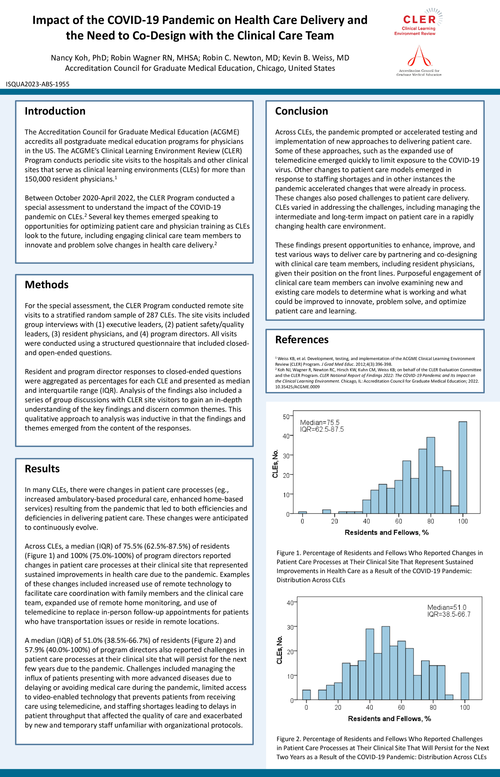
Across CLEs, a median (IQR) of 75.5% (62.5%-87.5%) of residents (Figure 1) and 100% (75.0%-100%) of program directors reported changes in patient care processes at their clinical site that represented sustained improvements in health care due to the pandemic. Examples of these changes included increased use of remote technology to facilitate care coordination with family members and the clinical care team, expanded use of remote home monitoring, and use of telemedicine to replace in-person follow-up appointments for patients who have transportation issues or reside in remote locations.
A median (IQR) of 51.0% (38.5%-66.7%) of residents (Figure 2) and 57.9% (40.0%-100%) of program directors also reported challenges in patient care processes at their clinical site that will persist for the next few years due to the pandemic. Challenges included managing the influx of patients presenting with more advanced diseases due to delaying or avoiding medical care during the pandemic, limited access to video-enabled technology that prevents patients from receiving care using telemedicine, and staffing shortages leading to delays in patient throughput that affected the quality of care and exacerbated by new and temporary staff unfamiliar with organizational protocols.
CONCLUSION
Across CLEs, the pandemic prompted or accelerated testing and implementation of new approaches to delivering patient care. Some of these approaches, such as the expanded use of telemedicine emerged quickly to limit exposure to the COVID-19 virus. Other changes to patient care models emerged in response to staffing shortages and in other instances the pandemic accelerated changes that were already in process. These changes also posed challenges to patient care delivery. CLEs varied in addressing the challenges, including managing the intermediate and long-term impact on patient care in a rapidly changing health care environment.
These findings present opportunities to enhance, improve, and test various ways to deliver care by partnering and co-designing with clinical care team members, including resident physicians, given their position on the front lines. Purposeful engagement of clinical care team members can involve examining new and existing care models to determine what is working and what could be improved to innovate, problem solve, and optimize patient care and learning.