708 posters, 8 topics, 16 sessions, 1,190 authors, 600 institutions
ePostersLive by SciGen Technologies S.A. All rights reserved.
ISQua's 39th International Conference 2023
August 27 - 30, 2023 | Seoul, Republic of Korea

P601
PATIENT EVALUATION OF REGIONAL-LEVEL HEALTHCARE QUALITY AFFECTS OUTMIGRATION: AN AGENT-BASED SIMULATION
Part of Topic
Coproduction with staff and service users
INTRODUCTION
•Patients’ decision-making and hospital choice reflect perception of the quality of their region’s health system, well beyond objective measures of quality and structural capacity.
•Outmigration, a characteristic phenomenon of the South Korean health system, occurs when patients in provincial areas bypass local hospitals and travel to Seoul in the hopes of receiving better treatment.
•Outmigration not only puts a heavy strain on the health system in the capital area but also deprives other regions of further opportunities to develop a high-quality regional healthcare system.
•To better understand the mechanism of outmigration, there is a need to analyze the perceived quality of the regional healthcare system from each patient’s perspective and at a population level.
AIM
•Adopting a complex systems approach, we constructed an agent-based model (ABM) of outmigration and performed policy simulations.
•We aimed to examine how outmigration is affected by changes in different aspects of quality.
METHOD
•We designed a virtual health system in which 1,000 individuals choose hospitals based on utility, which is updated based on interactions:
(1) Direct interaction: between individuals within a network, through direct transmission of words
(2) Indirect interaction: arising from common values within a certain society (i.e. neighborhood)
(3) Experience-based interaction: reflecting each individual’s past experience
(1) Direct interaction: between individuals within a network, through direct transmission of words
(2) Indirect interaction: arising from common values within a certain society (i.e. neighborhood)
(3) Experience-based interaction: reflecting each individual’s past experience
•Simulation software: NetLogo 6.0.4.
•Initial parameters were set empirically.
RESULTS
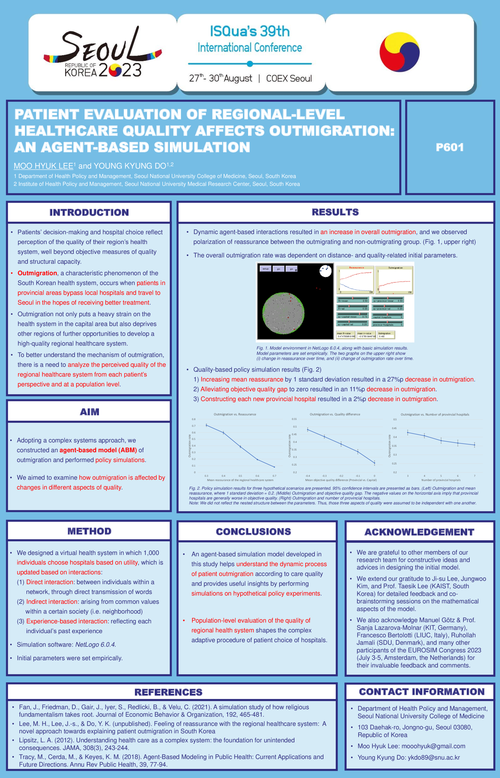
•Dynamic agent-based interactions resulted in an increase in overall outmigration, and we observed polarization of reassurance between the outmigrating and non-outmigrating group. (Fig. 1, upper right)
•The overall outmigration rate was dependent on distance- and quality-related initial parameters.
•Quality-based policy simulation results (Fig. 2)
1) Increasing mean reassurance by 1 standard deviation resulted in a 27%p decrease in outmigration.
2) Alleviating objective quality gap to zero resulted in an 11%p decrease in outmigration.
3) Constructing each new provincial hospital resulted in a 2%p decrease in outmigration.
1) Increasing mean reassurance by 1 standard deviation resulted in a 27%p decrease in outmigration.
2) Alleviating objective quality gap to zero resulted in an 11%p decrease in outmigration.
3) Constructing each new provincial hospital resulted in a 2%p decrease in outmigration.
CONCLUSIONS
•An agent-based simulation model developed in this study helps understand the dynamic process of patient outmigration according to care quality and provides useful insights by performing simulations on hypothetical policy experiments.
•Population-level evaluation of the quality of regional health system shapes the complex adaptive procedure of patient choice of hospitals.
ACKNOWLEDGEMENT
•We are grateful to other members of our research team for constructive ideas and advices in designing the initial model.
•We extend our gratitude to Ji-su Lee, Jungwoo Kim, and Prof. Taesik Lee (KAIST, South Korea) for detailed feedback and co-brainstorming sessions on the mathematical aspects of the model.
•We also acknowledge Manuel Götz & Prof. Sanja Lazarova-Molnar (KIT, Germany), Francesco Bertolotti (LIUC, Italy), Ruhollah Jamali (SDU, Denmark), and many other participants of the EUROSIM Congress 2023 (July 3-5, Amsterdam, the Netherlands) for their invaluable feedback and comments.
REFERENCES
•Fan, J., Friedman, D., Gair, J., Iyer, S., Redlicki, B., & Velu, C. (2021). A simulation study of how religious fundamentalism takes root. Journal of Economic Behavior & Organization, 192, 465-481.
•Lee, M. H., Lee, J.-s., & Do, Y. K. (unpublished). Feeling of reassurance with the regional healthcare system: A novel approach towards explaining patient outmigration in South Korea
•Lipsitz, L. A. (2012). Understanding health care as a complex system: the foundation for unintended consequences. JAMA, 308(3), 243-244.
•Tracy, M., Cerda, M., & Keyes, K. M. (2018). Agent-Based Modeling in Public Health: Current Applications and Future Directions. Annu Rev Public Health, 39, 77-94.