708 posters, 8 topics, 16 sessions, 1,190 authors, 600 institutions
ePostersLive by SciGen Technologies S.A. All rights reserved.
ISQua's 39th International Conference 2023
August 27 - 30, 2023 | Seoul, Republic of Korea

P588
IDENTIFYING THE CARE PATHWAY FOR YOUNG CHILDREN WITH HEMOPHILIA AT TWO HEMOPHILIA TREATMENT CENTERS IN THE NETHERLANDS
Poster Presenter
Part of Topic
Coproduction with staff and service users
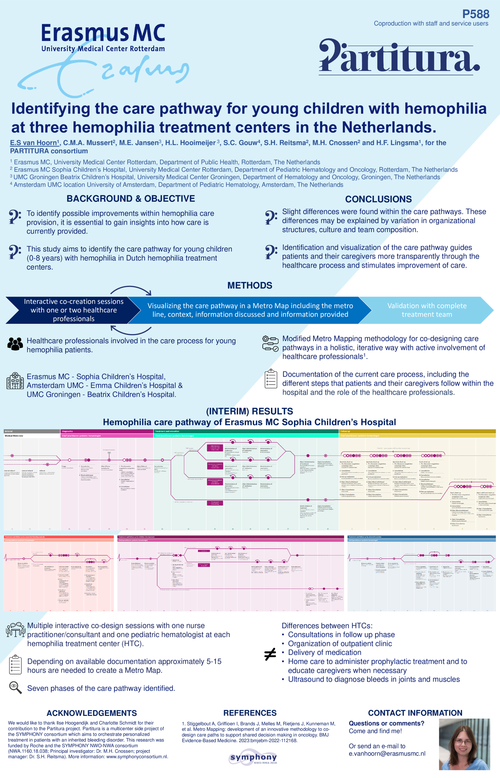
Identifying the care pathway for young children with hemophilia at three hemophilia treatment centers in the Netherlands.
Background and objective: To identify possible improvements within hemophilia care provision, it is essential to gain insights into how care is currently provided. This study aims to identify the care pathway for young children (0-8 years) with hemophilia in Dutch hemophilia treatment centers.
Methods: We used a modified Metro Mapping methodology for co-designing care pathways in a holistic, iterative way with active involvement of healthcare professionals. Healthcare professionals involved in the care process for young hemophilia patients at the hemophilia treatment centers Erasmus MC - Sophia Children’s Hospital, Amsterdam UMC - Emma Children’s Hospital & UMC Groningen - Beatrix Children’s Hospital participated in the interactive co-designing sessions. Documentation of the current care process, including the different steps that patients and their caregivers follow within the hospital and the role of the healthcare professionals was used to create the first version of the care pathway.
(Interim) results: Multiple interactive co-design sessions with one nurse practitioner/consultant and one pediatric hematologist at each hemophilia treatment center (HTC) were held. Depending on available documentation approximately 5-15 hours are needed to create a Metro Map. Seven phases of the care pathway identified. Differences between HTCs: 1) Consultations in follow up phase, 2) Organization of outpatient clinic, 3) Delivery of medication, 4) Home care to administer prophylactic treatment and to educate caregivers when necessary, and 5) Ultrasound to diagnose bleeds in joints and muscles.
Conclusions: Slight differences were found within the care pathways. These differences may be explained by variation in organizational structures, culture and team composition. Identification and visualization of the care pathway guides patients and their caregivers more transparently through the healthcare process and stimulates improvement of care.