708 posters, 8 topics, 16 sessions, 1,190 authors, 600 institutions
ePostersLive by SciGen Technologies S.A. All rights reserved.
ISQua's 39th International Conference 2023
August 27 - 30, 2023 | Seoul, Republic of Korea

P580
INNOVATIVE MODELS OF CARE FOR NEWLY DIAGNOSED TYPE 1 DIABETES: A SYSTEMATIC REVIEW OF THE EVIDENCE
Poster Presenter
Authors
Ann Carrigan, Genevieve Dammery, Nehal Singh, Rebecca Lake, Isabelle Meulenbroeks, Mitchell Sarkies, Nicole Halim, Elizabeth Davis, Timothy Jones, Jeffrey Braithwaite, Yvonne Zurynski
Affiliations
Macquarie University, Macquarie University; Partnership Centre for Health System Sustainability, Telethon Kids Institute, Western Australia; Perth Children’s Hospital, Perth, Western Australia., Telethon Kids Institute, Western Australia; 5 Perth Children’s Hospital, Perth, Western Australia.
Part of Topic
Coproduction with staff and service users
Models of care for children newly diagnosed with Type 1 Diabetes: A systematic review.
Ann Carrigan1, Genevieve Dammery1, Nehal Singh1, Rebecca Lake1, Isabelle Meulenbroeks3, Mitchell Sarkies1, Nicole Halim1,2,
Elizabeth Davis4,5, Timothy W Jones4,5, Jeffrey Braithwaite1 & Yvonne Zurynski1,2.
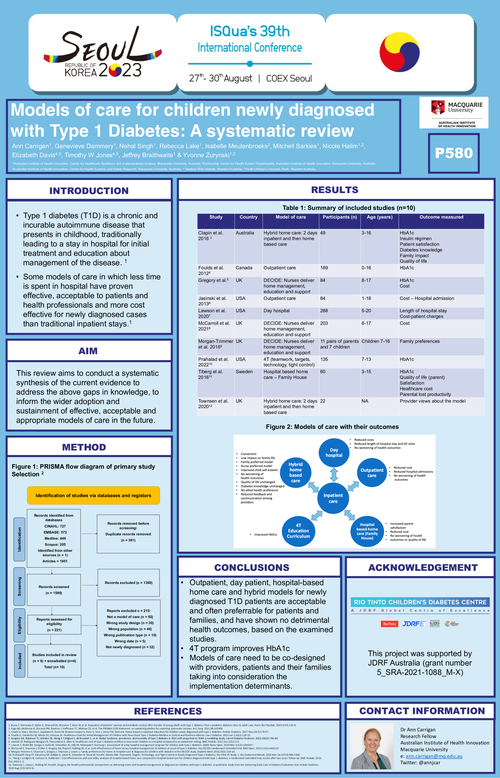
Type 1 diabetes (T1D) is a chronic and incurable autoimmune disease that presents in childhood, traditionally leading to a stay in hospital for initial treatment and education about management of the disease. Some models of care in which less time is spent in hospital have proven effective, acceptable to patients and health professionals and more cost effective for newly diagnosed cases than traditional inpatient stays.
This review aims to conduct a systematic synthesis of the current evidence to address the above gaps in knowledge, to inform the wider adoption and sustainment of effective, acceptable and appropriate models of care in the future.
Records identified from databases
CINAHL: 727
EMBASE: 572
Medline: 446
Scopus: 205
Identified from other sources (n = 1)
Articles = 1951
Studies included in review (n = 6) + snowballed (n=4) Total (n= 10).
Outpatient, day patient, hospital-based home care and hybrid models for newly diagnosed T1D patients are acceptable and often preferrable for patients and families, and have shown no detrimental health outcomes, based on the examined studies. 4T program improves HbA1c.
Models of care need to be co-designed with providers, patients and their families taking into consideration the implementation determinants.