477 posters, 14 topics, 2,052 authors, 1,056 institutions
ePostersLive by SciGen Technologies S.A. All rights reserved.
The Joint EBJIS-MSIS 2026 Conference
17 - 19 September, 2026 | Porto, Portugal
PP33
Comparing microbes detected by culture, next-generation sequencing, multiplex PCR, and antigen immunoassay in matched synovial fluid testing
Poster Presenter
Authors
Craig Tipton, Andrew Bennett, Jacob Ancira, Caleb Phillips, Edward McPherson
Affiliations
Microgen Dx, Lubbock, United States, Microgen Dx, Lubbock, United States; Texas Tech University, Lubbock, United States, Texas Tech University, Lubbock, United States, University of California Los Angeles, Los Angeles, United States, Microgen Dx
Part of Topic
Microbiology
Introduction:
•Identifying an organism preoperatively provides clarity in treatment.
•Multiple testing strategies are now commonly used for characterizing microbes, but limited data exist to understand their comparability and reliability [1-3].
Primary Objectives:
a)Compare detection rates of microbes by 4 common microbial testing strategies
b)Evaluate the concordance of each test for mutually detectable microbes.
c)Quantify species-level accuracy of NGS against culture-positive cohort.
Methods:
•Retrospective diagnostic comparison of hip and knee synovial fluid aspirations performed by single surgeon split for parallel testing by two commercial labs.
•PJI classified based modified ICM-2018 Shohat definition [4], using synovial WBC (3 pts), PMN% (2 pts), CRP (1 pt), α-defensin (3 pts), and positive culture or NGS (2 pts).
•Description of microbial testing strategies used:
–NGS (16S+ITS): V1-V2 16S rRNA gene for bacteria and ITS3-4 sequencing for fungi [1,5]
–Multiplex PCR (mPCR): Limited qPCR series provided as part of NGS panel, targeting 8 organisms: Enterococcus faecalis, Streptococcus pyogenes, Cutibacterium acnes, Klebsiella pneumoniae, Pseudomonas aeruginosa, Streptococcus agalactiae, Staphylococcus aureus, and Candida albicans.
–(Fluid) culture: Aerobic and anaerobic culture incubated for 7-14 days.
–Antigen immunoassay: 4 targets; Staphylococcus sp, C. acnes, Enterococcus sp., and Candida sp.. [2-3]
•Microbial composite reference: The reference was defined as detection of a common microbe by two or more independent testing methods.
•Concordance was assessed through detection rates, percent agreement, cohen’s Kappa, and McNemar testing.
•To evaluate performance of species-level reporting, NGS was compared to culture results by sensitivity, specificity, and accuracy.
Key Result #1: NGS and Antigen Immunoassay Improve Pre-Op Sensitivity for PJI Compared to Conventional Tests, but with Varying Trade-offs in Decreasing Specificity (Table 1)
- Antigen sensitivity highest (73%), followed by NGS (51%), culture (29%) and mPCR (10%)
- Antigen specificity lowest (91%), followed by NGS (94%), culture (97%), and mPCR (99%)
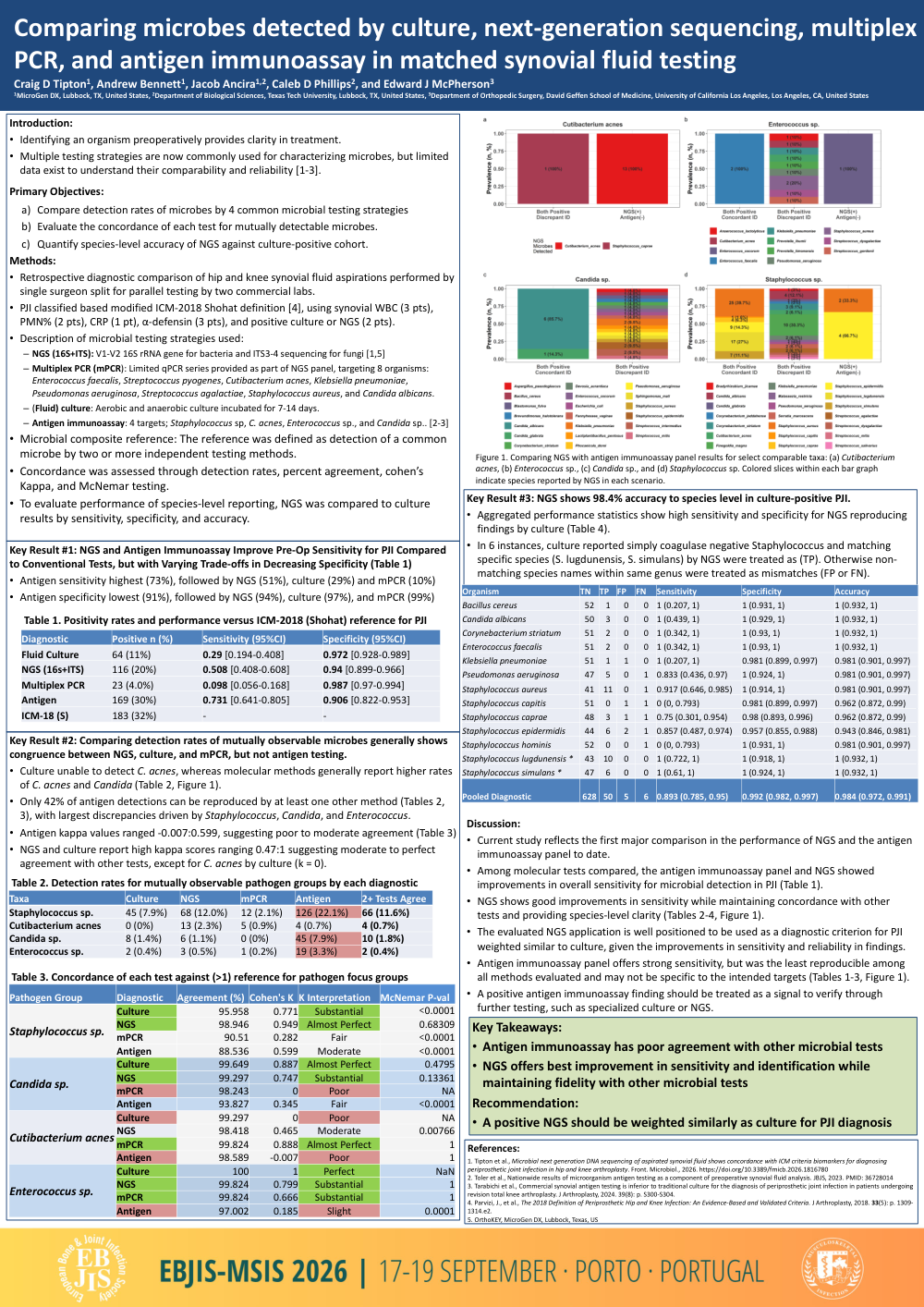
Key Result #2: Comparing detection rates of mutually observable microbes generally shows congruence between NGS, culture, and mPCR, but not antigen testing.
Culture unable to detect C. acnes, whereas molecular methods generally report higher rates of C. acnes and Candida (Table 2, Figure 1).
Only 42% of antigen detections can be reproduced by at least one other method (Tables 2, 3), with largest discrepancies driven by Staphylococcus, Candida, and Enterococcus.
Antigen kappa values ranged -0.007:0.599, suggesting poor to moderate agreement (Table 3)
NGS and culture report high kappa scores ranging 0.47:1 suggesting moderate to perfect agreement with other tests, except for C. acnes by culture (k = 0).
Key Result #3: NGS shows 98.4% accuracy to species level in culture-positive PJI.
Aggregated performance statistics show high sensitivity and specificity for NGS reproducing findings by culture (Table 4).
In 6 instances, culture reported simply coagulase negative Staphylococcus and matching specific species (S. lugdunensis, S. simulans) by NGS were treated as (TP). Otherwise non-matching species names within same genus were treated as mismatches (FP or FN).
Discussion:
Current study reflects the first major comparison in the performance of NGS and the antigen immunoassay panel to date.
Among molecular tests compared, the antigen immunoassay panel and NGS showed improvements in overall sensitivity for microbial detection in PJI (Table 1).
NGS shows good improvements in sensitivity while maintaining concordance with other tests and providing species-level clarity (Tables 2-4, Figure 1).
The evaluated NGS application is well positioned to be used as a diagnostic criterion for PJI weighted similar to culture, given the improvements in sensitivity and reliability in findings.
Antigen immunoassay panel offers strong sensitivity, but was the least reproducible among all methods evaluated and may not be specific to the intended targets (Tables 1-3, Figure 1).
A positive antigen immunoassay finding should be treated as a signal to verify through further testing, such as specialized culture or NGS.
Key Takeaways:
- Antigen immunoassay has poor agreement with other microbial tests
- NGS offers best improvement in sensitivity and identification while maintaining fidelity with other microbial tests
Recommendation:
- A positive NGS should be weighted similarly as culture for PJI diagnosis
References:
1. Tipton et al., Microbial next generation DNA sequencing of aspirated synovial fluid shows concordance with ICM criteria biomarkers for diagnosing periprosthetic joint infection in hip and knee arthroplasty. Front. Microbiol., 2026. https://doi.org/10.3389/fmicb.2026.1816780
2. Toler et al., Nationwide results of microorganism antigen testing as a component of preoperative synovial fluid analysis. JBJS, 2023. PMID: 36728014
3. Tarabichi et al., Commercial synovial antigen testing is inferior to traditional culture for the diagnosis of periprosthetic joint infection in patients undergoing revision total knee arthroplasty. J Arthroplasty, 2024. 39(8): p. S300-S304.
4. Parvizi, J., et al., The 2018 Definition of Periprosthetic Hip and Knee Infection: An Evidence-Based and Validated Criteria. J Arthroplasty, 2018. 33(5): p. 1309-1314.e2.
5. OrthoKEY, MicroGen DX, Lubbock, Texas, US