477 posters, 14 topics, 2,065 authors, 1,055 institutions
ePostersLive by SciGen Technologies S.A. All rights reserved.
The Joint EBJIS-MSIS 2026 Conference
17 - 19 September, 2026 | Porto, Portugal

EP174
Development Of Infections Caused By Pseudomonas Aeruginosa After Endoprosthetics And Monitoring The Rate Of Increase In It Is Antibiotic Resistance
Poster Presenter
Authors
Nataliay Pliska, Serik Balgazarov, Zhanatai Ramazanov, Ruslan Abilov, Artyom Moroshan, Alexandr Kriklivyy
Affiliations
National scientific center of traumatology and orthopedics named after academician N.D.Batpenov, Astana, Kazakhstan, National scientific center of traumatology and orthopedics named after academician N.D.Batpenov
Part of Topic
Microbiology
Introduction & Aim: The latest surgical approaches in traumatology and orthopedics rely heavily on implants. According to global data, 3–4% of primary arthroplasties are complicated by periprosthetic infection, while in revision arthroplasty this rate may reach 40%. The growing number of implant surgeries is accompanied by an increase in related complications. Chronic infection can cause systemic damage, leading to sepsis and death. Infections after large joint arthroplasty are especially important because of their major social and economic impact on working-age patients. Periprosthetic infection is most often caused by staphylococci and less commonly by gram-negative bacteria; treatment is challenging because of frequent antibiotic resistance. One of the most problematic pathogens is Pseudomonas aeruginosa, which is highly resistant in the environment, colonizes human skin and mucous membranes, and accounts for up to 20% of nosocomial infections. Over time, it is microcolonies can merge and form a biofilm. The aim of the study was to assess the dynamics and resistance of Pseudomonas aeruginosa in periprosthetic joint infection in order to optimize therapy.
Methods: The study included fistula tracts, synovial fluid samples, and intraoperative biopsies from patients with periprosthetic joint infections obtained during revision surgeries. The biological material was thoroughly examined using a special bacteriological method using sonication.
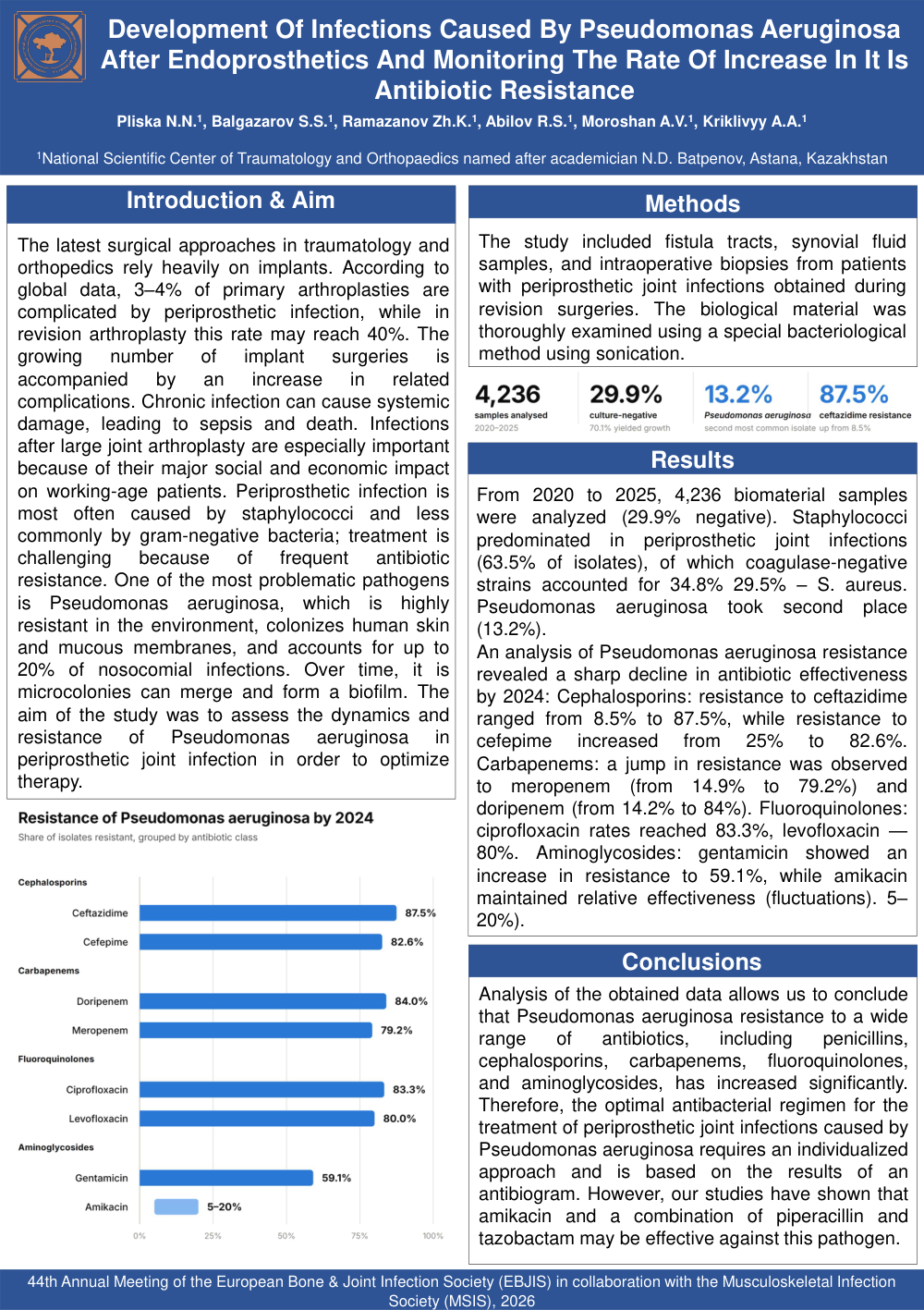
Results: From 2020 to 2025, 4,236 biomaterial samples were analyzed (29.9% negative). Staphylococci predominated in periprosthetic joint infections (63.5% of isolates), of which coagulase-negative strains accounted for 34.8% 29.5% – S. aureus. Pseudomonas aeruginosa took second place (13.2%).
An analysis of Pseudomonas aeruginosa resistance revealed a sharp decline in antibiotic effectiveness by 2024: Cephalosporins: resistance to ceftazidime ranged from 8.5% to 87.5%, while resistance to cefepime increased from 25% to 82.6%. Carbapenems: a jump in resistance was observed to meropenem (from 14.9% to 79.2%) and doripenem (from 14.2% to 84%). Fluoroquinolones: ciprofloxacin rates reached 83.3%, levofloxacin — 80%. Aminoglycosides: gentamicin showed an increase in resistance to 59.1%, while amikacin maintained relative effectiveness (fluctuations). 5–20%).
Conclusions: Analysis of the obtained data allows us to conclude that Pseudomonas aeruginosa resistance to a wide range of antibiotics, including penicillins, cephalosporins, carbapenems, fluoroquinolones, and aminoglycosides, has increased significantly. Therefore, the optimal antibacterial regimen for the treatment of periprosthetic joint infections caused by Pseudomonas aeruginosa requires an individualized approach and is based on the results of an antibiogram. However, our studies have shown that amikacin and a combination of piperacillin and tazobactam may be effective against this pathogen.