477 posters, 14 topics, 2,065 authors, 1,055 institutions
ePostersLive by SciGen Technologies S.A. All rights reserved.
The Joint EBJIS-MSIS 2026 Conference
17 - 19 September, 2026 | Porto, Portugal

EP175
A novel Iodine implant surface treatment demonstrates excellent antimicrobial efficacy in vitro that is not affected by serum protein concentration
Part of Topic
Microbiology
Background: Periprosthetic Joint Infection (PJI) remains one of the most common causes of revision, and a challenging complication of Total Joint Arthroplasty (TJA). The high volume of TJA procedures performed annually results in a substantial number of affected patients, contributing to a rising demand for revision surgeries1. The risk of re-infection following a revision due to infection is about 18%2. Notably, the mortality rate associated with PJI exceeds that of breast, melanoma, and prostate cancers3. Iodine is a well-known antimicrobial that is widely used in clinical practice for the management of PJI. Iodine-treated joint replacement devices are designed to reduce microbial adhesion to the device surface and may therefore contribute to infection risk management.
Objectives: This study aimed at assessing the in vitro antimicrobial efficacy of a novel Iodine implant surface treatment against bacteria and fungi. The effect of serum protein concentration within the growth medium was also assessed.
Materials and Methods:
Samples: Ti6Al4V discs (Ø20 mm x 6 mm) coated with Porous Plasma Spray (PPS) on one side were used in this study as representative of cementless joint replacement surfaces. All discs received the Iodine surface treatment, which is an electrochemical process developed from the work of Takaya et al4. Non-Iodine-treated discs were used as controls.
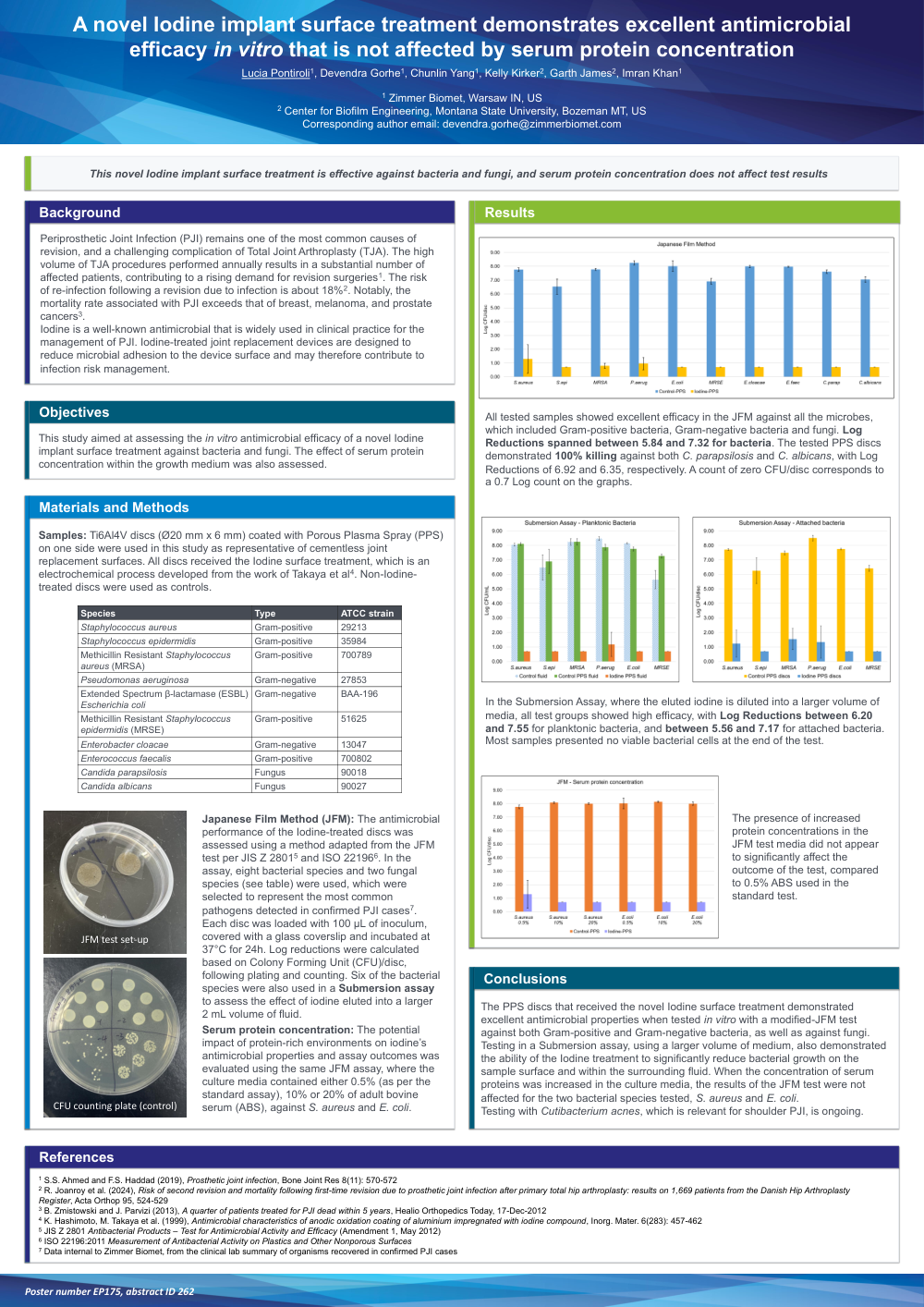
Japanese Film Method (JFM): The antimicrobial performance of the Iodine-treated discs was assessed using a method adapted from the JFM test per JIS Z 28015 and ISO 221966. In the assay, eight bacterial species and two fungal species (see table) were used, which were selected to represent the most common pathogens detected in confirmed PJI cases7. Each disc was loaded with 100 μL of inoculum, covered with a glass coverslip and incubated at 37°C for 24h. Log reductions were calculated based on Colony Forming Unit (CFU)/disc, following plating and counting. Six of the bacterial species were also used in a Submersion assay to assess the effect of iodine eluted into a larger 2 mL volume of fluid.
Serum protein concentration: The potential impact of protein-rich environments on iodine’s antimicrobial properties and assay outcomes was evaluated using the same JFM assay, where the culture media contained either 0.5% (as per the standard assay), 10% or 20% of adult bovine serum (ABS), against S. aureus and E. coli.
Results:
All tested samples showed excellent efficacy in the JFM against all the microbes, which included Gram-positive bacteria, Gram-negative bacteria and fungi. Log Reductions spanned between 5.84 and 7.32 for bacteria. The tested PPS discs demonstrated 100% killing against both C. parapsilosis and C. albicans, with Log Reductions of 6.92 and 6.35, respectively. A count of zero CFU/disc corresponds to a 0.7 Log count on the graphs.
In the Submersion Assay, where the eluted iodine is diluted into a larger volume of media, all test groups showed high efficacy, with Log Reductions between 6.20 and 7.55 for planktonic bacteria, and between 5.56 and 7.17 for attached bacteria. Most samples presented no viable bacterial cells at the end of the test.
The presence of increased protein concentrations in the JFM test media did not appear to significantly affect the outcome of the test, compared to 0.5% ABS used in the standard test.
Conclusions: The PPS discs that received the novel Iodine surface treatment demonstrated excellent antimicrobial properties when tested in vitro with a modified-JFM test against both Gram-positive and Gram-negative bacteria, as well as against fungi. Testing in a Submersion assay, using a larger volume of medium, also demonstrated the ability of the Iodine treatment to significantly reduce bacterial growth on the sample surface and within the surrounding fluid. When the concentration of serum proteins was increased in the culture media, the results of the JFM test were not affected for the two bacterial species tested, S. aureus and E. coli. Testing with Cutibacterium acnes, which is relevant for shoulder PJI, is ongoing.