477 posters, 14 topics, 2,065 authors, 1,055 institutions
ePostersLive by SciGen Technologies S.A. All rights reserved.
The Joint EBJIS-MSIS 2026 Conference
17 - 19 September, 2026 | Porto, Portugal

EP176
Antibacterial Efficacy of Antibiotic Loaded Calcium Sulfate Beads Against Staphylococcus aureus Biofilms on Different Orthopaedic Implant Surfaces
Part of Topic
Microbiology
Antibacterial efficacy of antibiotic loaded calcium sulfate beads against Staphylococcus aureus biofilms on different orthopedic implant surfaces
Aim:
To evaluate the antibacterial efficacy of antibiotic-loaded calcium sulfate beads containing two antibiotics combinations against early and mature S. aureus biofilms formed on titanium (Ti), stainless steel (316L), and polyethylene (PE) surfaces.
Introduction:
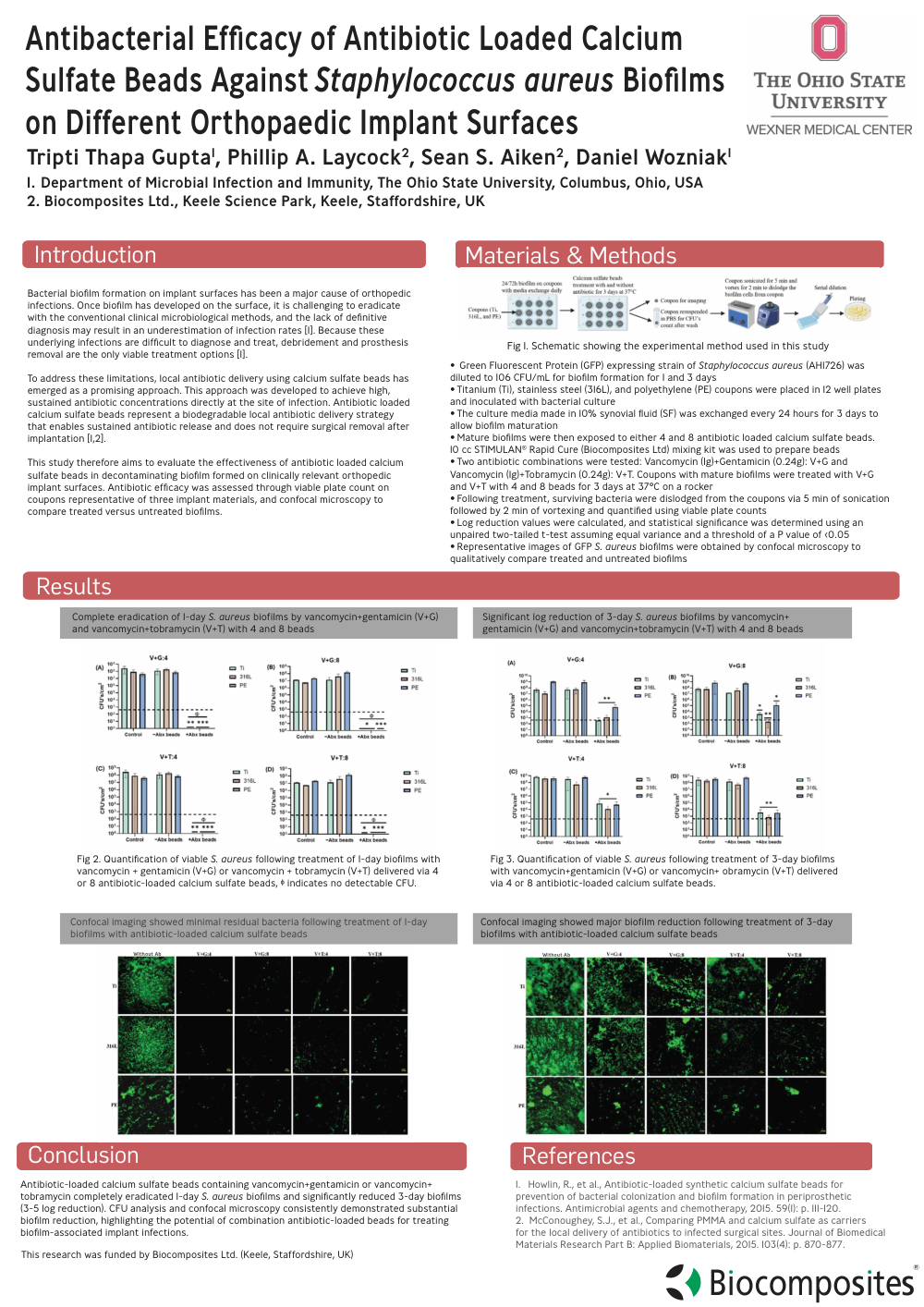
Bacterial biofilm formation on implant surfaces has been a major cause of orthopedic infections and is difficult to eradicate with conventional clinical treatments. Once established, biofilms can lead to persistent infections that often require surgical debridement or prosthesis removal. Local antibiotic delivery using calcium sulfate beads has emerged as a promising strategy to address this challenge. This study evaluated the effectiveness of antibiotic-loaded calcium sulfate beads in decontaminating Staphylococcus aureus biofilms on clinically relevant orthopedic implant surfaces. Antibacterial efficacy was assessed using viable plate counts and confocal microscopy to compare treated and untreated biofilms.
Methods:
GFP expressing strain of S. aureus (AH1726) was diluted to 106 CFU/mL and used to form 1 and 3-day biofilms on Ti, 316L, and PE coupons in 12 well plates at 37°C on a rocker. Biofilms were grown in 10% synovial fluid with media changes every 24 h for 3 days for 3-day biofilms. Biofilms were then treated for 3 days with 4 and 8 antibiotic-loaded sulfate beads loaded with Vancomycin (1g) plus either gentamicin (0.24 g; V+G) or tobramycin (0.24 g; V+T). After treatment, surviving bacteria were dislodged from the coupons by 5 minutes of sonication followed by 2 minutes of vortexing and quantified using viable plate counts. Log reduction values were calculated, and statistical significance was determined using an unpaired t-test. Representative images of GFP S. aureus biofilms were obtained by confocal microscopy to qualitatively compare treated and untreated biofilms.
Results:
Antibiotic-loaded V+G and V+T calcium sulfate beads completely eradicated 1-day S. aureus biofilms when treated with 4 or 8 beads. In contrast, treatment of more mature 3-day biofilms resulted in significant reduction of biofilm achieving 3-5 log decreases in bacterial counts. This effect was consistent across all tested implant materials.
Conclusions:
Antibiotic-loaded calcium sulfate beads containing V+G and V+T completely eradicated 1-day S. aureus biofilms and significantly reduced 3-day biofilms. CFU analysis and confocal microscopy consistently demonstrated substantial biofilm reduction, highlighting the potential of combination antibiotic-loaded beads for treating biofilm-associated implant infections.
Acknowledgmenets:
This research was funded by Biocomposites Ltd. (Keele, Staffordshire, UK)
* Stimulan Rapid Cure, Biocomposites Ltd.