477 posters, 14 topics, 2,065 authors, 1,055 institutions
ePostersLive by SciGen Technologies S.A. All rights reserved.
The Joint EBJIS-MSIS 2026 Conference
17 - 19 September, 2026 | Porto, Portugal

EP173
Analysis Of Risk Factors For Periprosthetic Joint Infection: Age, Gender, And Etiology
Poster Presenter
Authors
Pliska Natalya, Serik Balgazarov, Zhanatai Ramazanov, Ruslan Abilov, Artyom Moroshan, Alexandr Kriklivyy
Affiliations
National scientific center of traumatology and orthopedics named after academician N.D.Batpenov, Astana, Kazakhstan, National scientific center of traumatology and orthopedics named after academician N.D.Batpenov
Part of Topic
Microbiology
Introduction & Aim: Arthroplasty is effective treatments for injuries and orthopedic disorders. Although joint arthroplasty is now a standard procedure in specialized clinics and generally provides excellent outcomes, the growing rate of complications underscores the need for effective prevention. Periprosthetic infection is becoming an increasingly important issue in orthopedics due to the rising number of joint replacement surgeries worldwide and in Kazakhstan. Its persistently high incidence is associated with multiple factors, including implant materials, patient sex, surgical conditions, comorbidities, and the characteristics of pathogenic microflora. Additional contributors include delayed treatment of concomitant diseases, age-related growth in comorbidity burden, lifestyle-related differences, and harmful habits.
The study focused on the age and gender characteristics of patients with periprosthetic joint infections in Kazakhstan.
Methods: Data from patients with suspected periprosthetic joint infection was collected over a six-year study period. Biomaterial was analyzed using a special method for detecting periprosthetic joint infections and was subjected to quantitative bacteriological testing.
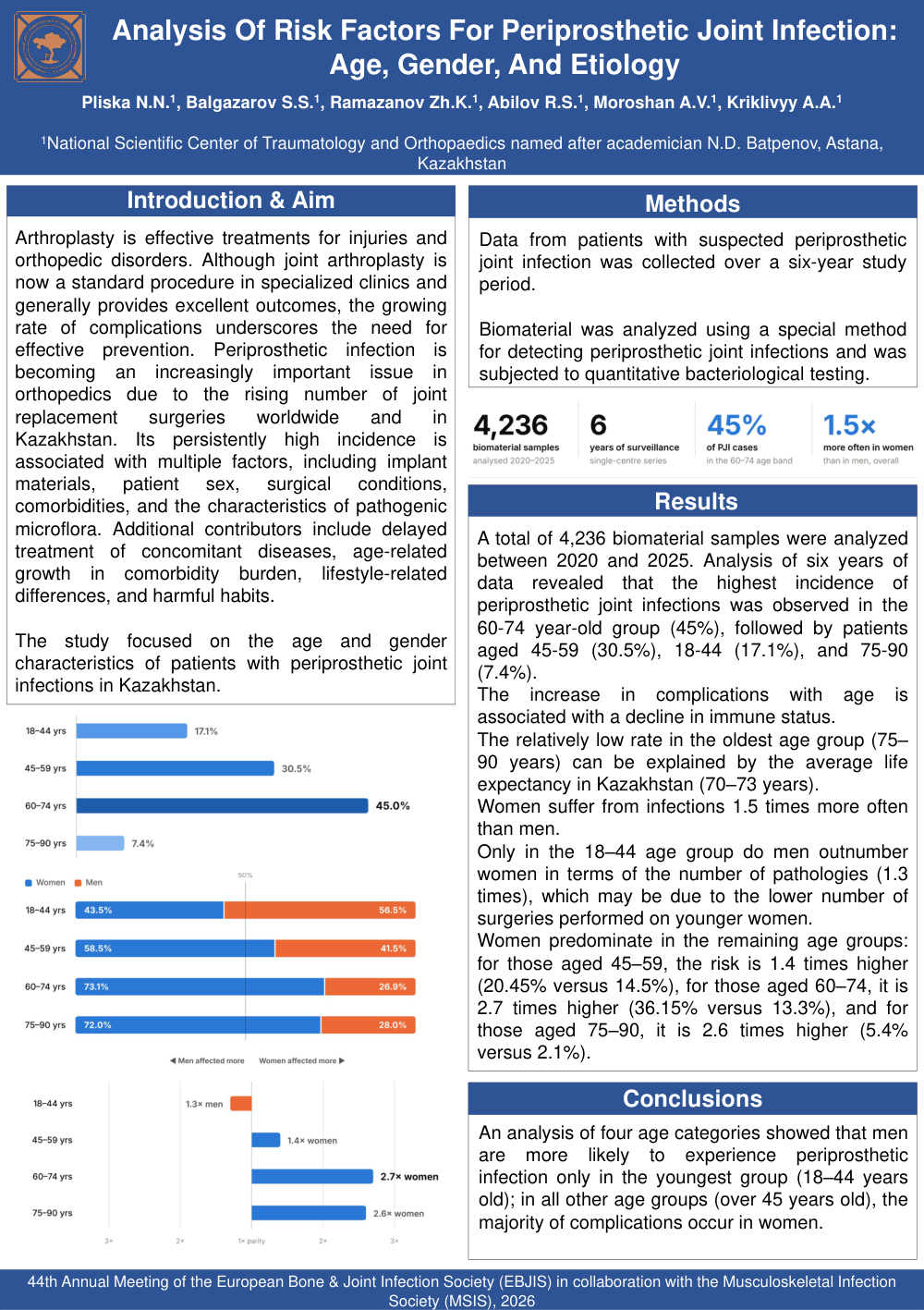
Results: A total of 4,236 biomaterial samples were analyzed between 2020 and 2025. Analysis of six years of data revealed that the highest incidence of periprosthetic joint infections was observed in the 60-74 year-old group (45%), followed by patients aged 45-59 (30.5%), 18-44 (17.1%), and 75-90 (7.4%). The increase in complications with age is associated with a decline in immune status. The relatively low rate in the oldest age group (75–90 years) can be explained by the average life expectancy in Kazakhstan (70–73 years). Women suffer from infections 1.5 times more often than men. Only in the 18–44 age group do men outnumber women in terms of the number of pathologies (1.3 times), which may be due to the lower number of surgeries performed on younger women. Women predominate in the remaining age groups: for those aged 45–59, the risk is 1.4 times higher (20.45% versus 14.5%), for those aged 60–74, it is 2.2 times higher (36.15% versus 13.3%), and for those aged 75–90, it is 2.6 times higher (5.4% versus 2.1%).
Conclusions: An analysis of four age categories showed that men are more likely to experience periprosthetic infection only in the youngest group (18–44 years old); in all other age groups (over 45 years old), the majority of complications occur in women.