477 posters, 14 topics, 2,052 authors, 1,056 institutions
ePostersLive by SciGen Technologies S.A. All rights reserved.
The Joint EBJIS-MSIS 2026 Conference
17 - 19 September, 2026 | Porto, Portugal
PP30
The Result of Standardized �No Touch Sampling Technique� Combine with BCB for Bone and Soft Tissue Infection
Poster Presenter
Part of Topic
Microbiology
The Result of Standardized “No Touch Sampling Technique” Combined with BCB for Bone and Soft Tissue Infection
Zheng-Yu Luo, MD, Yang Liu, MD.
Division of Microsurgery and Orthopedic Infection, Department of Orthopedic Surgery,
West China Hospital of Sichuan University, Chengdu, China.
E-mail:
Purpose
In this study, we hypothesized that the effectiveness of the “No Touch Sampling Technique” combined with the blood culture bottle (BCB) system is superior to that of conventional swab culture in terms of required specimen volume and microbial identification rate. We also analyzed the pathogen spectrum, antimicrobial resistance patterns, and the coverage of commonly used dual antimicrobial regimens.
Methods
We analyzed prospectively collected data from 77 cases that underwent primary revision surgical treatment for suspected or confirmed bone and soft-tissue infection at our center in 2025. Each sample was collected using sterile, single-use instruments to inoculate one aerobic BCB and one anaerobic general BCB. We also collected one conventional swab sample from the identical area. Compare positivity rates between culture modalities; summarize overall pathogen spectrum, single-agent susceptibility rates, and standard dual-agent regimen coverage.
Result
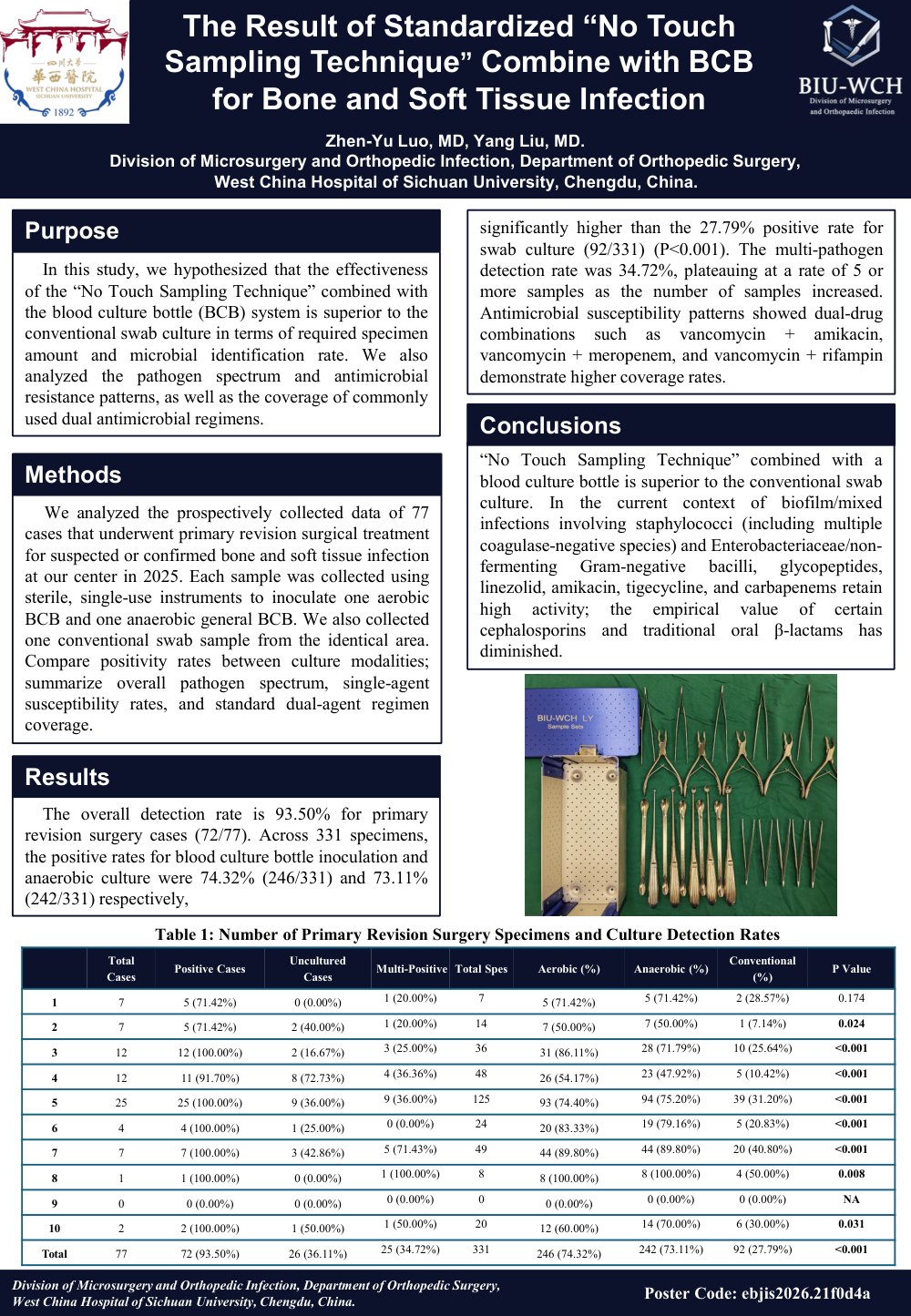
The overall detection rate is 93.50% for primary revision surgery cases (72/77). Across 328 specimens, the positive rates for blood culture bottle inoculation and anaerobic culture were 75.61% (248/328) and 72.56% (238/328), respectively, significantly higher than the 24.09% positive rate for swab culture (79/328) (P<0.001). The multi-pathogen detection rate plateaued at 5 or more samples, at 20.83%. Antimicrobial susceptibility patterns showed that dual-drug combinations, such as vancomycin + amikacin, vancomycin + meropenem, and vancomycin + rifampin, demonstrate higher coverage rates.
Conclusions
“No Touch Sampling Technique” combined with a blood culture bottle is superior to the conventional swab culture. In the current context of biofilm/mixed infections involving staphylococci (including multiple coagulase-negative species) and Enterobacteriaceae/non-fermenting Gram-negative bacilli, glycopeptides, linezolid, amikacin, tigecycline, and carbapenems retain high activity; the empirical value of certain cephalosporins and traditional oral β-lactams has diminished.