136 posters, 2 topics, 27 sessions, 339 authors, 88 institutions
ePostersLive by SciGen Technologies S.A. All rights reserved.
2024 ACP Annual Session
NOVEMBER 6-9, 2024 | MARCO ISLAND, FL JW MARRIOT

99
Leveraging technology in the fabrication of custom denture teeth
Poster Presenter
Authors
Affiliations
Part of Topic
Case Presentation
|
Leveraging Technology in the Fabrication of Custom Denture Teeth Dr. Eden Skopp, DDS; Dr. Radi Masri, BDS, MS, PhD University of Maryland, School of Dentistry |
|
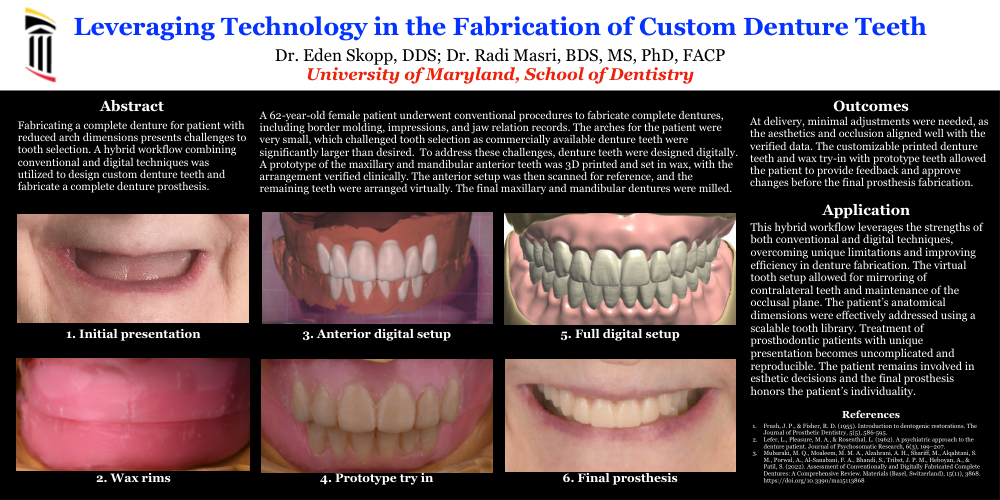
Abstract Fabricating a complete denture for patient with reduced arch dimensions presents challenges to tooth selection. A hybrid workflow combining conventional and digital techniques was utilized to design custom denture teeth and fabricate a complete denture prosthesis. A 62-year-old female patient underwent conventional procedures to fabricate complete dentures, including border molding, impressions, and jaw relation records. The arches for the patient were very small, which complicated tooth selection as commercially available denture teeth were significantly larger than desired. To address these challenges, denture teeth were designed digitally. A prototype of the maxillary and mandibular anterior teeth was 3D printed and set in wax, with the arrangement verified clinically. The anterior setup was then scanned, and the remaining teeth were arranged virtually. The final maxillary and mandibular dentures were milled. Outcomes At delivery, minimal adjustments were needed, as the aesthetics and occlusion aligned well with the verified data. The customizable printed denture teeth and wax try-in with prototype teeth allowed the patient to provide feedback and approve changes before the final prosthesis fabrication. Application This hybrid workflow leverages the strengths of both conventional and digital techniques, overcoming unique limitations and improving efficiency in denture fabrication. The virtual tooth setup allowed for mirroring of contralateral teeth and maintenance of the occlusal plane. The patient’s anatomical dimensions were effectively addressed using a scalable tooth library. Treatment of prosothodnic patients with unique presentation becomes uncomplicated and reproducible. The patient remains involved in esthetic decisions and the final prosthesis honors the patient’s individuality. Image captions: 1. Initial presentation 3. Anterior digital setup 5. Full digital setup 2. Wax rims 4. Prototype try in 5. Final prosthesis References
|