136 posters, 2 topics, 27 sessions, 339 authors, 88 institutions
ePostersLive by SciGen Technologies S.A. All rights reserved.
2024 ACP Annual Session
NOVEMBER 6-9, 2024 | MARCO ISLAND, FL JW MARRIOT

101
An Analog-Digital Workflow for Bilateral Balanced Immediate Dentures Using Jaw Motion Data
Poster Presenter
Authors
Affiliations
Part of Topic
Case Presentation
An Analog-Digital Workflow for Bilateral Balanced Immediate Dentures Using Jaw Motion Data.
Introduction:
The incorporation of digital technologies into the workflow for immediate dentures provides many benefits. However, concerns persist regarding compromised border extensions and the limited design of occlusion. Moreover, in partially edentulous patients, facial scan and jaw motion data can be hard to capture. To address these challenges, mutiple intraoral appliances were developed, and jaw motion data were utilized to achieve an optimized outcome.
Case Description:
A 74-year-old female patient presented to our department, complaining of tooth mobility and poor esthetics. The remaining teeth showed hopeless prognoses, resulting in a treatment plan of full-mouth extractions with immediate dentures. The case was described as follows.
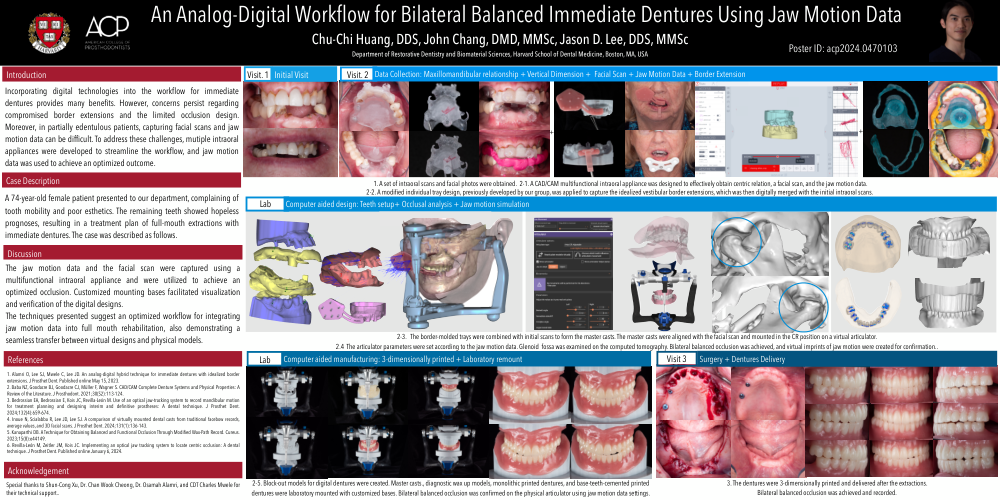
1. A set of intraoral scans and facial photos were obtained.
2-1. A CAD/CAM multifunctional intraoral appliance was designed to effectively obtain centric relation, a facial scan, and the jaw motion data.
2-2. A modified individual tray design, previously developed by our group, was applied to capture the idealized vestibular border extensions, which was then digitally merged with the initial intraoral scans.
2-3. The border-molded trays were combined with initial scans to form the master casts. The master casts were aligned with the facial scan and mounted in the CR position on a virtual articulator.
2.4 The articulator parameters were set according to the jaw motion data. Glenoid fossa was examined on the computed tomography. Bilateral balanced occlusion was achieved, and virtual imprints of jaw motion were created for confirmation.
2-5. Block-out models for digital dentures were created. Master casts., diagnostic wax up models, monolithic printed dentures, and base-teeth-cemented printed dentures were laboratory mounted with customized bases. Bilateral balanced occlusion was confirmed on the physical articulator using jaw motion data settings.
3. The dentures were 3-dimensionally printed and delivered after the extractions. Bilateral balanced occlusion was achieved and recorded.
Discussion:
The jaw motion data was captured using a multifunctional intraoral appliance and utilized to achieve optimized occlusion. Customized mounting bases facilitated visualization and verification of the digital designs.
The techniques presented in this case suggest an optimized workflow for integrating jaw motion data into full mouth rehabilitation, also demonstrating a seamless transfer between virtual designs and physical models.