136 posters, 2 topics, 27 sessions, 339 authors, 88 institutions
ePostersLive by SciGen Technologies S.A. All rights reserved.
2024 ACP Annual Session
NOVEMBER 6-9, 2024 | MARCO ISLAND, FL JW MARRIOT

103
A New Approach to Hollow Obturator for Palatal Defects: A Clinical Report
Poster Presenter
Authors
Affiliations
Part of Topic
Case Presentation
A Digital Approach to Hollow Obturator for Palatal Defects: A Clinical Report
(Sugandha Narula BDS, MDS, Fang-Yu-Su DMD, MSD, FACP, Kushaldeep FNU BDS, MDS, MS, FACP, Aaron Segal DDS, FACP, FAAMP, Dr. Louis DiPede DMD, FACP)
Post Graduate Clinic of Prosthodontics, Temple University Kornberg School of Dentistry
Introduction-
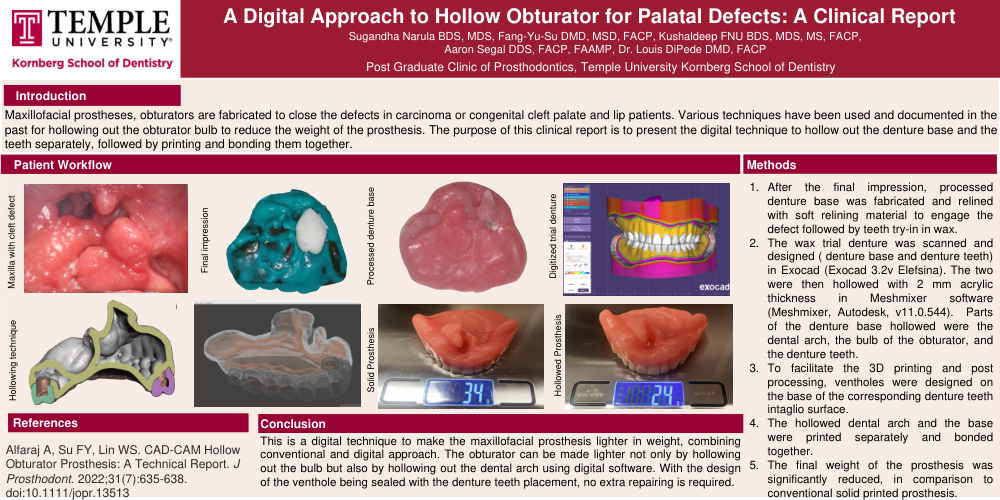
Maxillofacial prostheses, obturators are fabricated to close the defects in carcinoma or congenital cleft palate and lip patients. Various techniques have been used and documented in the past for hollowing out the obturator bulb to reduce the weight of the prosthesis. The purpose of this clinical report is to present the digital technique to hollow out the denture base and the teeth separately, followed by printing and bonding them together.
Methodology-
This is a digital technique to make the maxillofacial prosthesis lighter in weight, combining conventional and digital approach. The obturator can be made lighter not only by hollowing out the bulb but also by hollowing out the dental arch using digital software. With the design of the venthole being sealed with the denture teeth placement, no extra repairing is required.
References-
Alfaraj A, Su FY, Lin WS. CAD-CAM Hollow Obturator Prosthesis: A Technical Report. J Prosthodont. 2022;31(7):635-638. doi:10.1111/jopr.13513