136 posters, 2 topics, 27 sessions, 339 authors, 88 institutions
ePostersLive by SciGen Technologies S.A. All rights reserved.
2024 ACP Annual Session
NOVEMBER 6-9, 2024 | MARCO ISLAND, FL JW MARRIOT

83
"Revolutionizing Maxillary Defects Reconstruction: The Synergy of Zygomatic Implants and Additive Manufacturing"
Poster Presenter
Authors
Affiliations
Part of Topic
Case Presentation
Title:
"Revolutionizing Maxillary Defects Reconstruction: The Synergy of Zygomatic Implants and Additive Manufacturing“
Ahmed Aladawi BDS,MSC; Jorge Palavicini BDS ; Edwin Kee CDT
Prosthodontics Department, Louisiana State University School of Dentistry, New Orleans, LA
Objective:
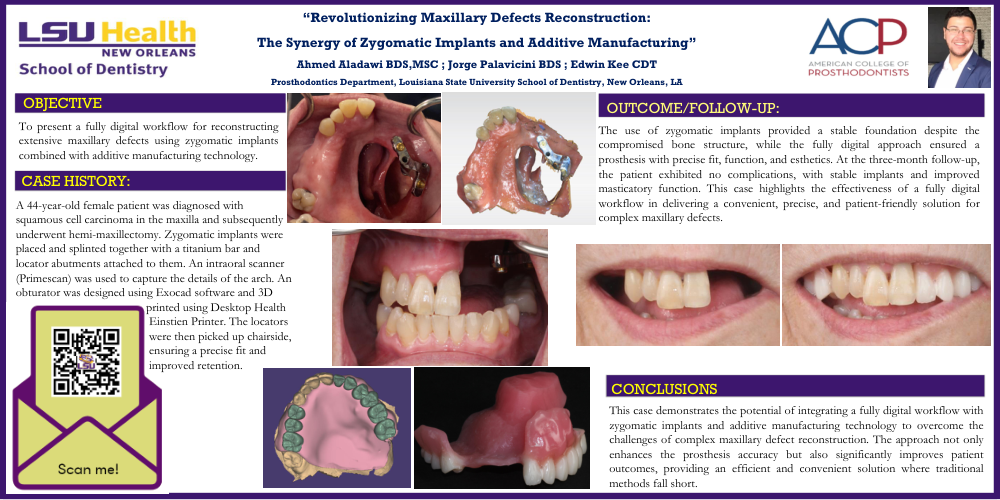
To present a fully digital workflow for reconstructing extensive maxillary defects using zygomatic implants combined with additive manufacturing technology.
Case History:
A 44-year-old female patient was diagnosed with squamous cell carcinoma in the maxilla and subsequently underwent hemi-maxillectomy. Zygomatic implants were placed and splinted together with a titanium bar and locator abutments attached to them. An intraoral scanner (Primescan) was used to capture the details of the arch. An obturator was designed using Exocad software and 3D printed using Desktop Health Einstien Printer.The locators were then picked up chairside, ensuring a precise fit and improved retention.
Outcome/Follow up:
The use of zygomatic implants provided a stable foundation despite the compromised bone structure, while the fully digital approach ensured a prosthesis with precise fit, function, and esthetics. At the three-month follow-up, the patient exhibited no complications, with stable implants and improved masticatory function. This case highlights the effectiveness of a fully digital workflow in delivering a convenient, precise, and patient-friendly solution for complex maxillary defects.
Conclusion:
This case demonstrates the potential of integrating a fully digital workflow with zygomatic implants and additive manufacturing technology to overcome the challenges of complex maxillary defect reconstruction. The approach not only enhances the prosthesis accuracy but also significantly improves patient outcomes, providing an efficient and convenient solution where traditional methods fall short.