136 posters, 2 topics, 27 sessions, 339 authors, 88 institutions
ePostersLive by SciGen Technologies S.A. All rights reserved.
2024 ACP Annual Session
NOVEMBER 6-9, 2024 | MARCO ISLAND, FL JW MARRIOT

76
Fabrication of Interim Dentures through a Digital Workflow for Patients with Failing Implants
Poster Presenter
Authors
Affiliations
Part of Topic
Case Presentation
Fabrication of Interim Dentures through Digital Workflow for Patients with Failing Implants
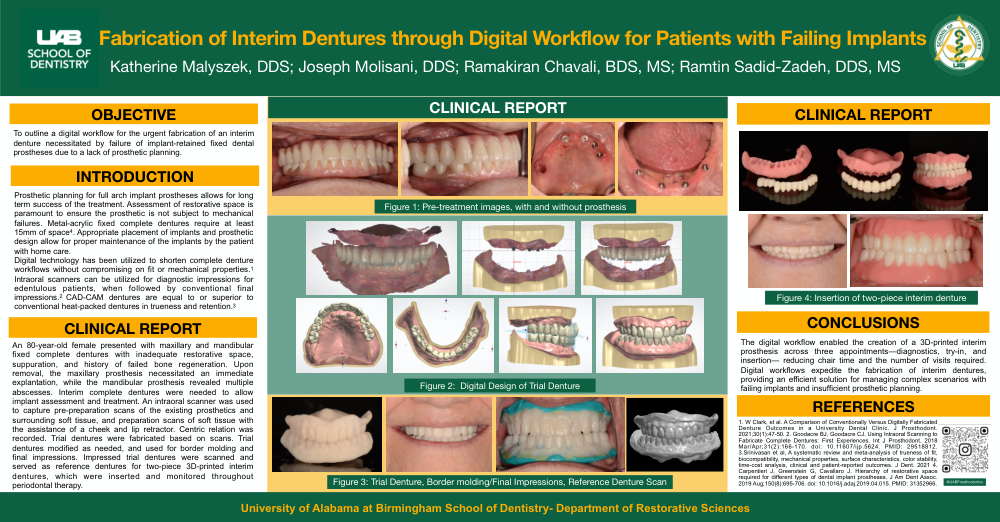
Objective: To outline a digital workflow for the urgent fabrication of an interim denture necessitated by failure of implant-retained fixed dental prostheses due to a lack of prosthetic planning.
Introduction:
Prosthetic planning for full arch implant prostheses allows for long term success of the treatment. Assessment of restorative space is paramount to ensure the prosthetic is not subject to mechanical failures. Metal-acrylic fixed complete dentures require at least 15mm of space4. Appropriate placement of implants and prosthetic design allow for proper maintenance of the implants by the patient with home care.
Digital technology has been utilized to shorten complete denture workflows without compromising on fit or mechanical properties.1 Intraoral scanners can be utilized for diagnostic impressions for edentulous patients, when followed by conventional final impressions.2 CAD-CAM dentures are equal to or superior to conventional heat-packed dentures in trueness and retention.3
Clinical Report:
An 80-year-old female presented with maxillary and mandibular fixed complete dentures with inadequate restorative space, suppuration, and history of failed bone regeneration. Upon removal, the maxillary prosthesis necessitated an immediate explantation, while the mandibular prosthesis revealed multiple abscesses. Interim complete dentures were needed to allow implant assessment and treatment. An intraoral scanner was used to capture pre-preparation scans of the existing prosthetics and surrounding soft tissue, and preparation scans of soft tissue with the assistance of a cheek and lip retractor. Centric relation was recorded. Trial dentures were fabricated based on scans. Trial dentures modified as needed, and used for border molding and final impressions. Impressed trial dentures were scanned and served as reference dentures for two-piece 3D-printed interim dentures, which were inserted and monitored throughout periodontal therapy.
Conclusion: The digital workflow enabled the creation of a 3D-printed interim prosthesis across three appointments—diagnostics, try-in, and insertion— reducing chair time and the number of visits required. Digital workflows expedite the fabrication of interim dentures, providing an efficient solution for managing complex scenarios with failing implants and insufficient prosthetic planning.