136 posters, 2 topics, 27 sessions, 339 authors, 88 institutions
ePostersLive by SciGen Technologies S.A. All rights reserved.
2024 ACP Annual Session
NOVEMBER 6-9, 2024 | MARCO ISLAND, FL JW MARRIOT

68
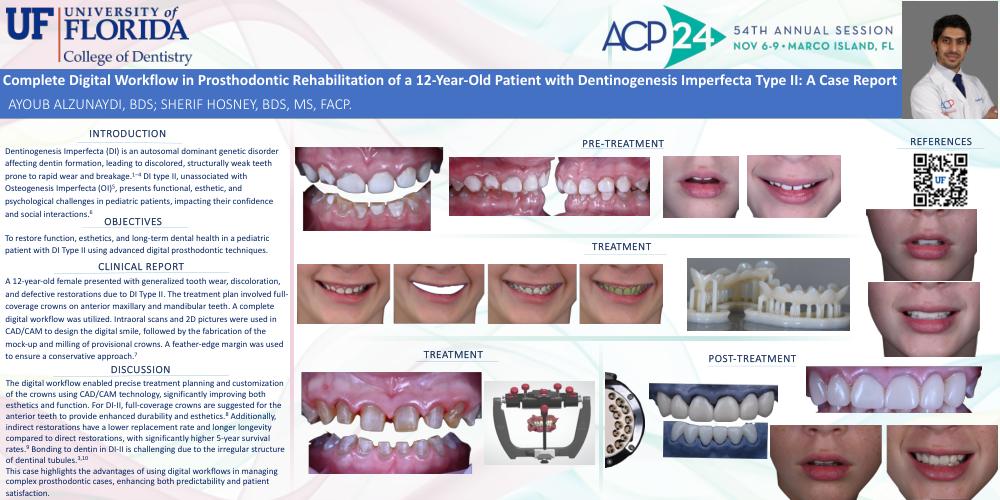
Complex Prosthodontic Rehabilitation in a 12-Year-Old Patient with Dentinogenesis Imperfecta Type II: A Digital Workflow Approach
Poster Presenter
Authors
Affiliations
Part of Topic
Case Presentation
Complete Digital Workflow in Prosthodontic Rehabilitation of a 12-Year-Old Patient with Dentinogenesis Imperfecta Type II: A Case Report
AYOUB ALZUNAYDI, BDS; SHERIF HOSNEY, BDS, MS, FACP.
introduction: Dentinogenesis Imperfecta (DI) is an autosomal dominant genetic disorder affecting dentin formation, leading to discolored, structurally weak teeth prone to rapid wear and breakage.1–4 DI type II, unassociated with Osteogenesis Imperfecta (OI)5, presents functional, esthetic, and psychological challenges in pediatric patients, impacting their confidence and social interactions.6
Objectives: To restore function, esthetics, and long-term dental health in a pediatric patient with DI Type II using advanced digital prosthodontic techniques.
Clinical report: A 12-year-old female presented with generalized tooth wear, discoloration, and defective restorations due to DI Type II. The treatment plan involved full-coverage crowns on both maxillary and mandibular teeth. A complete digital workflow was utilized. Intraoral scans and 2D pictures were used in CAD/CAM to design the digital smile, followed by the fabrication of the mock-up and milling of provisional crowns. A feather-edge margin was used to ensure a conservative approach.7
Discussion:
The digital workflow enabled precise treatment planning and customization of the crowns using CAD/CAM technology, significantly improving both esthetics and function. For DI-II, porcelain crowns are suggested for the anterior teeth to provide enhanced durability and esthetics.8 Additionally, indirect restorations have a lower replacement rate and longer longevity compared to direct restorations, with significantly higher 5-year survival rates.9 Bonding to dentin in DI-II is challenging due to the irregular structure of dentinal tubules.3,10
This case highlights the advantages of using digital workflows in managing complex prosthodontic cases, enhancing both predictability and patient satisfaction.
Conclusion: The use of a complete digital workflow in managing complex prosthodontic cases, such as DI type II, offers enhanced precision, predictability, and patient satisfaction. This approach is especially beneficial in pediatric patients, where long-term outcomes and esthetics are critical.
References:
(1)de La Dure-Molla, M.; Philippe Fournier, B.; Berdal, A. Isolated Dentinogenesis Imperfecta and Dentin Dysplasia: Revision of the Classification. Eur. J. Hum. Genet. EJHG 2015, 23 (4), 445–451. https://doi.org/10.1038/ejhg.2014.159.
(2)MacDougall, M. Refined Mapping of the Human Dentin Sialophosphoprotein (DSPP) Gene within the Critical Dentinogenesis Imperfecta Type II and Dentin Dysplasia Type II Loci. Eur. J. Oral Sci. 1998, 106 Suppl 1, 227–233. https://doi.org/10.1111/j.1600-0722.1998.tb02180.x.
(3)Mao, J.; Wang, L.; Jiang, Y.; Cheng, H.; Li, N.; Shi, S.; Fan, F.; Ma, J.; Huang, S. Nanoscopic Wear Behavior of Dentinogenesis Imperfecta Type II Tooth Dentin. J. Mech. Behav. Biomed. Mater. 2021, 120, 104585. https://doi.org/10.1016/j.jmbbm.2021.104585.
(4)Gallusi, G.; Libonati, A.; Campanella, V. SEM-Morphology in Dentinogenesis Imperfecta Type II: Microscopic Anatomy and Efficacy of a Dentine Bonding System. Eur. J. Paediatr. Dent. 2006, 7 (1), 9–17.
(5)Shields, E. D.; Bixler, D.; el-Kafrawy, A. M. A Proposed Classification for Heritable Human Dentine Defects with a Description of a New Entity. Arch. Oral Biol. 1973, 18 (4), 543–553. https://doi.org/10.1016/0003-9969(73)90075-7.
(6)Parekh, S.; Almehateb, M.; Cunningham, S. J. How Do Children with Amelogenesis Imperfecta Feel about Their Teeth? Int. J. Paediatr. Dent. 2014, 24 (5), 326–335. https://doi.org/10.1111/ipd.12080.
(7)Poggio, C. E.; Dosoli, R.; Ercoli, C. A Retrospective Analysis of 102 Zirconia Single Crowns with Knife-Edge Margins. J. Prosthet. Dent. 2012, 107 (5), 316–321. https://doi.org/10.1016/S0022-3913(12)60083-3.
(8)Sapir, S.; Shapira, J. Clinical Solutions for Developmental Defects of Enamel and Dentin in Children. Pediatr. Dent. 2007, 29 (4), 330–336.
(9)Pousette Lundgren, G.; Dahllöf, G. Outcome of Restorative Treatment in Young Patients with Amelogenesis Imperfecta. a Cross-Sectional, Retrospective Study. J. Dent. 2014, 42 (11), 1382–1389. https://doi.org/10.1016/j.jdent.2014.07.017.
(10)Massé, L.; Etienne, O.; Noirrit-Esclassan, E.; Bailleul-Forestier, I.; Garot, E. Dentine Disorders and Adhesive Treatments: A Systematic Review. J. Dent. 2021, 109, 103654. https://doi.org/10.1016/j.jdent.2021.103654.