136 posters, 2 topics, 27 sessions, 339 authors, 88 institutions
ePostersLive by SciGen Technologies S.A. All rights reserved.
2024 ACP Annual Session
NOVEMBER 6-9, 2024 | MARCO ISLAND, FL JW MARRIOT

66
A Custom-Made Laser Facebow System Following Prosthodontics Principles
Poster Presenter
Authors
Affiliations
DUMMY, University of Alabama at Birmingham School of Dentistry
Part of Topic
A Custom-Made Laser Facebow System Following Prosthodontic Principles
Purpose
The goal of this project was to manufacture an easy-to-use, custom-made facebow and transfer system following the principles of prosthodontics.
Introduction
Kois’s facial analyzer1 uses multiple principles in prosthodontics, including patient facial symmetry and maxillary incisal edge position as reference points. In addition, it uses the axis-incisal distance of 100 mm derived from Monson’s Spherical Theory2 and the Weinburg trials3 to establish an easy and repeatable position to mount patients’ maxillary casts. Moreover, Camper’s plane and the interpupillary line are additional prosthodontic references used to define the position of maxillary casts. The following project uses the principles mentioned above to design and fabricate an easy-to-use custom-made facebow.
Methods
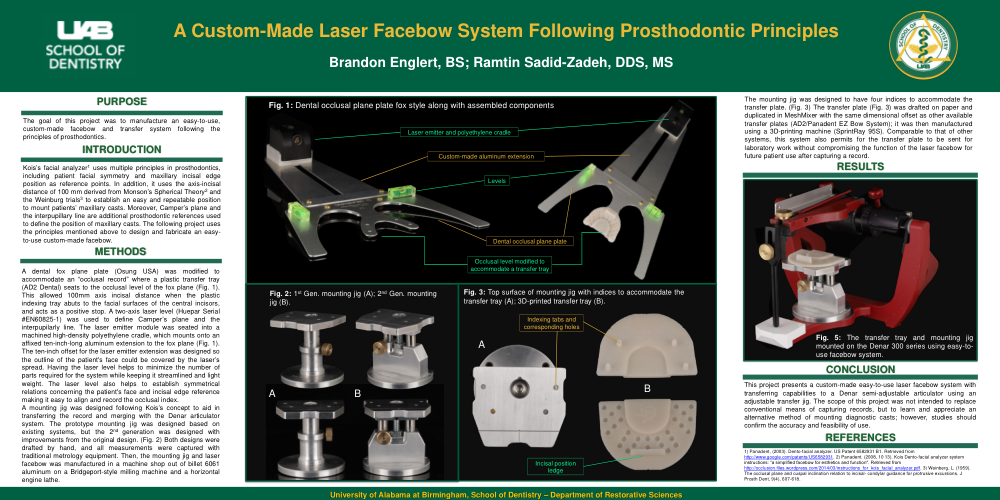
A dental fox plane plate (Osung USA) was modified to accommodate an “occlusal record” where a plastic transfer tray (AD2 Dental) seats to the occlusal level of the fox plane (Fig. 1). This allowed 100mm axis incisal distance when the plastic indexing tray abuts to the facial surfaces of the central incisors, and acts as a positive stop. A two-axis laser level (Huepar Serial #EN60825-1) was used to define Camper’s plane and the interpupilarly line. The laser emitter module was seated into a machined high-density polyethylene cradle, which mounts onto an affixed ten-inch-long aluminum extension to the fox plane (Fig. 1). The ten-inch offset for the laser emitter extension was designed so the outline of the patient's face could be covered by the laser’s spread. Having the laser level helps to minimize the number of parts required for the system while keeping it streamlined and light weight. The laser level also helps to establish symmetrical relations concerning the patient's face and incisal edge reference making it easy to align and record the occlusal index. A mounting jig was designed following Kois’s concept to aid in transferring the record and merging with the Denar articulator system. The prototype mounting jig was designed based on existing systems, but the 2nd generation was designed with improvements from the original design. (Fig. 2) Both designs were drafted by hand, and all measurements were captured with traditional metrology equipment. Then, the mounting jig and laser facebow was manufactured in a machine shop out of billet 6061 aluminum on a Bridgeport-style milling machine and a horizontal engine lathe. The mounting jig was designed to have four indices to accommodate the transfer plate. (Fig. 3) The transfer plate (Fig. 3) was drafted on paper and duplicated in MeshMixer with the same dimensional offset as other available transfer plates (AD2/Panadent EZ Bow System); it was then manufactured using a 3D-printing machine (SprintRay 95S). Comparable to that of other systems, this system also permits for the transfer plate to be sent for laboratory work without compromising the function of the laser facebow for future patient use after capturing a record.
Conclusion
This project presents a custom-made easy-to-use laser facebow system with transferring capabilities to a Denar semi-adjustable articulator using an adjustable transfer jig. The scope of this project was not intended to replace conventional means of capturing records, but to learn and appreciate an alternative method of mounting diagnostic casts; however, studies should confirm the accuracy and feasibility of use.
References
1) Panadent, (2003). Dento-facial analyzer. US Patent 6582931 B1. Retrieved from http://www.google.com/patents/US6582931. 2) Panadent. (2008, 10 13). Kois Dento-facial analyzer system instructions: “a simplified facebow for esthetics and function". Retrieved from http://occlusion.files.wordpress.com/2014/03/instructions_for_kois_facial_analyzer.pdf. 3) Weinberg, L. (1959). The occlusal plane and cuspal inclination relation to incisal- condylar guidance for protrusive excursions. J Prosth Dent, 9(4), 607-618.