136 posters, 2 topics, 27 sessions, 339 authors, 88 institutions
ePostersLive by SciGen Technologies S.A. All rights reserved.
2024 ACP Annual Session
NOVEMBER 6-9, 2024 | MARCO ISLAND, FL JW MARRIOT

102
The accuracy of different digital scanners in occlusal contacts assessment: a comparative study
Poster Presenter
Authors
Affiliations
DUMMY, University of North Carolina Adams School of Dentistry
Part of Topic
The accuracy of different digital scanners in occlusal contacts assessment: a comparative study
Ariana Motamedi, Tariq Alsahafi BDS MS, Wendy A. Clark DDS MS
University of North Carolina at Chapel Hill
Objectives:
The purpose of this study was to compare the accuracy of data obtained using three digital scanners to that of conventional articulating papers. This study also aims to evaluate overall patient comfort and preference with each digital device during scanning procedures.
Introduction:
Correcting occlusal discrepancies is crucial in comprehensive dental treatments, and articulating paper has been used for decades to aid in this process [1]. Furthermore, conventional methods of analyzing occlusion with articulating paper are standard in everyday dental treatment. Although articulating paper is a reliable source for assessing occlusion, variables such as saliva and paper thickness may influence the occlusal analysis [2]. In contrast, digital methods offer the advantage of more objective interpretations of occlusal records [3].
Published studies have compared the accuracy of T-scan, a digital occlusal analysis device, to the CEREC Omnicam scanner when assessing occlusal contacts. One study found the T-scan system more sensitive to determining occlusion, while the CEREC was more efficient in tight contact areas [4]. Modjaw is a recently developed digital articulator utilizing 4D technology to record real-time movements.
Materials and Methods:
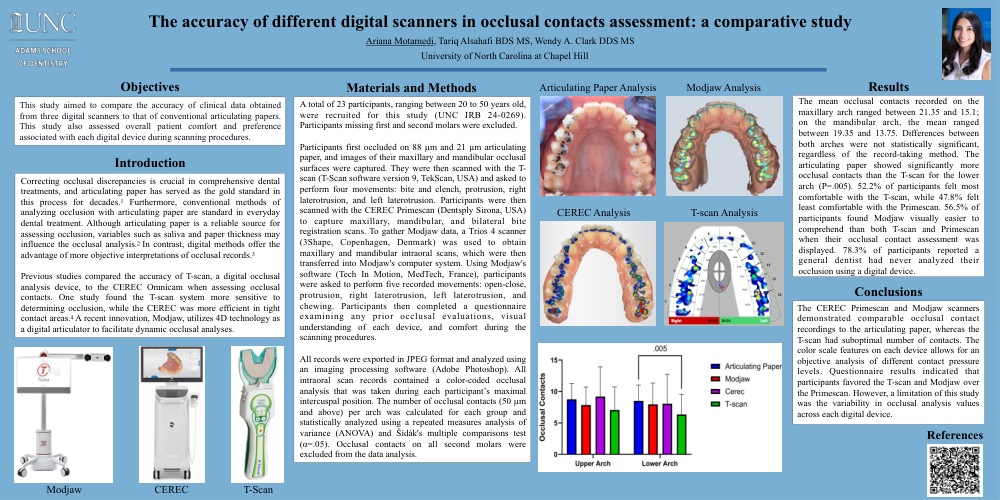
Twenty-three participants, ranging between 20 to 50 years old, were recruited for this study (UNC IRB 24-0269). The exclusion criteria included missing first and second molars. Participants first occluded on articulating paper (88 µm, Patterson Premium Articulating Paper, USA), and images of their maxillary and mandibular occlusal surfaces were captured.
Participants were scanned with the T-scan and asked to perform four movements: bite and clench, protrusion, right laterotrusion, and left laterotrusion. Participants were then scanned with the CEREC Primescan; maxillary, mandibular, and bilateral bite registration scans were obtained. To collect Modjaw data, a Trios 4 scanner was used to obtain maxillary and mandibular intraoral scans, which were then transferred into Modjaw's computer system. Using Modjaw's software, participants were asked to perform five recorded movements: open-close, protrusion, right laterotrusion, left laterotrusion, and chewing. Participants then completed a questionnaire examining any previous occlusal assessment, visual understanding of each device, and comfort during scanning processes.
All records were exported in JPEG format and analyzed using an imaging processing software (Adobe Photoshop). All intraoral scan records contained a color-coded occlusal analysis that was taken during each participant’s maximal intercuspal position. The number of occlusal contacts (50 µm and above) per arch was calculated for each group and statistically analyzed using a repeated measures analysis of variance (ANOVA) and Šídák's multiple comparisons test (α=.05). Occlusal contacts on all second molars were excluded from the data analysis.
Results:
The mean occlusal contacts recorded on the maxillary arch ranged between 21.35 and 15.1; on the mandibular arch, the mean ranged between 19.35 and 13.75. Differences between both arches were not statistically significant, regardless of the record-taking method. The articulating paper showed significantly more occlusal contacts than the T-scan for the lower arch (P=.005). 52.2% of participants felt most comfortable with the T-scan, while 47.8% felt least comfortable with the Primescan. 56.5% of participants found Modjaw visually easier to comprehend than both T-scan and Primescan when their occlusal contact assessment was displayed. 78.3% of participants reported a general dentist had never analyzed their occlusion using a digital device.
Conclusions:
With the exception of the T-scan, the Primescan and Modjaw digital scanners have comparable occlusal contact recordings to the articulating paper. The color scale features on each device allow an objective analysis of different contact pressure levels. Results from the questionnaire showed that participants preferred the T-scan and Modjaw over the Primescan. Limitations for this study include variation in the occlusal analysis values within each digital device.