136 posters, 2 topics, 27 sessions, 339 authors, 88 institutions
ePostersLive by SciGen Technologies S.A. All rights reserved.
2024 ACP Annual Session
NOVEMBER 6-9, 2024 | MARCO ISLAND, FL JW MARRIOT

61
An Approach to overcome scattering artifacts of immediate implant placement planning
Poster Presenter
Authors
Affiliations
Part of Topic
Case Presentation
An Approach to Overcome Scattering Artifacts for Immediate Implant Placement Planning
Introduction
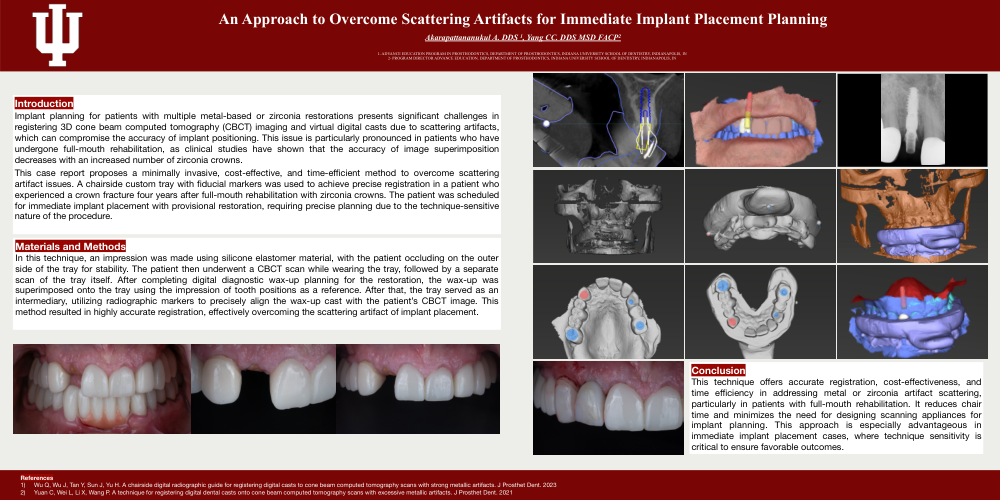
Implant planning for patients with multiple metal-based or zirconia restorations presents significant challenges in registering 3D cone beam computed tomography (CBCT) imaging and virtual digital casts due to scattering artifacts, which can compromise the accuracy of implant positioning. This issue is particularly pronounced in patients who have undergone full-mouth rehabilitation, as clinical studies have shown that the accuracy of image superimposition decreases with an increased number of zirconia crowns.
This case report proposes a minimally invasive, cost-effective, and time-efficient method to overcome scattering artifact issues. A chairside custom tray with fiducial markers was used to achieve precise registration in a patient who experienced a crown fracture four years after full-mouth rehabilitation with zirconia crowns. The patient was scheduled for immediate implant placement with provisional restoration, requiring precise planning due to the technique-sensitive nature of the procedure.
Materials and Methods
In this technique, an impression was made using silicone elastomer material, with the patient occluding on the outer side of the tray for stability. The patient then underwent a CBCT scan while wearing the tray, followed by a separate scan of the tray itself. After completing digital diagnostic wax-up planning for the restoration, the wax-up was superimposed onto the tray using the impression of tooth positions as a reference. After that, the tray served as an intermediary, utilizing radiographic markers to precisely align the wax-up cast with the patient’s CBCT image. This method resulted in highly accurate registration, effectively overcoming the scattering artifact of implant placement.
Conclusion
This technique offers accurate registration, cost-effectiveness, and time efficiency in addressing metal or zirconia artifact scattering, particularly in patients with full-mouth rehabilitation. It reduces chair time and minimizes the need for designing scanning appliances for implant planning. This approach is especially advantageous in immediate implant placement cases, where technique sensitivity is critical to ensure favorable outcomes.