136 posters, 2 topics, 27 sessions, 339 authors, 88 institutions
ePostersLive by SciGen Technologies S.A. All rights reserved.
2024 ACP Annual Session
NOVEMBER 6-9, 2024 | MARCO ISLAND, FL JW MARRIOT

59
Comparative Analysis of Intraoral Scanner Accuracy for Digitizing Edentulous Impressions
Poster Presenter
Part of Topic
Comparative Analysis of Intraoral Scanner Accuracy for Digitizing Edentulous Impressions
Landon Guy DDS, Matthew Manley DDS, Ariana Motamedi, Jackie Le DDS, Dariel Liakhovetski, Lauren Howard,
Wendy A. Clark DDS, MS, FACP, Tariq Alsahafi BDS
INTRODUCTION
With the increasing adoption of digital workflows in removable prosthodontics, understanding the accuracy of intraoral scanners (IOS) for digitizing edentulous impressions is critical. Traditionally, the digital workflow for complete dentures has been entered by digitizing conventional final impressions with a laboratory scanner. However, clinicians have been adopting a workflow that involves digitizing impressions with chairside intraoral scanners. This improves the patient experience, by eliminating travel time to laboratories, thus diminishing turnaround time, and shortening treatment time. Additionally, it eliminates the need to send out any physical impressions, minimizing the need for disinfection and possible transfer of fomites.
With rapid advancements in digital scanning systems, understanding the accuracy of these scanners and their limitations is critical for predictable and successful outcomes. According to ISO 5725-1, accuracy consists of trueness (proximity of measurement results to the true value) and precision (repeatability or reproducibility of the measurement). This study aims to evaluate the accuracy (trueness and precision) of impressions using different IOSs to optimize clinical outcomes. The key motivation is to reduce laboratory time, enhance patient experience, and minimize the risk of contamination during transport of physical impressions.
METHODS
An alginate impression of an edentulous maxillary typodont was used to fabricate a custom tray, which was impressed with polyvinyl siloxane and scanned with a bench top scanner (inEos Dentsply Sirona) as the reference scan. 200 digital scans of the impression were taken using 4 different intraoral scanners (IOS) (n=50/IOS). For each IOS, five dental students of different level of dental education ranging from first to fourth-year students performed ten of the allocated scans (n=10/operator).
All digital STL files of scans were exported from each application to be statistically analyzed for trueness and precision. A 3D analysis software (Geomagic Control X) was used to analyze the accuracy of each scan. To evaluate the trueness of each scan, the reference scan was imported into the software. Each test scan was imported and aligned to the master scan using best-fit alignment process through using prominent anatomical landmarks.
A 3D comparison was conducted and the mean absolute deviation (MAD) of each scan was calculated in microns. A similar process was performed to evaluate the precision with comparison made within the scans of each operator for 20 comparisons per IOS. Four different IOSs were tested: Primescan, Trios 5, Emerald, and Shining. Five dental students with varying experience levels conducted 10 scans per IOS. Trueness (deviation from the reference scan) and precision (reproducibility) were calculated using 3D software (Geomagic Control X). A two-way ANOVA was performed for statistical analysis (α = 0.05).
RESULTS
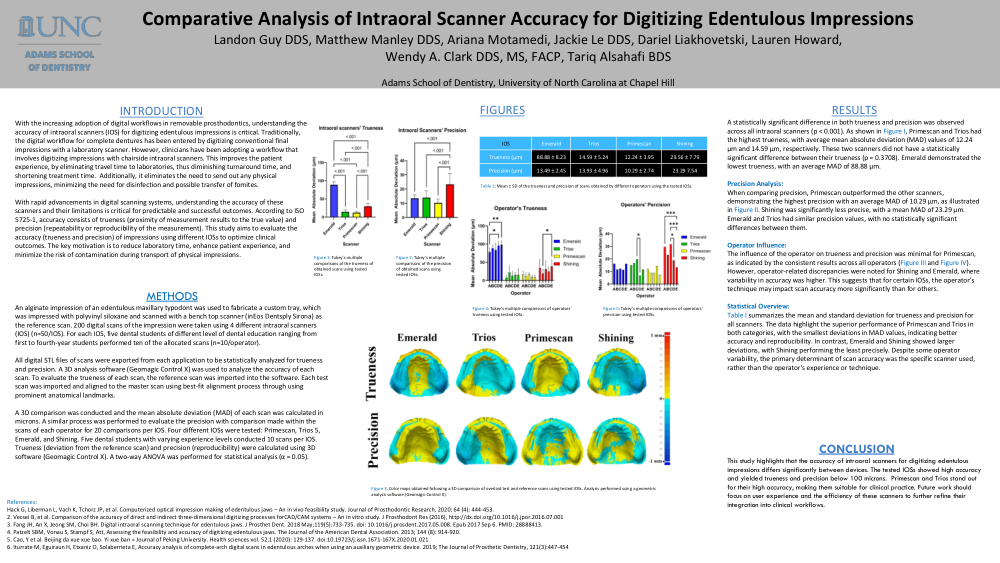
A statistically significant difference in both trueness and precision was observed across all intraoral scanners (p < 0.001). As shown in Figure I, Primescan and Trios had the highest trueness, with average mean absolute deviation (MAD) values of 12.24 µm and 14.59 µm, respectively. These two scanners did not have a statistically significant difference between their trueness (p = 0.3708). Emerald demonstrated the lowest trueness, with an average MAD of 88.88 µm.
Precision Analysis:
When comparing precision, Primescan outperformed the other scanners, demonstrating the highest precision with an average MAD of 10.29 µm, as illustrated in Figure II. Shining was significantly less precise, with a mean MAD of 23.29 µm. Emerald and Trios had similar precision values, with no statistically significant differences between them.
Operator Influence:
The influence of the operator on trueness and precision was minimal for Primescan, as indicated by the consistent results across all operators (Figure III and Figure IV). However, operator-related discrepancies were noted for Shining and Emerald, where variability in accuracy was higher. This suggests that for certain IOSs, the operator’s technique may impact scan accuracy more significantly than for others.
Statistical Overview:
Table I summarizes the mean and standard deviation for trueness and precision for all scanners. The data highlight the superior performance of Primescan and Trios in both categories, with the smallest deviations in MAD values, indicating better accuracy and reproducibility. In contrast, Emerald and Shining showed larger deviations, with Shining performing the least precisely. Despite some operator variability, the primary determinant of scan accuracy was the specific scanner used, rather than the operator's experience or technique.
CONCLUSION
This study highlights that the accuracy of intraoral scanners for digitizing edentulous impressions differs significantly between devices. The tested IOSs showed high accuracy and yielded trueness and precision below 100 microns. Primescan and Trios stand out for their high accuracy, making them suitable for clinical practice. Future work should focus on user experience and the efficiency of these scanners to further refine their integration into clinical workflows.