136 posters, 2 topics, 27 sessions, 339 authors, 88 institutions
ePostersLive by SciGen Technologies S.A. All rights reserved.
2024 ACP Annual Session
NOVEMBER 6-9, 2024 | MARCO ISLAND, FL JW MARRIOT

55
<p>Precision Border Molding with Digital Custom Trays and the Slow Hot Glue Gun Technique: Make it simple</p> <p> </p>
Poster Presenter
Part of Topic
Case Presentation
Precision Border Molding with Digital Custom Trays and the Slow Hot Glue Gun Technique: Make it simple
Introduction:
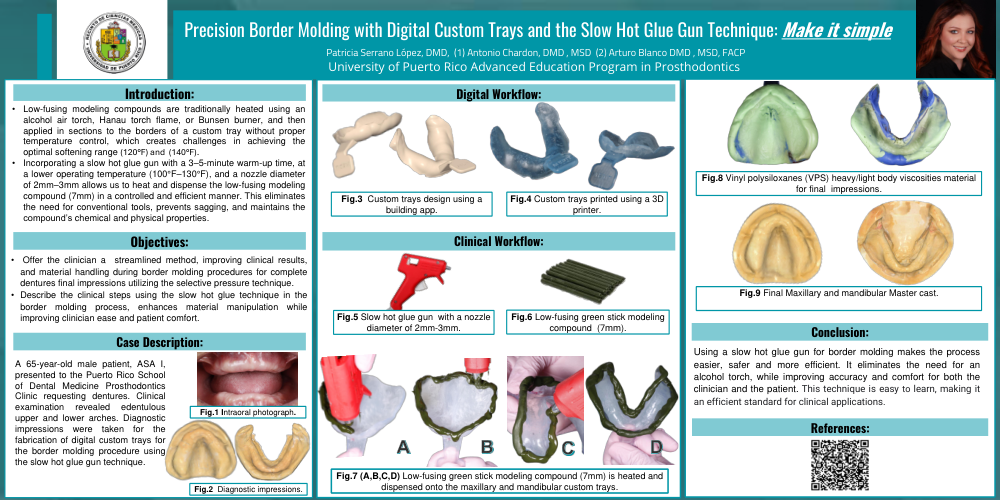
Low-fusing modeling compounds are traditionally heated using an alcohol air torch, Hanau torch flame, or Bunsen burner, and then applied in sections to the borders of a custom tray without proper temperature control, which creates challenges in achieving the optimal softening range (120°F) and (140°F).Incorporating a slow hot glue gun with a 3–5-minute warm-up time, at a lower operating temperature (100°F–130°F), and a nozzle diameter of 2mm–3mm allows us to heat and dispense the low-fusing modeling compound (7mm) in a controlled and efficient manner. This eliminates the need for conventional tools, prevents sagging, and maintains the compound’s chemical and physical properties.
Objectives:
Offer the clinician a streamlined method, improving clinical results, and material handling during border molding procedures for complete dentures final impressions utilizing the selective pressure technique. • Describe the clinical steps using the slow hot glue technique in the border molding process, enhances material manipulation while improving clinician ease and patient comfort.
Case Description:
A 65-year-old male patient, ASA I, presented to the Puerto Rico School of Dental Medicine Prosthodontics Clinic requesting dentures. Clinical examination revealed edentulous upper and lower arches. Diagnostic impressions were taken for the fabrication of digital custom trays for the border molding procedure using the slow hot glue gun technique.
Conclusion:
Using a slow hot glue gun for border molding makes the process easier, safer and more efficient. It eliminates the need for an alcohol torch, while improving accuracy and comfort for both the clinician and the patient. This technique is easy to learn, making it an efficient standard for clinical applications.