136 posters, 2 topics, 27 sessions, 339 authors, 88 institutions
ePostersLive by SciGen Technologies S.A. All rights reserved.
2024 ACP Annual Session
NOVEMBER 6-9, 2024 | MARCO ISLAND, FL JW MARRIOT

49
Analog and digital combined workflow for increasing the vertical dimension of occlusion
Poster Presenter
Authors
Affiliations
Part of Topic
Case Presentation
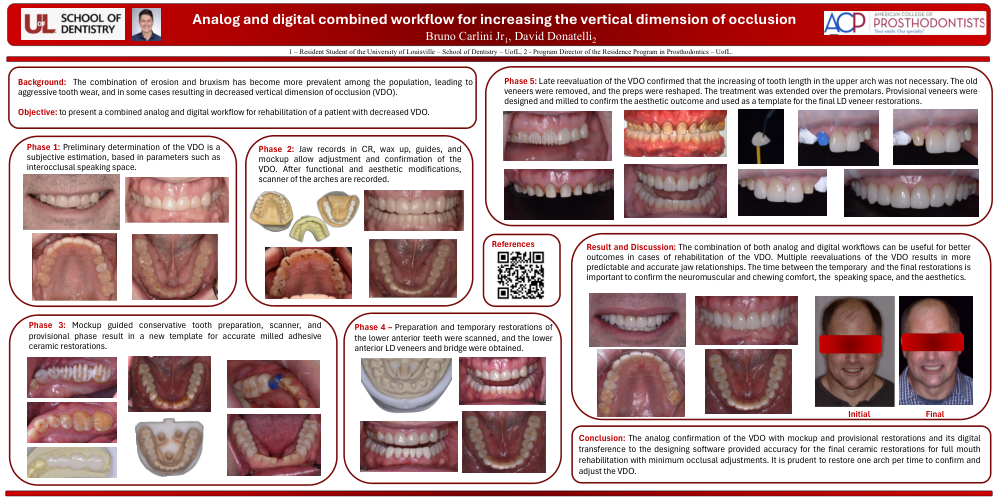
Tittle: Analog and digital combined workflow for increasing the vertical dimension of occlusion.
Background: The combination of erosion and bruxism has become more prevalent among the population, leading to aggressive tooth wear, and in some cases resulting in decreased vertical dimension of occlusion (VDO).
Objective: to present a combined analog and digital workflow for rehabilitation of a patient with decreased VDO.
Phase 1: Preliminary determination of the VDO is a subjective estimation, based in parameters such as interocclusal speaking space.
Phase 2: Jaw records in CR, wax up, guides, and mockup allow adjustment and confirmation of the VDO. After functional and aesthetic modifications, scanner of the arches are recorded.
Phase 3: Mockup guided conservative tooth preparation, scanner, and provisional phase result in a new template for accurate milled adhesive ceramic restorations.
Phase 4 – Preparation and temporary restorations of the lower anterior teeth were scanned, and the lower anterior LD veneers and bridge were obtained.
Phase 5: Late reevaluation of the VDO confirmed that the increasing of tooth length in the upper arch was not necessary. The old veneers were removed, and the preps were reshaped. The treatment was extended over the premolars. Provisional veneers were designed and milled to confirm the aesthetic outcome and used as a template for the final LD veneer restorations.
Result and Discussion: The combination of both analog and digital workflows can be useful for better outcomes in cases of rehabilitation of the VDO. Multiple reevaluations of the VDO results in more predictable and accurate jaw relationships. The time between the temporary and the final restorations is important to confirm the neuromuscular and chewing comfort, the speaking space, and the aesthetics.
Conclusion: The analog confirmation of the VDO with mockup and provisional restorations and its digital transference to the designing software provided accuracy for the final ceramic restorations for full mouth rehabilitation with minimum occlusal adjustments. It is prudent to restore one arch per time to confirm and adjust the VDO.
References: QR code.