136 posters, 2 topics, 27 sessions, 339 authors, 88 institutions
ePostersLive by SciGen Technologies S.A. All rights reserved.
2024 ACP Annual Session
NOVEMBER 6-9, 2024 | MARCO ISLAND, FL JW MARRIOT

42
Combined analog-digital workflow for treatment planning, digital dentures fabrication, and assessing accuracy of intraoral scanning: case report
Poster Presenter
Authors
Affiliations
Part of Topic
Case Presentation
Title: Combined analog-digital workflow for treatment planning, digital dentures fabrication, and assessing accuracy of intraoral scanning: case report.
Abstract:
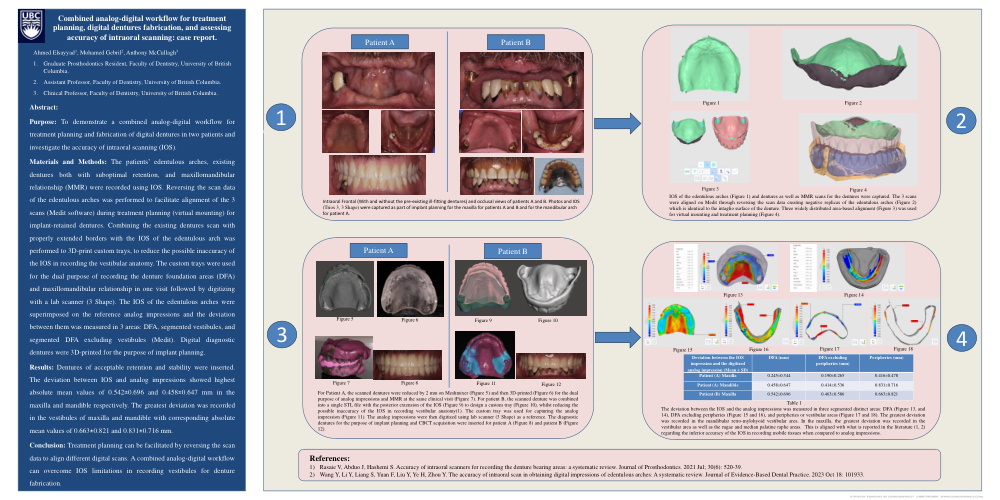
Purpose: To demonstrate a combined analog-digital workflow for treatment planning and fabrication of digital dentures in two patients and investigate the accuracy of intraoral scanning (IOS).
Materials and Methods: The patients’ edentulous arches, existing dentures both with suboptimal retention, and maxillomandibular relationship (MMR) were recorded using IOS. Reversing the scan data of the edentulous arches was performed to facilitate alignment of the 3 scans (Medit software) during treatment planning (virtual mounting) for implant-retained dentures. Combining the existing dentures scan with properly extended borders with the IOS of the edentulous arch was performed to 3D-print custom trays, to reduce the possible inaccuracy of the IOS in recording the vestibular anatomy. The custom trays were used for the dual purpose of recording the denture foundation areas (DFA) and maxillomandibular relationship in one visit followed by digitizing with a lab scanner (3 Shape). The IOS of the edentulous arches were superimposed on the reference analog impressions and the deviation between them was measured in 3 areas: DFA, segmented vestibules, and segmented DFA excluding vestibules (Medit). Digital diagnostic dentures were 3D-printed for the purpose of implant planning.
Results: Dentures of acceptable retention and stability were inserted. The deviation between IOS and analog impressions showed highest absolute mean values of 0.542±0.696 and 0.458±0.647 mm in the maxilla and mandible respectively. The greatest deviation was recorded in the vestibules of maxilla and mandible with corresponding absolute mean values of 0.663±0.821 and 0.831±0.716 mm.
Conclusion: Treatment planning can be facilitated by reversing the scan data to align different digital scans. A combined analog-digital workflow can overcome IOS limitations in recording vestibules for denture fabrication.