136 posters, 2 topics, 27 sessions, 339 authors, 88 institutions
ePostersLive by SciGen Technologies S.A. All rights reserved.
2024 ACP Annual Session
NOVEMBER 6-9, 2024 | MARCO ISLAND, FL JW MARRIOT

38
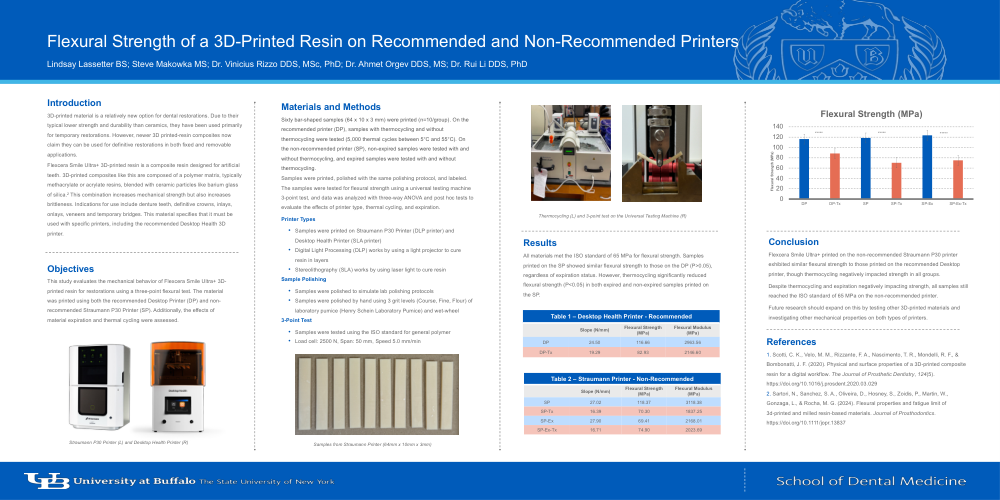
Flexural Strength of a 3D-Printed Resin on Recommended and Non-Recommended Printers
Poster Presenter
Authors
Affiliations
Part of Topic
Flexural Strength of a 3D-Printed Resin on Recommended and Non-Recommended Printers
Lindsay Lassetter BS; Steve Makowka MS; Dr. Vinicius Rizzo DDS, MSc, PhD; Dr. Ahmet Orgev DDS, MS; Dr. Rui Li DDS, PhD
Introduction
3D-printed material is a relatively new option for dental restorations. Due to their typical lower strength and durability than ceramics, they have been used primarily for temporary restorations. However, newer 3D printed-resin composites now claim they can be used for definitive restorations in both fixed and removable applications.
Flexcera Smile Ultra+ 3D-printed resin is a composite resin designed for artificial teeth. 3D-printed composites like this are composed of a polymer matrix, typically methacrylate or acrylate resins, blended with ceramic particles like barium glass of silica.5 This combination increases mechanical strength but also increases brittleness. Indications for use include denture teeth, definitive crowns, inlays, onlays, veneers and temporary bridges. This material specifies that it must be used with specific printers, including the recommended Desktop Health 3D printer.
Objectives
This study evaluates the mechanical behavior of Flexcera Smile Ultra+ 3D-printed resin for restorations using a three-point flexural test. The material was printed using both the recommended Desktop Printer (DP) and non-recommended Straumann P30 Printer (SP). Additionally, the effects of material expiration and thermal cycling were assessed.
Materials and Methods
Eighty bar-shaped samples (64 x 10 x 3 mm) were printed (n=10/group) : 40 with the SP and 40 with the DP. Each group had expired (Ex) and non-expired (NEx) materials, with half undergoing thermocycling (5,000 thermal cycles between 5°C and 55°C).
Samples were printed, polished with the same polishing protocol, and labeled. The samples were then tested for flexural strength using a universal testing machine 3-point test, and data were analyzed with three-way ANOVA and post hoc tests to evaluate the effects of printer type, thermal cycling, and expiration.
Printer Types
Sample Polishing
3-Point Test
Results
All materials met the ISO standard of 65 MPa for flexural strength. Samples printed on the SP showed similar flexural strength to those on the DP (P>0.05), regardless of expiration status. However, thermocycling significantly reduced flexural strength (P<0.05) in both expired and non-expired samples printed on the SP.
Conclusion
Flexcera Smile Ultra+ printed on the non-recommended Straumann P30 printer exhibited similar flexural strength to those printed on the recommended Desktop printer, though thermocycling negatively impacted strength.
Future research should expand on this by including other brands of 3d-printed material and investigate other mechanical properties tested including wear resistance.
References