136 posters, 2 topics, 27 sessions, 339 authors, 88 institutions
ePostersLive by SciGen Technologies S.A. All rights reserved.
2024 ACP Annual Session
NOVEMBER 6-9, 2024 | MARCO ISLAND, FL JW MARRIOT

32
Predictable full arch Immediate implant placement with immediate prosthetic loading using a magnetic stackable surgical guide
Poster Presenter
Authors
Affiliations
Part of Topic
Case Presentation
Digital Workflow for predictable Full Arch Immediate Implant Placement & Loading using a Magnetic Stackable Surgical Guide.
Ahmed Elbaz, Tarek El-Kerdani, Seok-Hwan Cho
The University of Iowa, College of Dentistry and Dental Clinics, Iowa City, IA
Clinical report:
A 57 year old caucasian male with failing dentition was referred from a private practice to the University of Iowa COD. Multiple treatment plans were discussed with the patient, and he agreed on full mouth extractions followed by a maxillary and mandibular full arch implant supported prosthesis.
Clinical steps:
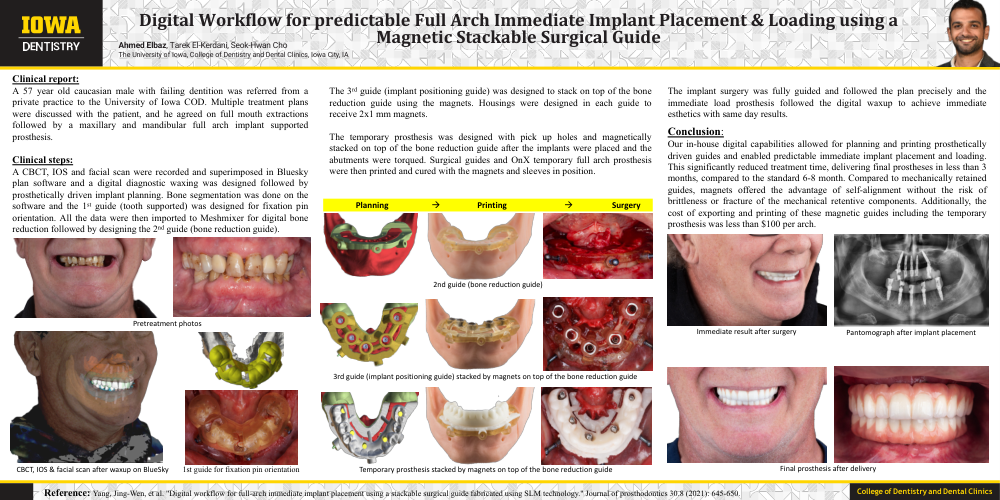
A CBCT, IOS and facial scan were recorded and superimposed in Bluesky plan software and a digital diagnostic waxing was designed followed by prosthetically driven implant planning. Bone segmentation was done on the software and the 1st guide (tooth supported) was designed for fixation pin orientation. All the data were then imported to Meshmixer for digital bone reduction followed by designing the 2nd guide (bone reduction guide).
The 3rd guide (implant positioning guide) was designed to stack on top of the bone reduction guide using the magnets. Housings were designed in each guide to receive 2x1 mm magnets.
The temporary prosthesis was designed with pick up holes and magnetically stacked on top of the bone reduction guide after the implants were placed and the abutments were torqued. Surgical guides and OnX temporary full arch prosthesis were then printed and cured with the magnets and sleeves in position.
The implant surgery was fully guided and followed the plan precisely and the immediate load prosthesis followed the digital waxup to achieve immediate esthetics with same day results.
Conclusion:
Our in-house digital capabilities allowed for planning and printing prosthetically driven guides and enabled predictable immediate implant placement and loading. This significantly reduced treatment time, delivering final prostheses in less than 3 months, compared to the standard 6-8 month. Compared to mechanically retained guides, magnets offered the advantage of self-alignment without the risk of brittleness or fracture of the mechanical retentive components. Additionally, the cost of exporting and printing of these magnetic guides including the temporary prosthesis was less than $100 per arch.