136 posters, 2 topics, 27 sessions, 339 authors, 88 institutions
ePostersLive by SciGen Technologies S.A. All rights reserved.
2024 ACP Annual Session
NOVEMBER 6-9, 2024 | MARCO ISLAND, FL JW MARRIOT

30
Permanent Soft Reline of Cast Metal Removable Partial Denture in patient with History of Medication-Related Osteonecrosis of Jaw (MRONJ)
Poster Presenter
Authors
Affiliations
Part of Topic
Case Presentation
Permanent Soft Reline of Cast Metal Removable Partial Denture in Patient with History of Medication-Related Osteonecrosis of the Jaw (MRONJ)
Introduction
A large population in the United States is prescribed bisphosphonates for the management of osteoporosis and malignancy. Despite the high prevalence of bisphophonate use, there is lacking knowledge to guide prosthodontists in managing patients with a history of bisphosphonate use. The use of a permanent soft reline has been considered to minimize potential trauma to the patient’s jaw. This patient report highlights a management approach focused on providing a well-fitted prosthesis for a patient with a history of medication-related osteonecrosis of the jaw (MRONJ), aimed at preventing future recurrence of the condition.
Case History
An elderly patient with a 15-year history of oral bisphosphonate use recently transitioned to intravenous bisphosphonates for osteoporosis management. Notably, the patient had a history of acute osteomyelitis and MRONJ in the mandibular 1 year prior. At the initial visit, no clinical signs of MRONJ were observed and radiographic evidence indicated early osseous healing (Fig 1).
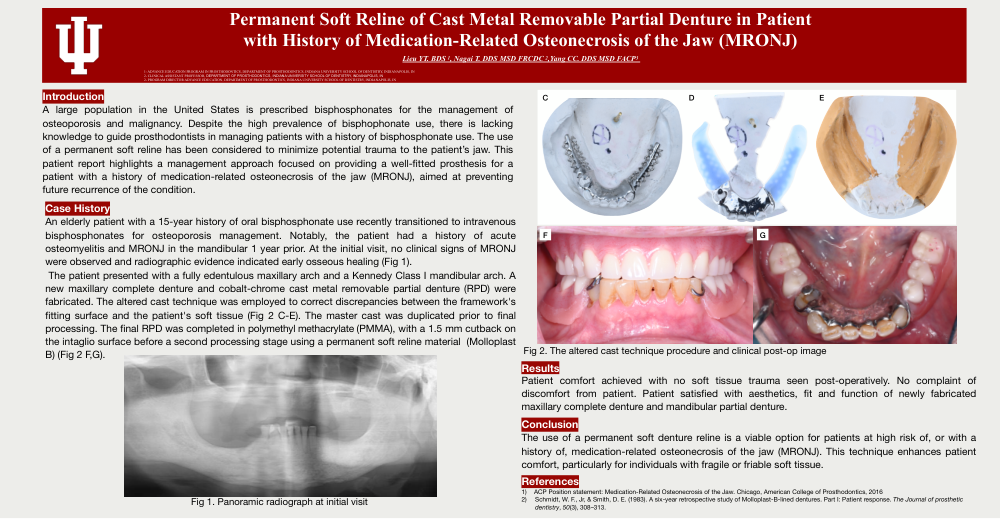
The patient presented with a fully edentulous maxillary arch and a Kennedy Class I mandibular arch. A new maxillary complete denture and cobalt-chrome cast metal removable partial denture (RPD) were fabricated. The altered cast technique was employed to correct discrepancies between the framework's fitting surface and the patient's soft tissue (Fig 2 C-E). The master cast was duplicated prior to final processing. The final RPD was completed in polymethyl methacrylate (PMMA), with a 1.5 mm cutback on the intaglio surface before a second processing stage using a permanent soft reline material (Molloplast B) (Fig 2 F,G).
Results
Patient comfort achieved with no soft tissue trauma seen post-operatively. No complaint of discomfort from patient. Patient satisfied with aesthetics, fit and function of newly fabricated maxillary complete denture and mandibular partial denture.
Conclusion
The use of a permanent soft denture reline is a viable option for patients at high risk of, or with a history of, medication-related osteonecrosis of the jaw (MRONJ). This technique enhances patient comfort, particularly for individuals with fragile or friable soft tissue.