136 posters, 2 topics, 27 sessions, 339 authors, 88 institutions
ePostersLive by SciGen Technologies S.A. All rights reserved.
2024 ACP Annual Session
NOVEMBER 6-9, 2024 | MARCO ISLAND, FL JW MARRIOT

28
Fabrication of Removable Partial Denture Utilizing a 40-year-cast gold alloy framework
Poster Presenter
Authors
Affiliations
Part of Topic
Case Presentation
Fabrication of a Removable Partial Dental Prostheses Using a 40-Year-Old Cast Gold Alloy Framework
Mayomhom Udomsinroj, DDS,John Alan Levon, DDS, MSD, Orlando Cayetano, DDS, MSD, Chao-Chieh Yang, DDS, MSD
Indiana University School of Dentistry
Objective: This case report aims to demonstrate the utilization of an existing cast gold alloy framework in the fabrication of new removable partial dental prostheses.
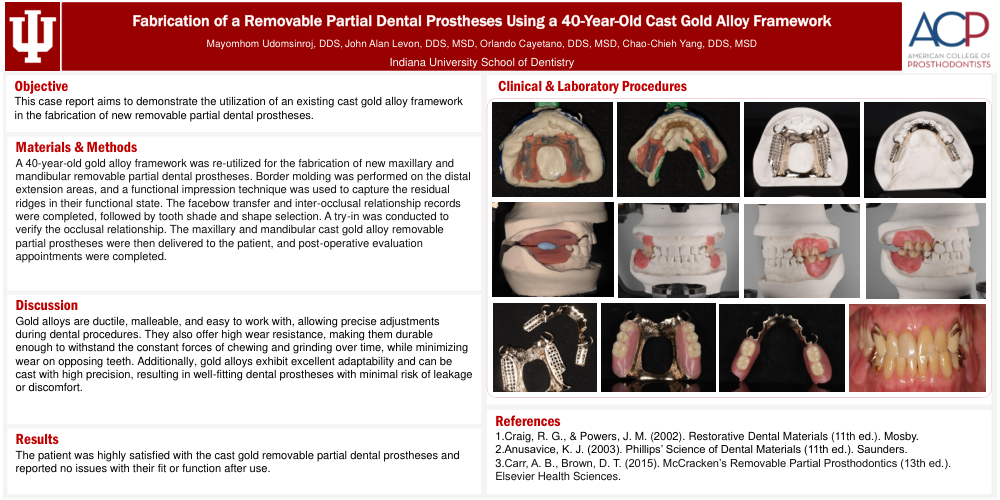
Materials & Methods: A 40-year-old gold alloy framework was re-utilized for the fabrication of new maxillary and mandibular removable partial dental prostheses. Border molding was performed on the distal extension areas, and a functional impression technique was used to capture the residual ridges in their functional state. The facebow transfer and inter-occlusal relationship records were completed, followed by tooth shade and shape selection. A try-in was conducted to verify the occlusal relationship. The maxillary and mandibular cast gold alloy removable partial prostheses were then delivered to the patient, and post-operative evaluation appointments were completed.
Discussion: Gold alloys are ductile, malleable, and easy to work with, allowing precise adjustments during dental procedures. They also offer high wear resistance, making them durable enough to withstand the constant forces of chewing and grinding over time, while minimizing wear on opposing teeth. Additionally, gold alloys exhibit excellent adaptability and can be cast with high precision, resulting in well-fitting dental prostheses with minimal risk of leakage or discomfort.
Results: The patient was highly satisfied with the cast gold removable partial dental prostheses and reported no issues with their fit or function after use.
References:
1.Craig, R. G., & Powers, J. M. (2002). Restorative Dental Materials (11th ed.). Mosby.
2.Anusavice, K. J. (2003). Phillips’ Science of Dental Materials (11th ed.). Saunders.
3.Carr, A. B., Brown, D. T. (2015). McCracken’s Removable Partial Prosthodontics (13th ed.). Elsevier Health Sciences.