136 posters, 2 topics, 27 sessions, 339 authors, 88 institutions
ePostersLive by SciGen Technologies S.A. All rights reserved.
2024 ACP Annual Session
NOVEMBER 6-9, 2024 | MARCO ISLAND, FL JW MARRIOT

26
Immediate Implant Placement and Restoration with Prefabricated Provisional CAD/CAM crown in Anterior Maxilla: A Case report
Poster Presenter
Authors
Marcel Hertanto, Shengtao Yang, Berna Saglik , Fei Liu , Junying Li
Affiliations
Part of Topic
Case Presentation
Immediate Implant Placement and Restoration with Prefabricated Provisional CAD/CAM Crown in Anterior Maxilla : A Case Report
Marcel Hertanto DDS MS, Shengtao Yang MS, Fei Liu DDS MS PhD FACP, Berna Saglik DDS MS FACP DABDSM, Junying Li DDS MS PhD
Department of Biologic and Materials Sciences & Prosthodontics, University of Michigan School of Dentistry
Introduction
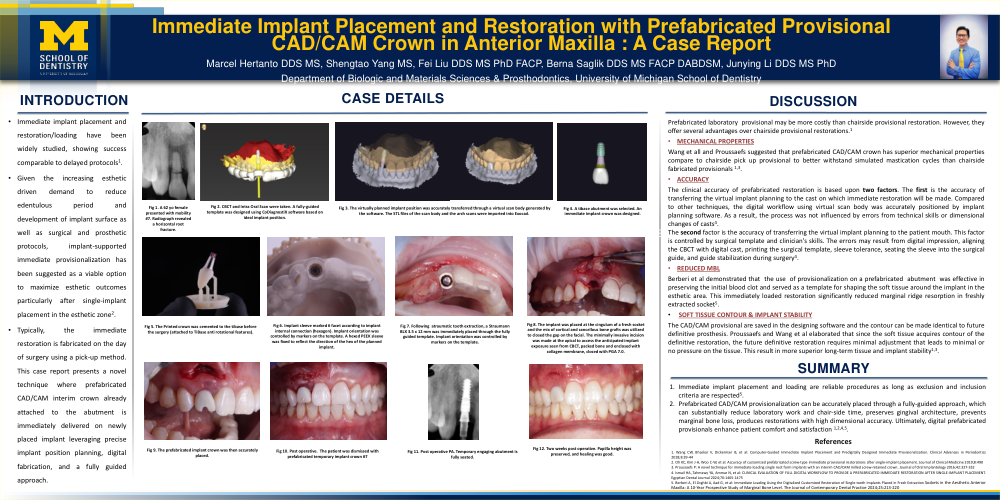
Prefabricated laboratory provisional may be more costly than chairside provisional restoration. However, they offer several advantages over chairside provisional restorations.1
Wang et all and Proussaefs suggested that prefabricated CAD/CAM crown has superior mechanical properties compare to chairside pick up provisional to better withstand simulated mastication cycles than chairside fabricated provisionals 1,3.
The clinical accuracy of prefabricated restoration is based upon two factors. The first is the accuracy of transferring the virtual implant planning to the cast on which immediate restoration will be made. Compared to other techniques, the digital workflow using virtual scan body was accurately positioned by implant planning software. As a result, the process was not influenced by errors from technical skills or dimensional changes of casts4.
The second factor is the accuracy of transferring the virtual implant planning to the patient mouth. This factor is controlled by surgical template and clinician’s skills. The errors may result from digital impression, aligning the CBCT with digital cast, printing the surgical template, sleeve tolerance, seating the sleeve into the surgical guide, and guide stabilization during surgery4.
Berberi et al demonstrated that the use of provisionalization on a prefabricated abutment was effective in preserving the initial blood clot and served as a template for shaping the soft tissue around the implant in the esthetic area. This immediately loaded restoration significantly reduced marginal ridge resorption in freshly extracted socket5.
The CAD/CAM provisional are saved in the designing software and the contour can be made identical to future definitive prosthesis. Proussaefs and Wang et al elaborated that since the soft tissue acquires contour of the definitive restoration, the future definitive restoration requires minimal adjustment that leads to minimal or no pressure on the tissue. This result in more superior long-term tissue and implant stability1,3.
Summary
References
1. Wang CW, Bhaskar V, Dickerman B, et al: Computer‐Guided Immediate Implant Placement and Predigitally Designed Immediate Provisionalization. Clinical Advances in Periodontics 2018;8:39-44
2. Oh KC, Kim J-H, Woo C-W, et al: Accuracy of customized prefabricated screw-type immediate provisional restorations after single-implant placement. Journal of Clinical Medicine 2019;8:490
3. Proussaefs P: A novel technique for immediate loading single root form implants with an interim CAD/CAM milled screw-retained crown. Journal of Oral Implantology 2016;42:327-332
4. Ismail HA, Tahmawy YA, Ammar N, et al: CLINICAL EVALUATION OF FULL DIGITAL WORKFLOW TO PROVIDE A PREFABRICATED IMMEDIATE RESTORATION AFTER SINGLE-IMPLANT PLACEMENT. Egyptian Dental Journal 2024;70:1465-1475
5. Berberi A, El Zoghbi A, Aad G, et al: Immediate Loading Using the Digitalized Customized Restoration of Single-tooth Implants Placed in Fresh Extraction Sockets in the Aesthetic Anterior Maxilla: A 10-Year Prospective Study of Marginal Bone Level. The Journal of Contemporary Dental Practice 2024;25:213-220