136 posters, 2 topics, 27 sessions, 339 authors, 88 institutions
ePostersLive by SciGen Technologies S.A. All rights reserved.
2024 ACP Annual Session
NOVEMBER 6-9, 2024 | MARCO ISLAND, FL JW MARRIOT

24
AI-assisted digital design of immediate implant custom anatomic healing abutment based on patient’s natural root form
Poster Presenter
Authors
Affiliations
Part of Topic
Case Presentation
Case Report: AI-assisted digital design of immediate implant custom anatomic healing abutment based on patient’s natural root form
Herschel Ungar DDS , Berna Saglik DDS, MS
Department of Biologic and Materials Sciences & Prosthodontics , University of Michigan School of Dentistry
BACKGROUND
The ideal implant supported replacement for an unrestorable tooth should replicate the original tooth’s form and function both during in the healing phase and the definitive restoration. Using a custom anatomic healing abutment helps to preserve the natural emergence guiding soft tissue and reducing food accumulation and plaque buildup which can lead to biologic and mechanical complications. This case presentation documents a technique in which a customized temporary healer can be prefabricated prior to implant surgery unlike previously reported post-surgery techniques.
OBJECTIVES
Pre-plan and design a custom healing abutment prosthesis for an immediate implant based on the patient's natural root form by utilizing artificial intelligence (AI)-assisted technologies to promote natural emergence for the final implant prosthesis.
CASE PRESENTATION & TECHNICAL STEPS
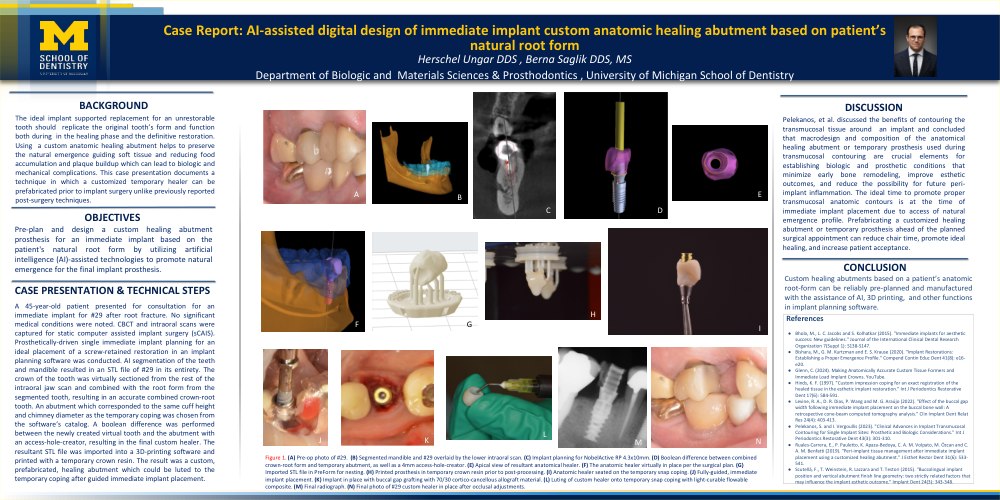
A 45-year-old patient presented for consultation for an immediate implant for #29 after root fracture. No significant medical conditions were noted. CBCT and intraoral scans were captured for static computer assisted implant surgery (sCAIS). Prosthetically-driven single immediate implant planning for an ideal placement of a screw-retained restoration in an implant planning software was conducted. AI segmentation of the teeth and mandible resulted in an STL file of #29 in its entirety. The crown of the tooth was virtually sectioned from the rest of the intraoral jaw scan and combined with the root form from the segmented tooth, resulting in an accurate combined crown-root tooth. An abutment which corresponded to the same cuff height and chimney diameter as the temporary coping was chosen from the software’s catalog. A boolean difference was performed between the newly created virtual tooth and the abutment with an access-hole-creator, resulting in the final custom healer. The resultant STL file was imported into a 3D-printing software and printed with a temporary crown resin. The result was a custom, prefabricated, healing abutment which could be luted to the temporary coping after guided immediate implant placement.
DISCUSSION
Pelekanos, et al. discussed the benefits of contouring the transmucosal tissue around an implant and concluded that macrodesign and composition of the anatomical healing abutment or temporary prosthesis used during transmucosal contouring are crucial elements for establishing biologic and prosthetic conditions that minimize early bone remodeling, improve esthetic outcomes, and reduce the possibility for future peri-implant inflammation. The ideal time to promote proper transmucosal anatomic contours is at the time of immediate implant placement due to access of natural emergence profile. Prefabricating a customized healing abutment or temporary prosthesis ahead of the planned surgical appointment can reduce chair time, promote ideal healing, and increase patient acceptance.
CONCLUSION
Custom healing abutments based on a patient’s anatomic root-form can be reliably pre-planned and manufactured with the assistance of AI, 3D printing, and other functions in implant planning software.
References