136 posters, 2 topics, 27 sessions, 339 authors, 88 institutions
ePostersLive by SciGen Technologies S.A. All rights reserved.
2024 ACP Annual Session
NOVEMBER 6-9, 2024 | MARCO ISLAND, FL JW MARRIOT

22
The Fully Digital Approach for Immediate Anterior Implant Placement and Temporization in a Full Mouth Reconstruction Case
Poster Presenter
Authors
Affiliations
Part of Topic
Case Presentation
The Fully Digital Approach for Immediate Anterior Implant Placement and Temporization in a Full Mouth Reconstruction Case
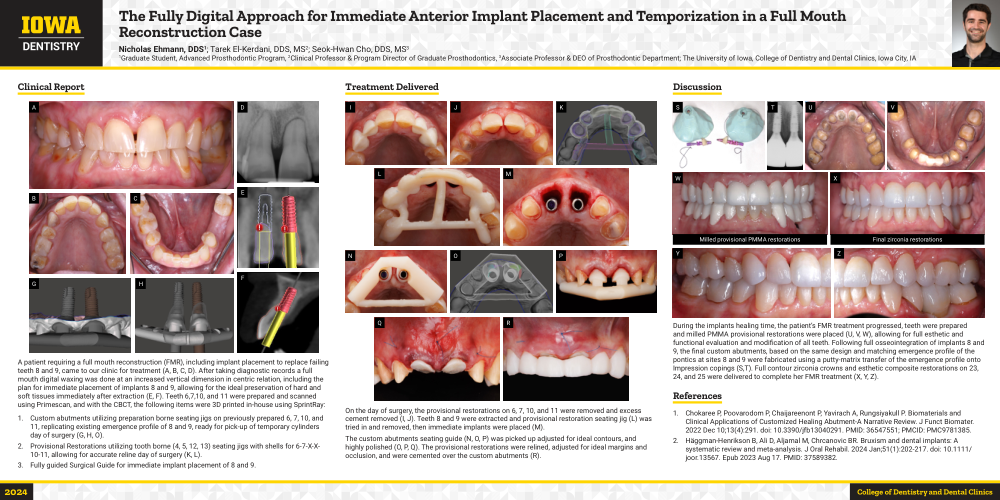
A patient requiring a full mouth reconstruction (FMR), including implant placement to replace failing teeth 8 and 9, came to our clinic for treatment (A, B, C, D). After taking diagnostic records a full mouth digital waxing was done at an increased vertical dimension in centric relation, including the plan for immediate placement of implants 8 and 9, allowing for the ideal preservation of hard and soft tissues immediately after extraction (E, F). Teeth 6,7,10, and 11 were prepared and scanned using Primescan, and with the CBCT, the following items were 3D printed in-house using SprintRay:
1.
Custom abutments utilizing preparation borne seating jigs on previously prepared 6, 7, 10, and 11, replicating existing emergence profile of 8 and 9, ready for pick-up of temporary cylinders day of surgery (G, H, O).
2.
Provisional Restorations utilizing tooth borne (4, 5, 12, 13) seating jigs with shells for 6-7-X-X- 10-11, allowing for accurate reline day of surgery (K, L).
3.
Fully guided Surgical Guide for immediate implant placement of 8 and 9.
On the day of surgery, the provisional restorations on 6, 7, 10, and 11 were removed and excess cement removed (I, J). Teeth 8 and 9 were extracted and provisional restoration seating jig (L) was tried in and removed, then immediate implants were placed (M).
The custom abutments seating guide (N, O, P) was picked up adjusted for ideal contours, and highly polished (O, P, Q). The provisional restorations were relined, adjusted for ideal margins and occlusion, and were cemented over the custom abutments (R).
During the implants healing time, the patient’s FMR treatment progressed, teeth were prepared and milled PMMA provisional restorations were placed (U, V, W), allowing for full esthetic and functional evaluation and modification of all teeth. Following full osseointegration of implants 8 and 9, the final custom abutments, based on the same design and matching emergence profile of the pontics at sites 8 and 9 were fabricated using a putty-matrix transfer of the emergence profile onto Impression copings (S,T). Full contour zirconia crowns and esthetic composite restorations on 23, 24, and 25 were delivered to complete her FMR treatment (X, Y, Z).