136 posters, 2 topics, 27 sessions, 339 authors, 88 institutions
ePostersLive by SciGen Technologies S.A. All rights reserved.
2024 ACP Annual Session
NOVEMBER 6-9, 2024 | MARCO ISLAND, FL JW MARRIOT

21
Enhancing Comfort and Retention: 3D-Printed Hollow Denture Solution for Palatal Augmentation Prosthesis
Poster Presenter
Authors
Affiliations
Part of Topic
Case Presentation
Introduction:
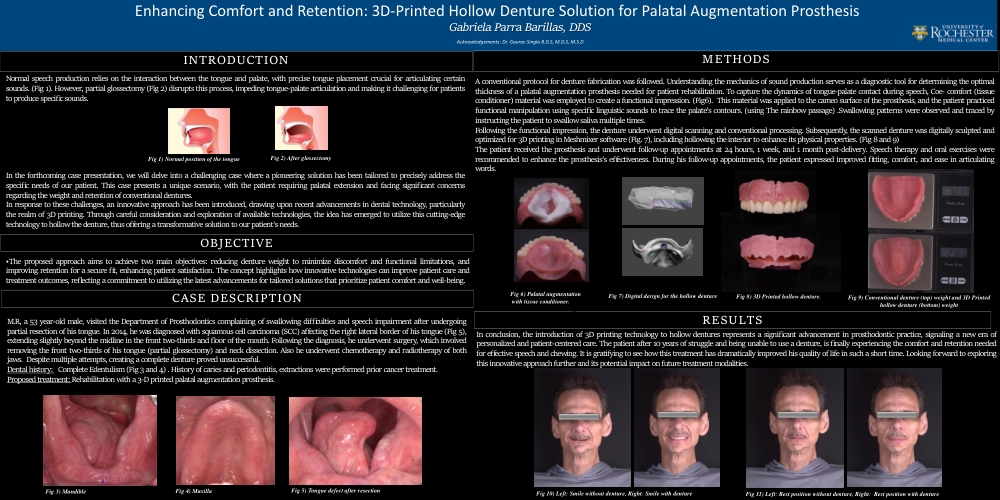
Normal speech production relies on the interaction between the tongue and palate, with precise tongue placement crucial for articulating certain sounds. (Fig 1). However, partial glossectomy (Fig 2) disrupts this process, impeding tongue-palate articulation and making it challenging for patients to produce specific sounds.
In the forthcoming case presentation, we will delve into a challenging case where a pioneering solution has been tailored to address the specific needs of our patient precisely. This case presents a unique scenario, with the patient requiring palatal extension and facing significant concerns regarding the weight and retention of conventional dentures.
In response to these challenges, an innovative approach has been introduced, drawing upon recent advancements in dental technology, particularly the realm of 3D printing. Through careful consideration and exploration of available technologies, the idea has emerged to utilize this cutting-edge technology to hollow the denture, thus offering a transformative solution to our patient's needs.
Objective:
•The proposed approach aims to achieve two main objectives: reducing denture weight to minimize discomfort and functional limitations, improving retention for a secure fit, and enhancing patient satisfaction. The concept highlights how innovative technologies can improve patient care and treatment outcomes, reflecting a commitment to utilizing the latest advancements for tailored solutions that prioritize patient comfort and well-being.
Case Description:
M.R., a 53-year-old male, visited the Department of Prosthodontics complaining of swallowing difficulties and speech impairment after undergoing partial resection of his tongue. In 2014, he was diagnosed with squamous cell carcinoma (SCC) affecting the right lateral border of his tongue (Fig 5), extending slightly beyond the midline in the front two-thirds and floor of the mouth. Following the diagnosis, he underwent surgery, which involved removing the front two-thirds of his tongue (partial glossectomy) and neck dissection. Also, he underwent chemotherapy and radiotherapy of both jaws. Despite multiple attempts, creating a complete denture proved unsuccessful.
Dental history: Complete Edentulism (Fig 3 and 4). History of caries and periodontitis, extractions were performed before cancer treatment.
Proposed treatment: Rehabilitation with a 3-D printed palatal augmentation prosthesis.
Methods:
A conventional protocol for denture fabrication was followed. Understanding the mechanics of sound production serves as a diagnostic tool for determining the optimal thickness of a palatal augmentation prosthesis needed for patient rehabilitation. To capture the dynamics of tongue-palate contact during speech, Coe-comfort (tissue conditioner) material was employed to create a functional impression. (Fig6). This material was applied to the cameo surface of the prosthesis, and the patient practiced functional manipulation using specific linguistic sounds to trace the palate's contours. (using The rainbow passage) . Swallowing patterns were observed and traced by instructing the patient to swallow saliva multiple times.
Following the functional impression, the denture underwent digital scanning and conventional processing. Subsequently, the scanned denture was digitally sculpted and optimized for 3D printing in Meshmixer software (Fig. 7), including hollowing the interior to enhance its physical properties. (Fig 8 and 9)
The patient received the prosthesis and underwent follow-up appointments at 24 hours, 1 week, and 1 month post-delivery. Speech therapy and oral exercises were recommended to enhance the prosthesis's effectiveness. During his follow-up appointments, the patient expressed improved fitting, comfort, and ease in articulating words.
Results:
In conclusion, the introduction of 3D printing technology to hollow dentures represents a significant advancement in prosthodontic practice, signaling a new era of personalized and patient-centered care. The patient after 10 years of struggle and being unable to use a denture, is finally experiencing the comfort and retention needed for effective speech and chewing. It is gratifying to see how this treatment has dramatically improved his quality of life in such a short time. Looking forward to exploring this innovative approach further and its potential impact on future treatment modalities.