136 posters, 2 topics, 27 sessions, 339 authors, 88 institutions
ePostersLive by SciGen Technologies S.A. All rights reserved.
2024 ACP Annual Session
NOVEMBER 6-9, 2024 | MARCO ISLAND, FL JW MARRIOT

19
Enhancing comfort for long-term denture wearer combining digital technology and conventional prosthodontics
Poster Presenter
Authors
Affiliations
Part of Topic
Case Presentation
The DigitalWorkflowforRestoringVDO and Worn DownOcclusionOnaDigitallyDuplicatedDenture
Introduction
Patients who have worn the same set of dentures for extended periods often experience difficulty transitioning to new prosthetics. This challenge arises due to the patient’s muscle memory, deep-seated comfort, and familiarity with the old dentures. This case study investigates a novel approach to denture replacement that integrates traditional prosthodontic techniques with digital technology.
Materials&Methods
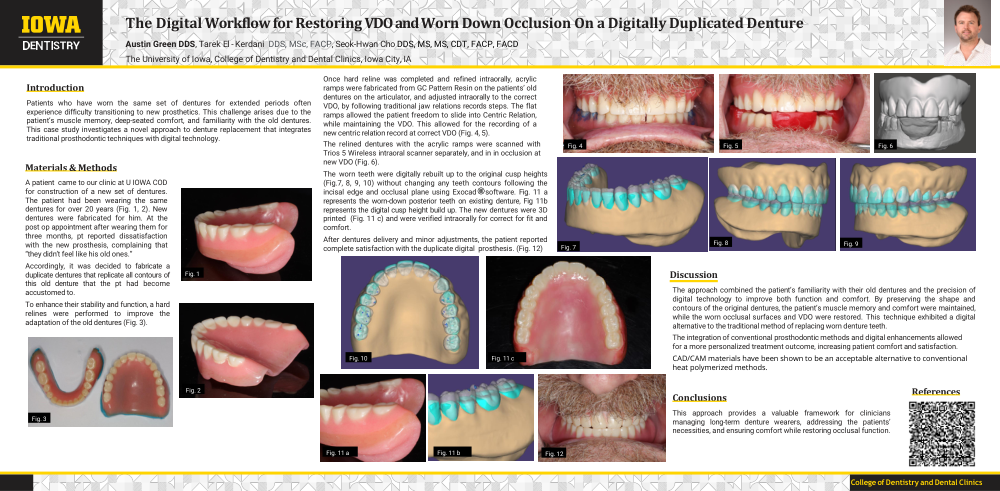
A patient came to our clinic at U IOWA COD for construction of a new set of dentures. The patient had been wearing the same dentures for over 20 years (Fig. 1, 2). New dentures were fabricated for him. At the post op appointment after wearing them for three months, pt reported dissatisfaction with the new prosthesis, complaining that “they didn’t feel like his old ones.”
Accordingly, it was decided to fabricate a duplicate dentures that replicate all contours of this old denture that the pt had become accustomed to.
To enhance their stability and function, a hard relines were performed to improve the adaptation of the old dentures (Fig. 3).
Once hard reline was completed and refined intraorally, acrylic ramps were fabricated from GC Pattern Resin on the patients’ old dentures on the articulator, and adjusted intraorally to the correct VDO, by following traditional jaw relations records steps. The flat ramps allowed the patient freedom to slide into Centric Relation, while maintaining the VDO. This allowed for the recording of a new centric relation record at correct VDO (Fig. 4, 5).
The relined dentures with the acrylic ramps were scanned with Trios 5 Wireless intraoral scanner separately, and in in occlusion at new VDO (Fig. 6).
The worn teeth were digitally rebuilt up to the original cusp heights (Fig.7, 8, 9, 10) without changing any teeth contours following the incisal edge and occlusal plane using Exocad software. Fig. 11 a represents the worn-down posterior teeth on existing denture, Fig 11b represents the digital cusp height build up. The new dentures were 3D printed (Fig. 11 c) and were verified intraorally for correct for fit and comfort.
After dentures delivery and minor adjustments, the patient reported complete satisfaction with the duplicate digital prosthesis. (Fig. 12)
Discussion
The approach combined the patient’s familiarity with their old dentures and the precision of digital technology to improve both function and comfort. By preserving the shape and contours of the original dentures, the patient’s muscle memory and comfort were maintained, while the worn occlusal surfaces and VDO were restored. This technique exhibited a digital alternative to the traditional method of replacing worn denture teeth.
The integration of conventional prosthodontic methods and digital enhancements allowed for a more personalized treatment outcome, increasing patient comfort and satisfaction.
CAD/CAM materials have been shown to be an acceptable alternative to conventional heat polymerized methods.
Conclusions
This approach provides a valuable framework for clinicians managing long-term denture wearers, addressing the patients’ necessities, and ensuring comfort while restoring occlusal function